
Wood Pellet Market Insights: Industrial Boilers, Circular Economy & Forecast to 2034
How carbon reduction targets, biomass power generation, and clean fuel demand are transforming the global wood pellet market outlook globally.

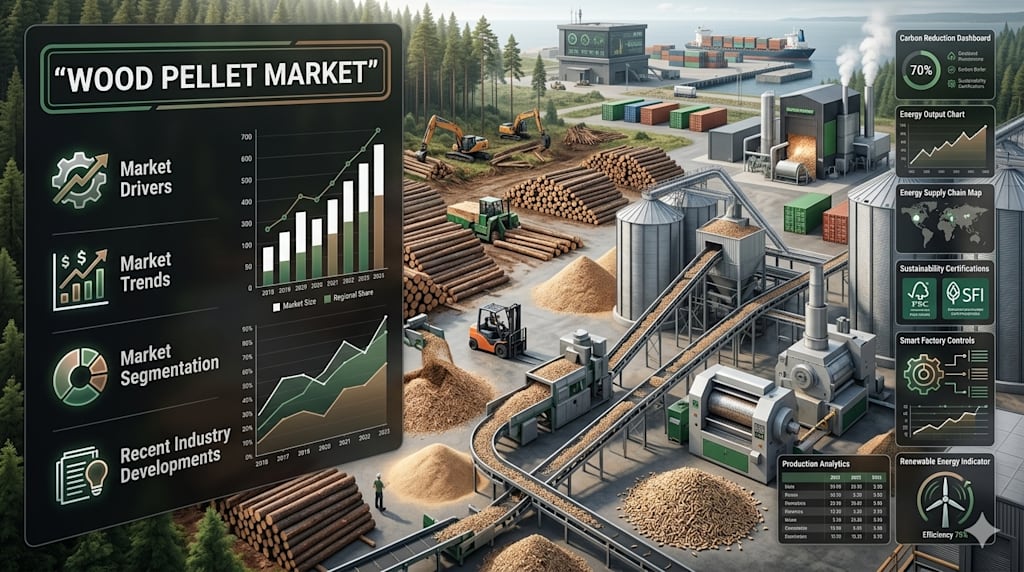
Rising demand for renewable energy, supportive government policies promoting carbon neutrality, increasing biomass power generation, and the growing use of wood pellets in residential and industrial heating applications are driving the wood pellet market forward. According to IMARC Group's latest data, The global wood pellet market size was valued at USD 14.8 Billion in 2025. Looking forward, IMARC Group estimates the market to reach USD 23.3 Billion by 2034, exhibiting a CAGR of 5.20% during 2026-2034. Europe currently dominates the market, holding a significant market share of over 47.9% in 2025.
The wood pellet market represents a rapidly expanding segment within the global bioenergy landscape, propelled by the urgent global need to phase out fossil fuels and meet net-zero targets. Wood pellets, produced from compressed biomass such as sawdust and wood shavings, are carbon-neutral by nature since CO2 emitted during combustion is offset by CO2 absorbed during the biomass growth cycle.
Wood Pellet Market Growth Drivers:
Increasing Demand for Renewable Energy
Nations worldwide are accelerating the shift away from fossil fuels amid mounting climate pressure. Wood pellets serve as a combustion-ready, grid-compatible renewable fuel that requires minimal infrastructure change at existing power plants. Atmospheric CO2 is currently more than 50% higher than pre-industrial levels according to NOAA, driving urgency for biomass-based alternatives.
Government Initiatives and Policy Support
Regulatory frameworks across major markets are directly fueling wood pellet demand. The European Union Renewable Energy Directive has triggered significant growth in pelletized wood fiber trading across member states. In the United States, the Home Efficiency Rebate Program, also known as the Clean Air Program, incentivizes households to replace legacy heating systems with biomass-fed alternatives including wood pellet boilers. Canada's Clean Fuels Fund commits a USD 1.1 billion investment toward innovative clean fuel technologies, including advanced pellet production systems.
Escalating Environmental Concerns
The UN Environment Programme's Emissions Gap Report outlined the need for global greenhouse gas reductions of 42% by 2030 and 57% by 2035 to preserve the Paris Agreement's 1.5 degree Celsius threshold. Wood pellets' carbon-neutral combustion lifecycle makes them a strategically critical fuel for industries and utilities under decarbonization mandates. Their ability to reduce dependence on finite fossil fuels while improving air quality compared to traditional solid fuel combustion positions them as a practical and immediate solution for climate-conscious energy buyers across residential, commercial, and industrial segments globally.
Wood Pellet Market Trends:
Technological Advancements in Pellet Production
Innovations in pelletizing machinery and automation have significantly increased production capacity while lowering per-unit manufacturing costs. Improvements in combustion technology have addressed historic concerns about particulate emissions, making wood pellets viable in urban heating applications with stringent air quality regulations.
Expansion of Co-Firing Applications in Power Generation
Utility operators are increasingly co-firing wood pellets alongside coal at existing power stations as a cost-effective decarbonization pathway, requiring limited capital retooling of current infrastructure. In October 2024, PT Bukit Asam Tbk launched a Wood Pellet Pilot Plant in Tanjung Enim, South Sumatra, Indonesia, producing 200 kg of biomass per hour from Red Kaliandra feedstock specifically to support coal co-firing at domestic power plants.
Growth in Export Trade and Cross-Border Supply Chains
Global wood pellet trade volumes are expanding rapidly as European and East Asian utilities scale up imports to meet renewable energy compliance requirements. Vietnam exported 2.6 million tons of wood pellets sourced from forest residues in a single recent reporting period, reflecting the depth of Asia-Pacific production capacity entering international markets.
Recent News and Developments in Wood Pellet Market
October 2024: PT Bukit Asam Tbk launched a Wood Pellet Pilot Plant in Tanjung Enim, South Sumatra, with a production capacity of 200 kg of biomass per hour from Red Kaliandra feedstock, designed to support coal co-firing initiatives and contribute to Indonesia's national emission reduction goals.
March 2025: The European Commission advanced revised sustainability criteria under the updated Renewable Energy Directive, introducing tighter traceability and lifecycle emissions standards for imported wood pellets, directly reshaping supplier qualification processes across major exporting nations.
January 2026: South Korea's Ministry of Trade, Industry and Energy announced expanded biomass procurement targets for state-owned power utilities, significantly boosting demand for certified wood pellet imports from the United States and Southeast Asian producers.
Note: If you require specific details, data, or insights that are not currently included in the scope of this report, we are happy to accommodate your request. As part of our customization service, we will gather and provide the additional information you need, tailored to your specific requirements. Please let us know your exact needs, and we will ensure the report is updated accordingly to meet your expectations.
About the Creator
Suhaira Yusuf
I specialize in Consumer Insights, focusing on transforming detailed market data into strategic business solutions that accelerate growth and improve customer engagement.
Enjoyed the story? Support the Creator.
Subscribe for free to receive all their stories in your feed.
Comments
There are no comments for this story
Be the first to respond and start the conversation.