
Wood Chips Market Benefits from Innovation in Biomass Processing
How innovations in biomass processing, environmental regulations, and premium wood chip applications are accelerating adoption and market expansion worldwide

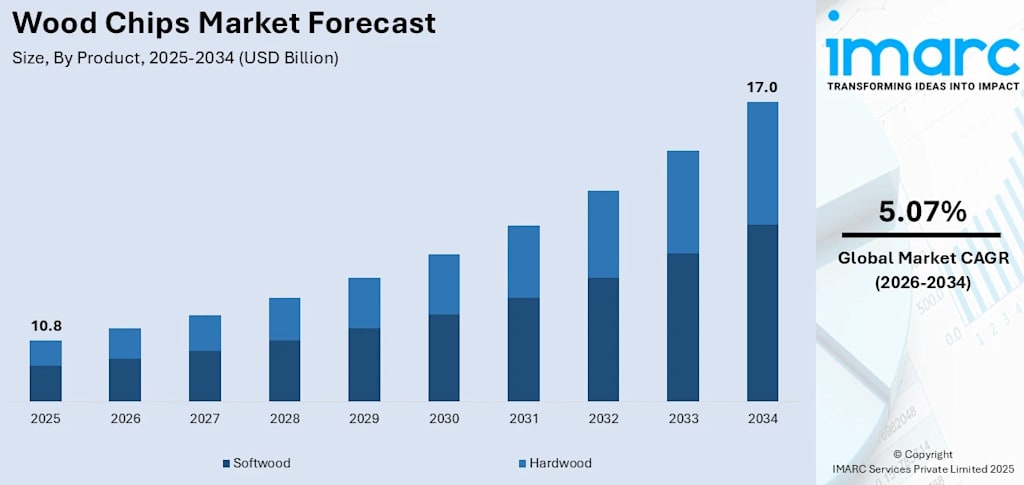
The increasing utilization of biomass for green energy, expansion in the construction sector, and rising applications in sustainable agriculture are driving the demand for wood chips, supported by clean-energy initiatives, advancements in wood processing technologies, and a growing emphasis on circular economy practices. According to IMARC Group’s latest data, The global wood chips market size was valued at USD 10.8 Billion in 2025. Looking forward, IMARC Group estimates the market to reach USD 17.0 Billion by 2034, exhibiting a CAGR of 5.07% from 2026-2034.
Wood chips now represent a multi-billion-dollar global industry that forms a vital pillar of the modern bioeconomy, showing consistent year-on-year expansion. Demand is heavily driven by the global transition away from fossil fuels, where raw industrial wood fragments serve as an efficient, renewable biomass solid fuel for thermal power plants and residential heating. Beyond clean energy, the pulp and paper industry relies heavily on these chips as a primary raw material for manufacturing daily hygiene products and eco-friendly packaging alternatives.
Download the Latest "Wood Chips Market" Intelligence Report Sample Today!
Wood Chips Market Growth Drivers:
- Surging Demand for Biomass Energy and Thermal Power
As countries race to meet national decarbonization goals, wood chips have become a vital fuel source for bioenergy. Power plants are increasingly retrofitting coal facilities to burn biomass or co-fire with wood fragments to drop carbon emissions immediately. Real-world applications are clear in northern climates; for instance, the European Union's updated Renewable Energy Directive (RED III) heavily pushes for sustainably sourced solid biomass to displace coal and gas. This legislative backup keeps municipal utility companies sourcing wood residue chips continuously to supply steady regional district heating networks during peak winter seasons without triggering carbon penalties.
- Expanding Needs of the Global Pulp and Paper Sector
The rapid expansion of global e-commerce has triggered an unprecedented need for paper-based packaging, shipping boxes, and biodegradable filling materials. Wood chips serve as the direct raw input for manufacturing structural wood pulp. Furthermore, consumer packaged goods companies are actively phasing out single-use plastics in favor of molded fiber options, which has significantly heightened the reliance on high-quality pulpwood chips. Industrial operations globally utilize millions of tons of processed chips weekly to maintain continuous factory outputs for personal hygiene products, containerboards, and essential consumer paper goods.
- Widespread Application in Modern Landscaping and Infrastructure
Civil engineering projects and commercial landscaping rely extensively on wood chips for environmental stabilization and soil management. Contractors apply thick layers of wood residue chips across highway embankments and structural slopes to prevent critical soil erosion during heavy rainfall events. Additionally, municipal parks and school districts utilize softwoods for playground surfacing to meet specific safety cushioning standards. In large-scale agriculture, farmers deploy chips to suppress weed growth naturally and maintain field moisture levels, significantly cutting down on synthetic herbicide usage and irrigation water costs.
Wood Chips Market Trends:
- Integration of Advanced Wood Processing Technologies
To optimize product yield and manage volatile raw material costs, the industry is widely adopting automated, high-throughput mobile chipping machinery. Modern industrial wood chippers utilize real-time sensors and smart sorting systems to separate bark and fine dust instantly from premium-grade fuel chips. This technological shift allows forestry operators to process logging residues directly at the harvesting site, drastically reducing transportation weights and associated fuel emissions. These advancements ensure a highly standardized chip size, which prevents mechanical clogging when fed into automated residential heating systems and commercial boilers.
- Stricter Supply Chain Traceability and Green Certifications
Regulatory pressures across major importing nations have made transparency a core market trend. Suppliers must now prove their wood fragments do not originate from deforested zones or protected habitats. Compliance with international standards, such as the Forest Stewardship Council (FSC) or the Programme for the Endorsement of Forest Certification (PEFC), is now mandatory to access premium utility contracts. For example, major energy corporations like Denmark's Ørsted require comprehensive verification of origin for all biomass inputs, ensuring that global wood chip trading aligns perfectly with strict greenhouse gas mitigation criteria.
- Emergence of High-Value Bioproduct Applications
Innovators are pushing wood chips past traditional combustion by extracting value-added chemical components from the raw fibers. Wood pulp processed from chips is increasingly used to synthesize nano-crystalline cellulose (NCC). This highly adaptable material is being integrated into the next generation of flexible electronic displays, automotive interior panels, and advanced medical filters due to its remarkable strength-to-weight ratio. By transforming basic wood waste into highly specialized engineering materials, manufacturers are opening entirely new, premium revenue streams that sit completely outside the traditional energy and paper markets.
Recent News and Developments in Wood Chips Market
- September 2025: A leading European energy company completed the conversion of its final coal-fired district heating plant into a dedicated biomass facility utilizing locally sourced, high-grade wood chips, drastically lowering regional urban emissions.
- November 2025: A prominent industrial engineering firm unveiled a next-generation mobile wood chipper featuring real-time moisture diagnostics and automated sorting, allowing forestry operations to optimize chip quality directly at the harvest site.
- January 2026: A coalition of biomass suppliers announced an updated digital tracking framework to provide end-to-end blockchain verification for wood chip shipments, satisfying strict new international environmental regulations regarding forest conservation.
Note: If you require specific details, data, or insights that are not currently included in the scope of this report, we are happy to accommodate your request. As part of our customization service, we will gather and provide the additional information you need, tailored to your specific requirements. Please let us know your exact needs, and we will ensure the report is updated accordingly to meet your expectations.
About the Creator
Andrew Sullivan
Hello, I’m Andrew Sullivan. I have over 9+ years of experience as a market research specialist.
Enjoyed the story? Support the Creator.
Subscribe for free to receive all their stories in your feed.
Comments
There are no comments for this story
Be the first to respond and start the conversation.