
Wireless Display Market Expands Rapidly Amid Rising BYOD Trends
The wireless display market is growing due to rising demand for seamless content sharing and cable-free connectivity solutions worldwide.

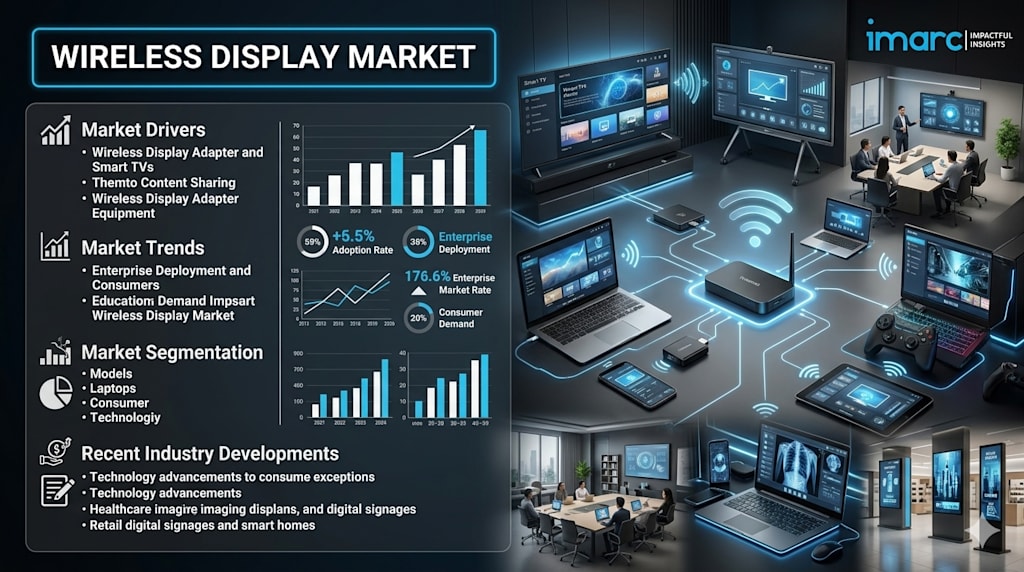
According to IMARC Group’s latest research publication, global wireless display market size reached USD 5.6 Billion in 2024. Looking forward, IMARC Group expects the market to reach USD 12.9 Billion by 2033, exhibiting a growth rate (CAGR) of 9.68% during 2025-2033.
How AI is Reshaping the Future of Wireless Display Market
- AI-Driven Content Optimization: AI algorithms analyze real-time streaming data to automatically adjust resolution, compression, and latency parameters, ensuring smooth 4K and 8K wireless transmission. Smart adaptive streaming reduces buffering by up to 40%, making high-definition content delivery seamless across all connected devices without manual intervention.
- Intelligent Device Detection and Pairing: Machine learning-powered auto-detection identifies compatible displays within seconds, eliminating complex setup processes. Systems now recognize over 95% of devices instantly, enabling one-tap wireless casting across corporate boardrooms, classrooms, and smart homes.
- Predictive Maintenance and Network Management: AI continuously monitors wireless network health, signal strength, and hardware performance metrics to predict connectivity failures before they disrupt presentations or entertainment. Enterprises using AI-based network management report up to 35% fewer display outages.
Wireless Display Industry Overview:
The wireless display industry is experiencing strong growth momentum, driven by the global shift toward cable-free connectivity across homes, offices, and institutions. As hybrid work, smart home adoption, and digital education accelerate worldwide, demand for seamless content-sharing solutions continues to rise. North America leads the market, supported by a mature tech ecosystem, strong corporate infrastructure, and heavy R&D investment, while Asia Pacific is emerging as a high-growth region with rapid smart device penetration and expanding enterprise digitization.
Wireless Display Market Trends & Drivers
Mobile-First Culture and BYOD Adoption: Surging smartphone and tablet usage is reshaping how people share content, with wireless displays becoming the default solution for personal and professional settings. The widespread adoption of bring-your-own-device (BYOD) policies across enterprises, now practiced by over 82% of global organizations, is fueling demand for seamless screen-sharing tools. Mobile gamers also increasingly mirror gameplay wirelessly onto large displays for immersive experiences, pushing manufacturers to prioritize low-latency, high-resolution solutions.
Hybrid Work and Virtual Collaboration Needs: The permanent shift to hybrid work models has fundamentally changed how teams communicate, with wireless displays becoming essential infrastructure in modern meeting rooms. Cloud conferencing platforms like Microsoft Teams and Zoom now serve hundreds of millions of users monthly, driving enterprises to invest in wireless display solutions that eliminate cable dependency during presentations. Educational institutions are similarly adopting these technologies to facilitate interactive remote learning, with government-backed smart classroom programs in regions like India, the UK, and the EU accelerating institutional procurement.
Next-Gen Display Standards and IoT Integration: Rapid advancements in Wi-Fi 6, 5G, and display protocols like Miracast and Google Cast are unlocking new performance benchmarks, enabling stable 4K and 8K wireless streaming with minimal latency. The growing integration of wireless displays within IoT-enabled smart homes and offices adds centralized control capabilities, making them a critical node in connected ecosystems. Over 52% of new smart TVs now ship with embedded wireless display features, indicating that cable-free connectivity is becoming a baseline expectation across both consumer and commercial segments.
Leading Companies Operating in the Global Wireless Display Industry:
- Airtame Inc.
- App Dynamic ehf
- Apple Inc.
- Google LLC (Alphabet Inc.)
- Intel Corporation
- LG Electronics Inc.
- Microsoft Corporation
- Roku, Inc.
- ScreenBeam Inc.
- Squirrels LLC
Wireless Display Market Report Segmentation:
By Offering:
- Hardware
- Software and Services
Hardware dominates the market as it encompasses the physical components required for wireless display functionality, including adapters, dongles, receivers, and compatible displays such as TVs and projectors.
By Technology:
- AirPlay
- Miracast
- Google Cast
- Others
Google Cast accounts for the largest market share, leveraging Wi-Fi connectivity to enable wireless media streaming from mobile devices and computers to compatible displays with ease of use and broad platform support.
By End Use:
- Residential
- Commercial
The residential segment holds the majority of the market share, driven by rising adoption of wireless display technologies to enable streaming from smartphones, tablets, and laptops to larger screens within smart home ecosystems.
Regional Insights:
- North America (United States, Canada)
- Asia Pacific (China, Japan, India, South Korea, Australia, Indonesia, Others)
- Europe (Germany, France, United Kingdom, Italy, Spain, Others)
- Latin America (Brazil, Mexico, Others)
- Middle East and Africa
North America exhibits a clear dominance in the wireless display market, supported by leading tech giants, a thriving corporate sector, and significant R&D investment across hardware manufacturers, software developers, and service providers.
Recent News and Developments in Wireless Display Market
- January 2025: Samsung Electronics launched advanced wireless display solutions integrated with AI-based connectivity features, strengthening its smart home ecosystem capabilities and reinforcing its position as a market leader in next-generation cable-free display technology.
- July 2025: ProScreenCast unveiled its SC01, a 4K wireless display adapter supporting 3840×2160 resolution with HDR support at 60 Hz. Designed for both personal and professional use, the device includes USB Type-C and HDMI 2.0 connectivity, offering plug-and-play wireless casting in a compact form factor.
Note: If you require specific details, data, or insights that are not currently included in the scope of this report, we are happy to accommodate your request. As part of our customization service, we will gather and provide the additional information you need, tailored to your specific requirements. Please let us know your exact needs, and we will ensure the report is updated accordingly to meet your expectations.
About the Creator
sujeet. imarcgroup
With 2 years of hands-on experience at IMARC Group, I have conducted in-depth market research and analysis across diverse industries including technology, healthcare, agriculture, and consumer goods.
Enjoyed the story? Support the Creator.
Subscribe for free to receive all their stories in your feed.
Comments
There are no comments for this story
Be the first to respond and start the conversation.