
Will AI make game development faster?
According to the Google Cloud 2025 Games Report, surveyed by The Harris Poll across 615 developers, 90% are already using AI in some form.


TL;DR:
AI won't shrink a 4-year game development cycle into 1 year. Instead, studios will pack 40 years' worth of content into that same 4-year window. Speed is the wrong question. Scope is the real story.
Every few months, a headline promises that AI will cut game development time in half. And honestly? The numbers back it up, at least partially. A 2024 survey of over 650 game developers by a16z found that 73% of studios already use AI tools, with 39% reporting over 20% gains in productivity. A Google Cloud and Harris Poll study from August 2025 surveyed 615 developers and found that 90% already use generative AI in their workflows.
So the speed gains are real. But faster AI game development doesn't mean faster games. It means something far more complicated.
Does AI Actually Speed Up Game Development?
Yes, but only for specific tasks. The overall pipeline tells a different story.
AI does a handful of things extremely well. It generates art assets in minutes instead of weeks. It writes code suggestions. It automates repetitive playtesting loops. According to Capitol Technology University, the GDC's 2025 State of the Game Industry report confirmed that more than 50% of game development companies now use generative AI. That adoption rate jumped from 31% just one year earlier.
However, development time isn't shaped by a single bottleneck. It's shaped by a chain of them. AI blows one link wide open, then the chain snaps somewhere else entirely. To understand why, let's start at the beginning of this story.
Why Do Bigger Tools Always Lead to Bigger Games, Not Faster Ones?
Because studios don't use saved time to ship sooner. They use it to build more.
Look at every major leap in development technology over the past 30 years. Unreal Engine didn't make studios release games faster. It made Skyrim possible. Procedural generation tools didn't shrink timelines. They made No Man's Sky's 18 quintillion planets possible.
This pattern has a name. Parkinson's Law states that work expands to fill the time available for its completion. AI gives studios more time by automating low-level tasks. Studios respond by expanding scope, not shrinking deadlines.
The data confirms this pattern. According to Midia Research's December 2024 analysis, games that would have taken 20 hours to finish a decade ago now take 50 to 100 hours. Nobody asked for longer games. Scope creep made them that way. Meanwhile, Matt Booty, head of Xbox Game Studios, stated that the era of AAA games shipping in two to three years is over. Today, most major titles need five to seven years to complete.
AI won't reverse this trend. It'll accelerate it. Studios will use AI to generate bigger open worlds, more NPC dialogue trees, and more side content than any team could have built manually. The savings in time become investments in scale. This isn't a failure of AI. It's just how the industry thinks.
We looked at this dynamic closely in our piece on how easy it really is to build a game with AI. The tools are getting remarkably capable. But capability and timeline reduction are two very different things.
Are Developers Becoming Curators Instead of Creators?
Yes. And curation turns out to be just as hard as creation.
When AI can generate 10,000 sword designs in ten seconds, the developer's job stops being "model the sword." It becomes "find the right sword among 10,000 options." That shift sounds like a time-saver. In practice, it introduces a new kind of cognitive load.
According to the a16z Games survey, the most common AI use case in studios today is design inspiration and storyboarding, not final asset creation. Why? Because AI-generated content still requires a human eye to filter, refine, and integrate into a coherent vision. An AI can generate 500 dungeon layouts. A designer still needs to decide which one feels right, then adjust it so it fits the game's pacing, narrative, and art direction.
This curation burden is significant. The new core skill in game development isn't writing code from scratch. It's being a precise, taste-driven editor who can stitch AI-generated systems together without the game collapsing into incoherence. Furthermore, this role requires deep creative judgment, something AI simply doesn't have.
Will the QA Bottleneck Undo AI's Speed Gains?
Very possibly. QA scales with scope, not with generation speed.
This is the angle most AI coverage ignores completely. Here's the problem: AI can generate a world 100 times larger than anything a human team could build manually. But the QA burden grows with that world, not with the speed of its creation.
Traditional QA frameworks struggle to scale in generative contexts. A 2025 research paper on LLM-based narrative testing confirmed that rule-based QA scripts can verify whether a quest reward is distributed correctly, but they can't detect a situation where an NPC references an event that never occurred in the player's save file. AI-generated content introduces semantic errors that older testing tools weren't designed to catch.
Ubisoft addressed this directly by deploying AI bots to explore their open-world environments, uncovering rare clipping issues and pathfinding errors that manual testers missed. That's promising. But here's the critical detail: those bots were testing a world built by human designers. In an AI-generated world, the number of edge cases multiplies exponentially.
Square Enix set a goal to automate 70% of QA and debugging tasks by the end of 2027 using generative AI. That's a bold target. It also means that even Square Enix, one of the world's largest studios, acknowledges that QA is a bottleneck severe enough to demand AI intervention. The development pipeline is a chain. AI might accelerate the asset creation link. But QA, localization, platform certification, and balance testing are links that AI has not yet broken through.
The honest conclusion: AI may speed up some phases of development while lengthening others. Net time saved may be far smaller than headlines suggest.
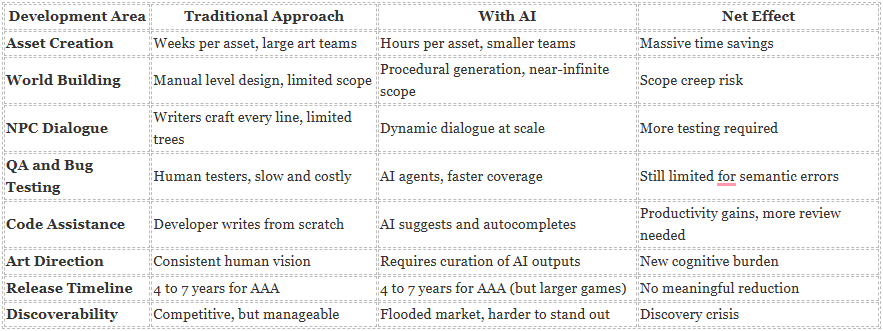
What Does AI Game Development Look Like vs. Traditional Development?
Here's a side-by-side comparison of where AI helps and where it creates new challenges:
Is "Algorithmic Slop" Already Flooding the Market?
Yes. And it's getting worse faster than anyone expected.
Here's where AI's speed gain creates a genuine crisis, just not for the studios you're thinking of. The real damage happens at the market level.
In 2025, over 20,000 games were released on Steam, an 8% increase on 2024 and a 42% increase on 2023. Of those titles, 22% included a generative AI content disclosure, representing a nearly 700% increase year-over-year from 2024. By February 2026, Steam's own Next Fest event was flooded with criticism. Players described the event as packed with "crappy AI slop games," and warned that quality titles risk being drowned out if discovery tools don't improve.
This is the speed problem nobody wants to talk about. When AI makes it cheap and fast for a solo developer to produce a game that looks AAA on a store thumbnail, the market floods with titles that look compelling but deliver little. The hardest part of game development stops being the development itself. It becomes marketing, discoverability, and proving to players that your game has something real inside it.
What Does Infinite Content Do to Players?
It exhausts them. And player exhaustion is already a documented crisis.
This is the dimension that AI coverage almost always ignores completely. Even if AI solves the production problem, it creates a player psychology problem that may be even harder to fix.
Open-world fatigue is already real and measurable. According to completion rate data from PlayStation trophies, only 29.8% of players finished The Witcher 3: Wild Hunt despite having years to complete it. Ghost of Tsushima's completion rate sits at 48.6%. Horizon Zero Dawn comes in at 34.4%. These are celebrated, well-designed games. Most players still don't finish them.
A 2023 study published in the Journal of Game Studies found that players in highly structured open-world games reported significantly higher mental fatigue than those playing linear or minimalist RPGs. One participant stated they "stopped enjoying the story because they were too focused on not missing anything." That's the experience AI-generated infinite content risks delivering at industrial scale.
Players don't want more content. They want meaningful content. Abundance and value are not the same thing, and players feel the difference viscerally even when they can't articulate it. Games like Outer Wilds, Disco Elysium, and Pentiment are celebrated specifically because they are small, deliberate, and clearly authored by a specific human sensibility. Every element in those games exists because someone made a conscious choice to include it. That intentionality is something AI cannot generate, and players can sense its absence.
As game designer Yoko Taro warned in a conversation that shook the industry, the loss of human imperfection and soul in games is not a small risk. We explored his full argument in our piece on why Yoko Taro urges caution with AI in game development. His core fear is worth sitting with: technically perfect games that feel emotionally hollow are worse than imperfect games that feel human.
Will Human-Made Games Become the New Luxury?
The early signs say yes. And the market is already responding.
As AI-generated content becomes the default, a counter-movement is forming. It started small and is accelerating fast. In December 2025, the developers of Peak, a viral co-op climbing game, publicly rebutted claims that their game used AI. Their response became a rallying cry: "We might be slop, but we're human-made locally-sourced artisanal slop." The internet loved it. The framing was instinctive and revealing: being human-made is now a differentiator, not a given.
The tabletop industry already crossed this threshold. In January 2026, Games Workshop explicitly positioned its "Human Made" branding as a luxury product signal. Their analysis was sharp: the "AI look," glossy, generic, and occasionally anatomically suspect, is becoming associated with cheap content. By contrast, a human-sculpted miniature or a hand-written lore entry carries a premium. That principle will migrate into video games.
We are at the beginning of what you might call "Artisanal Gaming." Just as the slow food movement emerged specifically in response to fast food culture, a segment of players will actively seek out games that advertise zero AI involvement. Slowness and deliberate human limitation will become selling points. The studios that build on this counter-movement early will own a powerful, defensible niche in an otherwise commoditized market.
So, Will AI Make Game Development Faster?
It'll make some tasks faster. It won't make games ship sooner. It'll make games larger, markets more crowded, and player expectations harder to meet.
The speed gains from AI are real and documented. But development timelines are shaped by scope decisions, QA pipelines, and player psychology, not just asset creation velocity. AI accelerates one part of the chain while adding weight to every other link.
The real revolution in AI game development isn't speed. It's a fundamental reshaping of who makes games, what games look like, and what players come to value. Studios that understand this now will be in a very different position from those chasing the headline.
The question was never "will AI make game development faster?" The real question is: "What will studios do with the capacity AI creates?" History suggests the answer is always the same. They'll build something bigger than anyone thought possible. Whether that's better is a different conversation entirely.
Frequently Asked Questions
Does AI actually reduce game development time?
AI reduces time for specific tasks like asset creation and code assistance. However, studios typically redirect that saved time toward expanding scope rather than shipping earlier. The a16z 2024 survey showed 39% of studios report 20%+ productivity gains, but development timelines for AAA games have continued to grow, not shrink.
What is "algorithmic slop" in gaming?
"Algorithmic slop" is a term players use for low-effort, AI-generated game content that feels generic and meaningless. As of 2025, 22% of all new Steam releases disclosed generative AI use, and player complaints about content quality at events like Steam Next Fest have increased significantly.
Will AI replace human game developers?
No, but roles will evolve. The GDC 2025 report found 30% of developers believe AI has a negative impact on the industry. However, most analysts agree that human creativity, narrative judgment, and artistic vision remain irreplaceable. What changes is the balance: developers shift from creating individual assets to curating and directing AI-generated outputs.
What is "Artisanal Gaming"?
Artisanal Gaming refers to a growing market segment where studios explicitly market their games as human-made with zero AI involvement. Companies like Games Workshop have already positioned "Human Made" branding as a luxury signal in the tabletop space. The same trend is emerging in video games, driven by player demand for intentional, authored experiences rather than AI-generated content.
Is open-world fatigue connected to AI game development?
Yes. Open-world fatigue, the mental exhaustion players feel from games with too much content, already affects major titles with human-made content. Completion rates for games like The Witcher 3 sit at just 29.8%. AI-generated infinite content risks dramatically accelerating this fatigue, pushing players toward smaller, more deliberate game experiences.
How does AI affect QA and game testing?
AI can automate some testing tasks. Square Enix has set a goal of automating 70% of QA by 2027. However, AI-generated worlds create new categories of errors that traditional testing frameworks weren't built to catch, particularly narrative contradictions and semantic inconsistencies in NPC behavior. QA remains one of the most significant bottlenecks in the development pipeline.
About the Creator
Industrifyai
At IndustrifyAI, we are a four-member editorial team specializing in Marketing and Research within the Artificial Intelligence space, committed to delivering clear, credible, and actionable insights.
Enjoyed the story? Support the Creator.
Subscribe for free to receive all their stories in your feed.
Comments
There are no comments for this story
Be the first to respond and start the conversation.