
Wi-Fi Market Gains Momentum Amid Rising Smart Device Adoption
How rising smart home adoption, cloud connectivity, and IoT integration are accelerating innovation and infrastructure expansion across the global Wi-Fi market

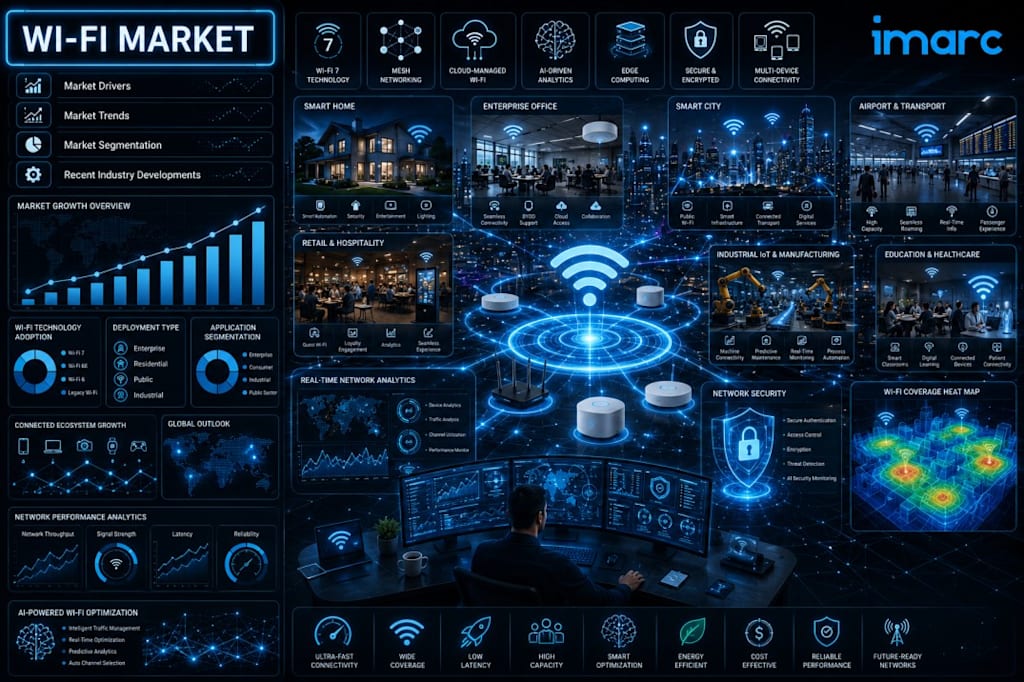
According to IMARC Group's latest research publication, The global Wi-Fi market size reached USD 39.7 Billion in 2025. Looking forward, IMARC Group expects the market to reach USD 101.0 Billion by 2034, exhibiting a growth rate (CAGR) of 10.90% during 2026-2034.
How Wi-Fi is Reshaping the Future of Global Connectivity
- Proliferation of Connected Devices Driving Network Demand: The exponential growth of smartphones, tablets, laptops, smart home appliances, and IoT devices is fundamentally reshaping the demand landscape for Wi-Fi infrastructure globally. Each of these devices relies on wireless networks to access the internet and communicate seamlessly, creating an ever-expanding load on existing connectivity systems. As the total number of connected devices continues to climb across both consumer and enterprise environments, individuals and businesses are actively seeking reliable, high-speed Wi-Fi networks capable of supporting highly diverse usage patterns. From streaming and video conferencing to industrial automation and remote diagnostics, the convenience of wireless connectivity has made Wi-Fi a foundational requirement in the modern digital ecosystem rather than an optional feature.
- BYOD Policy Adoption Expanding Enterprise Wi-Fi Requirements: The accelerating adoption of Bring Your Own Device (BYOD) policies across corporate workplaces is significantly amplifying demand for enterprise-grade Wi-Fi solutions. When employees use personal smartphones, tablets, and laptops for professional tasks, organizations must maintain network infrastructure that can accommodate a heterogeneous mix of devices while maintaining strict security protocols. This has driven investment in enterprise-class Wi-Fi systems featuring advanced security frameworks, centralized network management platforms, Quality of Service (QoS) controls, and virtual LAN (VLAN) segmentation capabilities. The IT and telecommunication sector leads all industry verticals in Wi-Fi adoption precisely because it must support the highest density of personal and professional devices operating simultaneously within a single network environment.
- Smart City Development Creating Large-Scale Wi-Fi Infrastructure Demand: Rapid urbanization and large-scale smart city development initiatives are making Wi-Fi a core component of urban digital infrastructure worldwide. Municipal governments are deploying public Wi-Fi hotspots across transportation hubs, parks, shopping centers, and civic facilities as part of integrated urban technology ecosystems. Smart city applications including intelligent traffic management, public safety surveillance, utility monitoring, and citizen service delivery all depend on robust wireless connectivity to function in real time. Wi-Fi-enabled location-based services and indoor navigation systems are further enhancing user experiences in dense urban environments. As cities continue to invest in digital infrastructure to improve quality of life and operational efficiency, Wi-Fi networks are being planned as permanent public utilities rather than supplementary amenities.
- IoT Expansion Accelerating Wireless Infrastructure Investment: The rapid multiplication of Internet of Things applications across industries including healthcare, logistics, retail, agriculture, and industrial manufacturing is creating sustained and growing demand for robust Wi-Fi infrastructure. IoT devices embedded with sensors require seamless, low-latency wireless networks to exchange data in real time and perform automated tasks reliably. In smart homes, connected appliances communicate via Wi-Fi to enable remote control and energy optimization. In industrial settings, automated systems and predictive maintenance platforms transmit continuous sensor data over Wi-Fi networks to central management platforms. As businesses and consumers integrate more IoT devices into daily operations, investment in scalable and secure wireless network infrastructure is intensifying across every major sector.
- Online Gaming, Esports, and Social Media Fuelling Consumer Wi-Fi Upgrades: The surging popularity of online gaming and competitive esports is translating into significant consumer demand for high-performance, low-latency Wi-Fi connections capable of supporting smooth, uninterrupted gameplay experiences. Professional and amateur gamers require Wi-Fi networks that can sustain high data throughput with minimal packet loss, pushing households and gaming venues to upgrade to the latest Wi-Fi standards. Simultaneously, the pervasive use of social media platforms and the cultural imperative to share real-time experiences and video content have made fast and reliable Wi-Fi connectivity a non-negotiable expectation in public venues, including hotels, restaurants, cafes, sports arenas, and retail environments. Businesses providing public Wi-Fi have increasingly recognized it as a direct driver of footfall, customer satisfaction, and digital service engagement.
Wi-Fi Industry Overview
The global Wi-Fi industry is experiencing strong growth momentum, underpinned by the convergence of enterprise digitalization, smart infrastructure development, consumer connectivity expectations, and the explosive expansion of IoT ecosystems. Wi-Fi technology, operating across the 2.4 GHz and 5 GHz radio frequency bands, enables high-speed wireless data transmission between devices without physical cables, making it indispensable across homes, offices, public spaces, healthcare facilities, logistics networks, and industrial environments.
Leading network equipment manufacturers are incorporating beamforming and beam steering technologies into next-generation access points, enabling dynamic focusing of wireless signals toward individual connected devices for more stable and optimized connections. The introduction of Wi-Fi 6 (802.11ax) marked a significant leap forward for the industry, delivering increased data rates, higher network capacity, and improved efficiency in managing multiple simultaneous device connections compared to previous generations. Multi-User Multiple Input Multiple Output (MU-MIMO) technology allows access points to serve multiple devices at the same time without sacrificing performance, a critical capability in high-density environments such as stadiums, convention centers, and corporate campuses.
The hardware segment currently holds the largest share of the Wi-Fi market by component, reflecting continued strong investment in physical network infrastructure including wireless routers, access points, network interface cards, and Wi-Fi extenders. At the same time, demand for software-driven Wi-Fi solutions encompassing network management platforms, demand-side optimization tools, and security configuration services is growing rapidly as organizations seek greater centralized visibility and control over increasingly complex wireless environments.
Wi-Fi Market Trends and Drivers
Rising Smart City Investments and Public Infrastructure Digitalization
Government-led smart city programs are emerging as one of the most powerful structural drivers of Wi-Fi market expansion globally. As municipal authorities digitalize transportation, public safety, and citizen service delivery, they are investing in city-wide Wi-Fi infrastructure as a foundational connectivity layer. These deployments require high-density Wi-Fi access points capable of supporting thousands of simultaneous public users in outdoor environments. In the Asia Pacific region, where urbanization is advancing at the fastest pace globally, smart city initiatives are directly stimulating Wi-Fi infrastructure procurement by both public authorities and private operators seeking to leverage location-based services and indoor navigation to enhance urban resident experiences.
Hospitality and Retail Sectors Driving Public Wi-Fi Expansion
The hospitality, food service, and retail sectors are investing heavily in public Wi-Fi as a direct lever for enhancing customer experience, enabling digital ordering, and facilitating online booking platforms. Hotels, restaurants, and cafes are deploying enterprise-class Wi-Fi solutions that can accommodate high volumes of simultaneously connected guest devices while maintaining secure separation between public and operational networks. Retail environments are integrating Wi-Fi with location analytics to understand in-store shopper behavior, optimize product placement, and deliver personalized promotions to connected devices in real time. This commercial imperative is generating consistent demand for Wi-Fi hardware upgrades and managed network service contracts across the global hospitality and retail ecosystem.
Healthcare and Education Sectors Accelerating Wireless Adoption
Educational institutions from schools to universities are deploying campus-wide Wi-Fi networks to support digital learning platforms, student device connectivity, and collaborative research environments. The integration of e-learning tools, digital textbooks, and cloud-based educational content delivery has made consistent, high-performance Wi-Fi a prerequisite for modern academic operations. In parallel, the healthcare sector is leveraging Wi-Fi to connect medical devices, enable real-time patient monitoring systems, support telemedicine consultations, and facilitate electronic health record access at the point of care. Both sectors represent large, institutionalized sources of Wi-Fi infrastructure demand that is relatively insulated from short-term economic fluctuations, providing stable long-term growth foundations for the market.
Leading Companies Operating in the Global Wi-Fi Industry
- AT&T Inc.
- Broadcom Inc.
- Cisco Systems Inc.
- Extreme Networks
- Fortinet Inc.
- Fujitsu Limited
- Hewlett Packard Enterprise Company
- Huawei Technologies Co. Ltd.
- Juniper Networks Inc.
- Motorola Solutions Inc.
- Panasonic Corporation
- Singapore Telecommunications Limited
- Telefonaktiebolaget LM Ericsson
- Telstra Corporation Limited
- Ubiquiti Inc.
Wi-Fi Market Report Segmentation
By Component:
- Hardware
- Solutions
- Services
Hardware represents the largest component segment, driven by consistent investment in physical network infrastructure including wireless routers, access points, and network interface cards across residential, commercial, and industrial deployments worldwide.
By Density:
- High-Density Wi-Fi
- Enterprise-Class Wi-Fi
High-density Wi-Fi is designed for environments with high concentrations of simultaneous users such as stadiums, airports, and convention centers, while enterprise-class Wi-Fi serves corporate campuses, hospitals, and hotels with advanced security protocols and sophisticated network management capabilities.
By Location Type:
- Indoor
- Outdoor
Indoor Wi-Fi dominates the location type segment, encompassing deployments across homes, offices, schools, shopping malls, hospitals, and airports where seamless wireless connectivity for employees, students, patients, and visitors is operationally essential.
By Organization Size:
- Large Enterprises
- Small and Medium-sized Enterprises
Large enterprises require robust, scalable Wi-Fi solutions with comprehensive centralized management, VLAN segmentation, and enterprise-grade security, while SMEs typically deploy simpler, more cost-effective solutions suited to smaller device populations and lower traffic volumes.
By Industry Vertical:
- IT and Telecommunication
- Education
- BFSI
- Healthcare
- Logistics and Transportation
- Retail
- Government
- Others
IT and telecommunication leads all industry verticals in Wi-Fi market share, as companies in this sector require comprehensive wireless connectivity to support employees, facilitate communication, and deliver public Wi-Fi services to customers across commercial locations and transit environments.
Regional Insights:
- North America (United States, Canada)
- Asia Pacific (China, Japan, India, South Korea, Australia, Indonesia, Others)
- Europe (Germany, France, United Kingdom, Italy, Spain, Russia, Others)
- Latin America (Brazil, Mexico, Others)
- Middle East and Africa
Asia Pacific accounts for the largest regional share of the global Wi-Fi market, driven by deep smartphone penetration, rapid urbanization, large-scale smart city development, and strong government investment in digital infrastructure across education, healthcare, and transportation sectors. The region's vast and fast-growing population of internet users, combined with rising middle-class consumption and active government digitalization programs, creates consistent structural demand for Wi-Fi hardware and managed services. North America and Europe follow as mature but continuously expanding markets, where enterprise network upgrades, Wi-Fi 6 migration programs, and the integration of wireless connectivity into smart building initiatives are sustaining steady investment momentum.
Recent News and Developments in the Wi-Fi Market
- February 2025: Juniper Networks Inc. completed its acquisition of WiteSand, a provider of cloud-native zero trust Network Access Control (NAC) solutions. The move strengthens Juniper's AI-driven enterprise networking portfolio by adding advanced access control capabilities designed to secure Wi-Fi environments with zero trust architecture, enabling more intelligent and automated enforcement of network access policies across enterprise deployments.
- January 2025: Extreme Networks completed its acquisition of Infovista's SD-WAN and network management software portfolio, expanding its suite of cloud-managed networking solutions. The addition of Infovista's capabilities enables Extreme Networks to offer integrated SD-WAN, security, and Wi-Fi management under a unified cloud platform, positioning the company to serve enterprise customers seeking to consolidate their wireless and wide-area network infrastructure management.
- March 2025: Cisco Systems reinforced its enterprise Wi-Fi 6E and Wi-Fi 7 infrastructure roadmap with new Catalyst access point launches targeting high-density environments. The latest access points support multi-gigabit backhaul connections and integrate natively with Cisco's AI-powered network analytics platform, enabling predictive performance optimization and automated fault detection across large enterprise wireless deployments.
- April 2025: Hewlett Packard Enterprise's Aruba Networks division expanded its cloud-managed Wi-Fi portfolio with new AI-powered access points designed specifically for healthcare and education campuses. The new systems provide enhanced IoT device visibility, automated security policy enforcement, and predictive radio frequency management, addressing the complexity of managing thousands of simultaneously connected devices across large institutional campuses.
Note: If you require specific details, data, or insights that are not currently included in the scope of this report, we are happy to accommodate your request. As part of our customization service, we will gather and provide the additional information you need, tailored to your specific requirements. Please let us know your exact needs, and we will ensure the report is updated accordingly to meet your expectations.
About the Creator
Abhay Rajput
I am working in market research company that provides market and business research intelligence across the globe.
Enjoyed the story? Support the Creator.
Subscribe for free to receive all their stories in your feed.
Comments
There are no comments for this story
Be the first to respond and start the conversation.