
Why the United States Digital Twin Market Is Exploding With AI and Smart Infrastructure
The United States digital twin market is booming as AI, IoT, and smart city initiatives drive demand for real-time simulation and predictive analytics technologies.

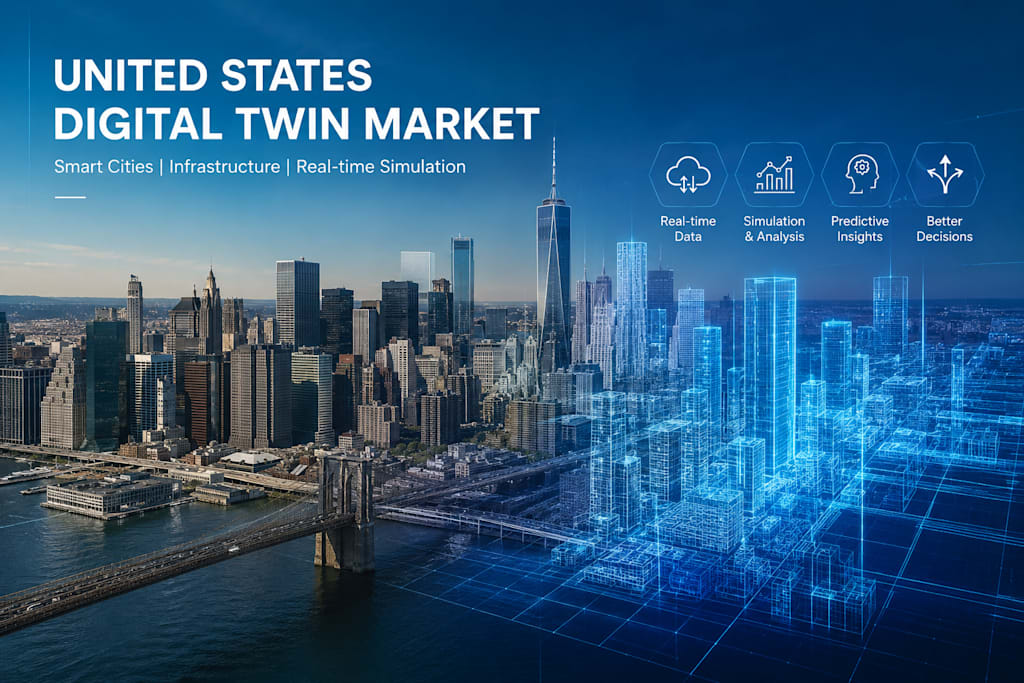
It is in the USA where the current digital transformation is being championed, and of all the most disrupting technologies is digital twin technology. Digital twins are a virtual reproduction of physical systems, processes or products, and by doing so allow real time monitoring, predictiveness maintenance, as well as analysis on simulations-this has led to a revolution within many industries ranging from smart city infrastructure to the manufacturing sector.
According to the IMARC Group, the USA digital twin market value reached $3.9 Billion in 2025 and is expected to grow to $42.7 Billion by 2034, with a massive CAGR growth rate between 2026 and 2034 of 30.56%.
The growth of the market is due to a variety of factors including a surge in advanced technology, such as IIoT, AI, cloud computing, which are creating the basic foundations of a digital twin and will allow for real time monitoring and simulation in multiple industries. Predictive maintenance and operational efficiency have also contributed to market growth.
Many companies within aerospace and defense as well as energy have started to monitor the operations of its systems through the use of a digital twin in order to better improve operational efficiency and also detect system failure before it happens. Smart infrastructure and smart city technologies is one of the key factors to boosting the growth in the USA digital twin market, with states such as California as well as New York using smart city technology to better manage their urban infrastructures, monitor their systems in a city, predict traffic patterns, improve overall efficiency and increase sustainability.
Due to its expansive nature, smart city applications are predicted to witness significant growth in the market along with the increase of the Internet of Things devices. Over 5 million devices are estimated to be connected on the World Wide Web, and the data from this can be used to create more accurate real-time system replicas that are ideal to help organizations with their decision making.
Segment-wise, the system digital twin has acquired a 43.8% market share in 2025 as this application is seen as comprehensive for interconnected system monitoring across many industries. For technology, the IoT and IIoT share represents approximately 35.2% due to their application across industries, such as healthcare, manufacturing and smart infrastructure.
The aerospace and defense sector are the key stakeholders as it has accounted for 23.7% of the market due to their need for precision, and predictive analytics within this complex industry. From a regional outlook, the Western US holds 33.7% of the market share and the reason being that this area of the country has many centers of technology as well as high-tech industries.
Another sector which is beginning to see significant investment into the digital twin market is AI, in terms of its analytics. Many tech giants such as Microsoft and IBM are investing in digital twin technology in order to make it more intelligent, and efficient through data analysis, as well as automated solutions for system management and decision making.
Sustainability has also become an increasingly important area within the market and digital twin technology is being employed by businesses, as well as governments in order to monitor energy systems, factory output and other emission levels. Despite these encouraging statistics the market may face a few obstacles including high implementation cost, complexity with regard to data integration and security concerns surrounding it, however despite this it is expected that the USA digital twin market is still set for phenomenal growth.
Detailed United States Digital Twin Market forecast and trends
About the Creator
michael matthew
I’m a market researcher passionate about understanding people, markets, and motivations. My work blends data analysis, consumer psychology, and strategic insight to help brands and businesses make informed, human-centered decisions.
Enjoyed the story? Support the Creator.
Subscribe for free to receive all their stories in your feed.
Comments
There are no comments for this story
Be the first to respond and start the conversation.