
Why the United States Battery Management System Market Is Booming With EV and Renewable Growth
The United States battery management system market is expanding rapidly as electric vehicles, renewable energy, and smart technologies drive demand for advanced battery solutions.

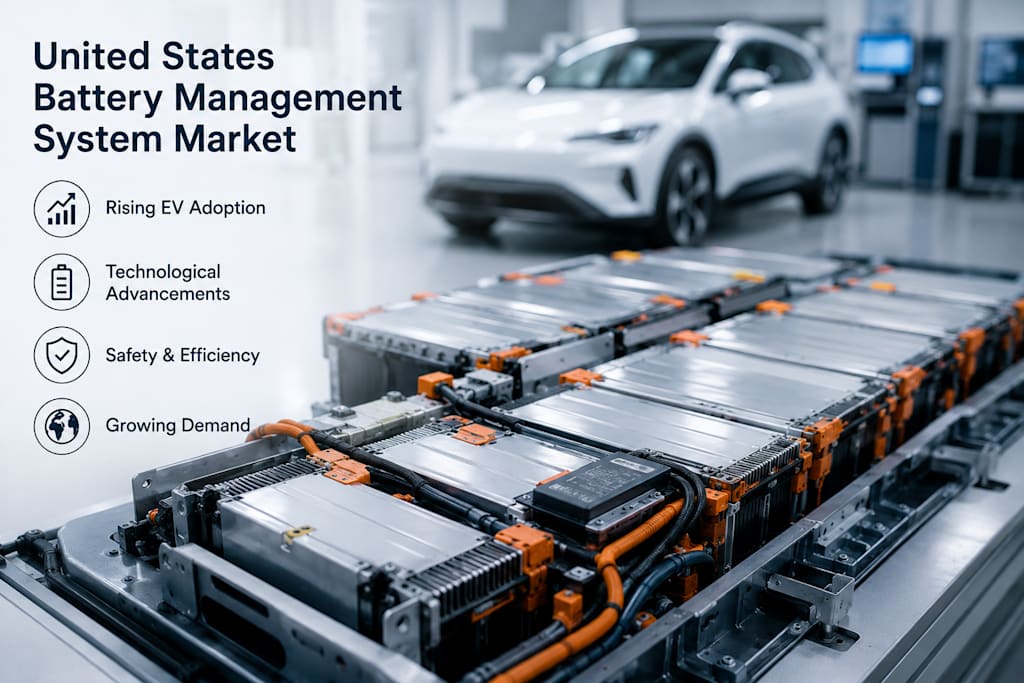
Battery systems are at the heart of the modern infrastructure as the United States continues its acceleration toward electrification and renewables. A key element within this technology revolution is the Battery Management System (BMS)-the essential technology for safe, efficient, and long-lasting batteries. With fast growth in the electric vehicle, energy storage, and smart electronics industries, the U.S. BMS market is experiencing remarkable growth.
The United States battery management system market reached USD 2.4 Million in 2025, and IMARC Group projects it to reach USD 10.4 Million by 2034, growing at a strong CAGR of 17.23% from 2026 to 2034.
The main driving factor is the increased adoption of electric vehicles (EVs). The huge investment into future generation EVs with larger capacity batteries from major auto manufacturers is contributing to increased demand for an advanced BMS. The systems monitor battery conditions to prevent overheating and ensure safe operation-particularly for the high-performance environments of EVs.
Renewable energy and energy storage systems also play an important role. Many of the renewable energy systems such as wind or solar, depend heavily on battery storage to manage unstable power generation. A BMS system is crucial to manage the energy, sustain the health of the battery, and prevent any system malfunction.
The growing market for consumer electronics also influences demand for BMS. The usage of higher capacity batteries within smart gadgets such as smartphones, laptops, wearable devices, and other IoT-enabled gadgets has been rising steadily, requiring more efficient systems to prolong battery life. Smart home technology has a large role in increasing the demand for reliable BMS.
The integration of the Internet of Things (IoT) and artificial intelligence (AI) into the BMS platform is a dominant market trend. This trend is allowing for the implementation of many new applications that facilitate real-time monitoring, predictive maintenance, and enhanced energy efficiency. An AI-enabled BMS can diagnose battery condition using system data and optimize battery charging, greatly increasing reliability.
The market is segmented by battery type, with lead-acid holding the largest market share at 50.2%, mainly used in backup power and grid storage applications. The growth of Lithium-ion battery type, which holds higher energy density and longer cycle life, is a dominant growth factor in EV and portable electronic devices applications.
Segmentation by application sees consumer electronics holding 43.2% market share, led by growing use of portable smart devices and gadget demand. Key segments also include automotive, telecommunications, health care, military and defense, and renewable energy systems.
Segmentation by topology consists of centralized, distributed, and modular systems with differentiated flexibility, scalability and efficiency depending on the application's specific needs, such as those in renewable energy and large-scale storage applications with modularity and scalability playing an important role.
The market spans several regions including Northeast, Midwest, South and West. The Southern region has 33.5% market share with the key states of Texas and Florida leading, driven by large scale renewable energy projects and the adoption of EV.
Another significant trend impacting the U.S. Market is the advancement in wireless battery management systems. By reducing wire complexity, system weight, and improving reliability, the technology is seen as key in the design of future generation EV's.
Investments in R&D and strategic partnerships with companies such as NXP Semiconductors, Texas Instruments, Schneider Electric, and Sensata Technologies are contributing to market growth and pushing innovation within the BMS space. However, high system cost and complexity remain an issue for more cost-sensitive applications.
What drives the United States battery management system market is its direct correlation with national electrification and sustainability efforts. As various industries shift toward renewable energy and smart technologies, BMS systems are being built as a critical part of a modern infrastructure. Looking forward, future market growth is likely driven by continued increases in EV adoption, growth in renewable energy storage, development in battery technology and the increasing prevalence of smart energy management system integrations, powered by AI technologies.
Detailed United States battery management system forecast and trends
About the Creator
michael matthew
I’m a market researcher passionate about understanding people, markets, and motivations. My work blends data analysis, consumer psychology, and strategic insight to help brands and businesses make informed, human-centered decisions.
Enjoyed the story? Support the Creator.
Subscribe for free to receive all their stories in your feed.
Comments
There are no comments for this story
Be the first to respond and start the conversation.