
Why the U.S. Food Allergen Testing Market Is Becoming a Critical Part of Modern Food Safety
Rising food allergy cases, stricter regulations, and advanced testing technologies are driving strong growth across America's food safety industry.

For millions of Americans, a simple meal can carry serious health risks if allergens are not properly identified, labeled, and controlled. Even trace amounts of ingredients such as peanuts, milk, soy, wheat, eggs, shellfish, tree nuts, sesame, or fish can trigger severe allergic reactions, leading to emergency medical treatment and, in some cases, life-threatening complications.
As consumer awareness grows and regulatory requirements become more stringent, food manufacturers are under increasing pressure to ensure product safety throughout the supply chain. This responsibility has placed food allergen testing at the center of modern food production.
Food allergen testing helps manufacturers verify ingredient accuracy, detect cross-contamination, comply with federal regulations, and protect consumers from potentially dangerous exposure. As food products become more complex and global supply chains continue to expand, accurate testing is becoming an essential component of quality assurance programs across the industry.
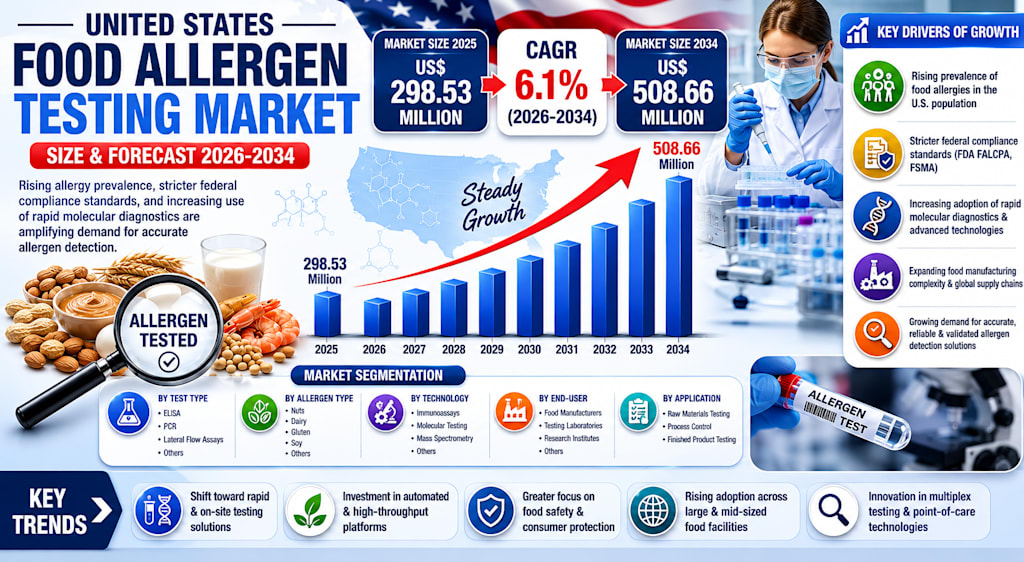
According to Renub Research, the United States Food Allergen Testing Market is projected to grow from US$ 298.53 million in 2025 to US$ 508.66 million by 2034, expanding at a CAGR of 6.1% between 2026 and 2034. The market is being driven by rising allergy prevalence, stricter compliance standards, growing food manufacturing complexity, and increased adoption of advanced diagnostic technologies.
As food safety expectations continue to rise, allergen testing is evolving from a compliance requirement into a critical business necessity.

Why Food Allergen Testing Matters More Than Ever
Food allergen testing refers to the scientific analysis of food products, ingredients, production facilities, and processing environments to identify allergenic substances that may pose risks to sensitive consumers.
Testing helps manufacturers detect trace levels of allergenic proteins and verify that products meet labeling requirements. Laboratories commonly use technologies such as ELISA testing, polymerase chain reaction (PCR), lateral-flow assays, and mass spectrometry to ensure accuracy and reliability.
The importance of these systems continues to increase as food manufacturing becomes more sophisticated. Today's products often contain numerous ingredients sourced from multiple suppliers across different countries, increasing the risk of accidental cross-contact.
Without reliable allergen testing, manufacturers face the possibility of product recalls, regulatory penalties, legal liabilities, and reputational damage.
For consumers, the stakes are even higher.
Testing serves as a critical safeguard that helps ensure food products are safe for individuals living with allergies.
Rising Food Allergy Rates Are Driving Demand
One of the strongest growth drivers in the market is the increasing prevalence of food allergies throughout the United States.
Food allergies affect millions of adults and children, creating a growing need for safer products and more rigorous manufacturing standards.
As awareness of food allergies continues to expand, consumers are paying closer attention to ingredient labels and allergen disclosures. Parents, healthcare professionals, schools, and advocacy organizations are placing greater emphasis on allergen management and transparency.
This heightened awareness is encouraging food companies to invest more heavily in testing programs designed to prevent accidental exposure and improve consumer confidence.
Food manufacturers increasingly recognize that allergen control is not simply a regulatory obligation. It is also a critical component of customer trust and brand protection.
As allergy diagnoses continue to rise, demand for reliable testing solutions is expected to grow steadily throughout the forecast period.
Technology Is Transforming Allergen Detection
The food allergen testing industry is benefiting significantly from advances in analytical technology.
Traditional testing methods remain important, but newer technologies are enabling faster, more accurate, and more sensitive detection capabilities.
Manufacturers increasingly require tools capable of identifying extremely small quantities of allergenic substances. Advanced technologies such as digital PCR, multiplex immunoassays, and automated extraction systems allow laboratories to detect allergen residues that older testing approaches may miss.
These innovations help companies improve compliance while reducing the risk of costly recalls.
A notable example occurred in April 2025 when Thermo Fisher Scientific announced a US$2 billion investment in U.S. manufacturing and research operations. The initiative includes expanded production of analytical instruments used within allergen detection workflows, strengthening domestic testing capabilities and supporting future innovation.
As laboratory technologies continue to improve, food companies are gaining access to faster and more reliable testing solutions than ever before.
Regulatory Pressure Is Increasing
Government regulations have become one of the most important forces shaping the allergen testing market.
Federal agencies continue strengthening food safety expectations and increasing scrutiny of allergen management practices. Manufacturers must demonstrate that products are properly labeled and that production processes minimize the risk of unintended allergen contamination.
In January 2025, the U.S. Food and Drug Administration issued final guidance regarding food allergen labeling and the evaluation of non-listed allergens. The guidance clarified compliance obligations and provided scientific frameworks for assessing emerging allergens beyond the currently recognized major allergen categories.
This regulatory modernization is expected to increase demand for sophisticated testing technologies.
Companies are proactively investing in advanced monitoring systems to ensure compliance with evolving requirements and avoid regulatory risks.
As food safety standards continue to evolve, testing will remain a critical component of compliance programs across the industry.
Safer Diagnostic Alternatives Are Creating New Opportunities
Food allergy research is also contributing to market expansion.
Traditional oral food challenges, commonly used in allergy research and diagnosis, carry the risk of triggering severe allergic reactions. As a result, researchers are increasingly seeking safer laboratory-based alternatives.
In April 2025, Beckman Coulter Life Sciences introduced a next-generation Basophil Activation Test designed to evaluate allergen responses through blood-based analysis rather than direct allergen exposure. The innovation provides researchers with safer diagnostic capabilities while expanding opportunities for advanced allergen testing technologies.
These developments are helping broaden the role of allergen testing beyond food manufacturing and into healthcare and clinical research applications.
As demand for safer diagnostic tools grows, laboratories and research institutions are expected to increase investment in allergen detection technologies.
Supply Chain Complexity Is Increasing Risk
Modern food supply chains are becoming increasingly complicated.
Many food products now rely on ingredients sourced from multiple countries, processed through various facilities, and transported through extensive distribution networks before reaching consumers.
While globalization offers efficiency and product variety, it also increases the risk of allergen cross-contact.
Ingredients may pass through multiple suppliers, contract manufacturers, storage facilities, and transportation providers before final assembly. Each stage introduces opportunities for contamination if controls are not carefully managed.
To address these risks, companies are investing in supplier verification programs, traceability systems, environmental monitoring, and routine allergen testing.
However, maintaining consistent standards across large supply chains remains a significant challenge, particularly for smaller businesses with limited resources.
High Costs Remain a Challenge
Despite strong market growth, implementation costs continue to present obstacles for many food manufacturers.
Advanced testing technologies require substantial investment in laboratory equipment, specialized personnel, validation procedures, and ongoing quality assurance programs. Environmental monitoring, sanitation verification, and regulatory documentation add additional expenses.
Large food manufacturers often possess the resources necessary to implement comprehensive allergen management systems.
Smaller and mid-sized producers, however, may struggle to keep pace with evolving regulatory expectations and technological requirements.
Many smaller companies rely on third-party laboratories for testing services, which can reduce equipment costs but may increase turnaround times and operational complexity.
Balancing compliance requirements with affordability remains a key challenge across the industry.
California Leads the Market
California remains one of the most advanced food allergen testing markets in the United States.
The state's large food manufacturing sector, extensive agricultural production, and strict regulatory environment contribute to strong demand for testing services.
According to the California Department of Public Health, approximately four million Californians—representing about 10% of the state's population—live with food allergies. This significant public health burden drives investment in allergen detection technologies, contamination prevention programs, and digital testing workflows.
Food producers throughout California increasingly rely on PCR systems, ELISA testing platforms, and automated verification technologies to ensure compliance and reduce recall risks.
Texas Continues to Expand Testing Capacity
Texas has emerged as another major growth market.
The state's large food processing industry includes substantial production of meat products, baked goods, snacks, and packaged foods. Rising consumer awareness and increasing regulatory oversight are encouraging manufacturers to strengthen allergen management programs.
The Texas Department of State Health Services reports that approximately one in thirteen children in Texas has a food allergy, creating strong demand for allergen-safe products and robust testing procedures.
Laboratories throughout Houston, Dallas, and Austin are expanding testing capacity to accommodate growing demand for allergen analysis across multiple food categories.
New York and Florida Present Strong Opportunities
New York and Florida also represent important regional markets.
In New York, nearly two million residents were reported to have food allergies in 2023, creating significant demand for allergen management across restaurants, schools, retail food businesses, and manufacturing facilities. Companies increasingly invest in sanitation protocols, labeling accuracy, and high-throughput testing technologies to meet consumer expectations and regulatory requirements.
Florida's market is driven by its large tourism industry, extensive foodservice sector, and substantial packaged food production activities. More than 2.3 million Florida residents were estimated to be living with food allergies in 2023, supporting continued investment in allergen testing and food safety programs.
These regional markets illustrate how public health concerns directly influence testing demand across the country.
Biosensors Are Shaping the Future
One of the most promising areas of innovation involves biosensor-based allergen detection.
Biosensors provide real-time or near-real-time detection capabilities and can identify allergens such as peanuts, dairy, soy, and gluten directly within production environments. These technologies offer advantages including portability, rapid results, and reduced reliance on centralized laboratory facilities.
Advancements in nanotechnology, microfluidics, smartphone-connected devices, and artificial intelligence are further improving biosensor performance.
As costs decline and accuracy improves, biosensor-based testing may become an increasingly important part of routine allergen management programs.
Dairy Allergen Testing Remains a Major Segment
Among specific allergen categories, dairy testing continues to represent a significant market opportunity.
Milk allergies remain among the most common food allergies, particularly among children. Manufacturers producing baked goods, chocolates, beverages, snacks, and plant-based alternatives rely heavily on testing systems capable of detecting milk proteins such as casein and whey.
The growth of dairy-free products has further increased the need for reliable allergen verification.
Consumers purchasing dairy-free products expect complete confidence in labeling accuracy, making rigorous testing essential for brand credibility and consumer safety.
Final Thoughts
Food allergen testing has become one of the most important components of modern food safety.
As food allergies become more prevalent, supply chains grow more complex, and regulations become increasingly rigorous, manufacturers can no longer rely solely on traditional quality assurance methods. Advanced testing technologies are helping companies detect contamination risks earlier, improve compliance, and protect consumers more effectively.
With the United States Food Allergen Testing Market expected to grow from US$ 298.53 million in 2025 to US$ 508.66 million by 2034, the industry is positioned for steady expansion in the years ahead.
For food manufacturers, testing laboratories, regulators, and consumers alike, the future of food safety will increasingly depend on accurate, reliable, and innovative allergen detection technologies. As expectations for transparency and protection continue to rise, allergen testing will remain a cornerstone of trust within America's food system.
About the Creator
Enjoyed the story? Support the Creator.
Subscribe for free to receive all their stories in your feed.
Comments
There are no comments for this story
Be the first to respond and start the conversation.