
Why the Semiconductor Market Keeps Outpacing Expectations
Inside the trends, investments, and chip demand reshaping a $840 billion industry.
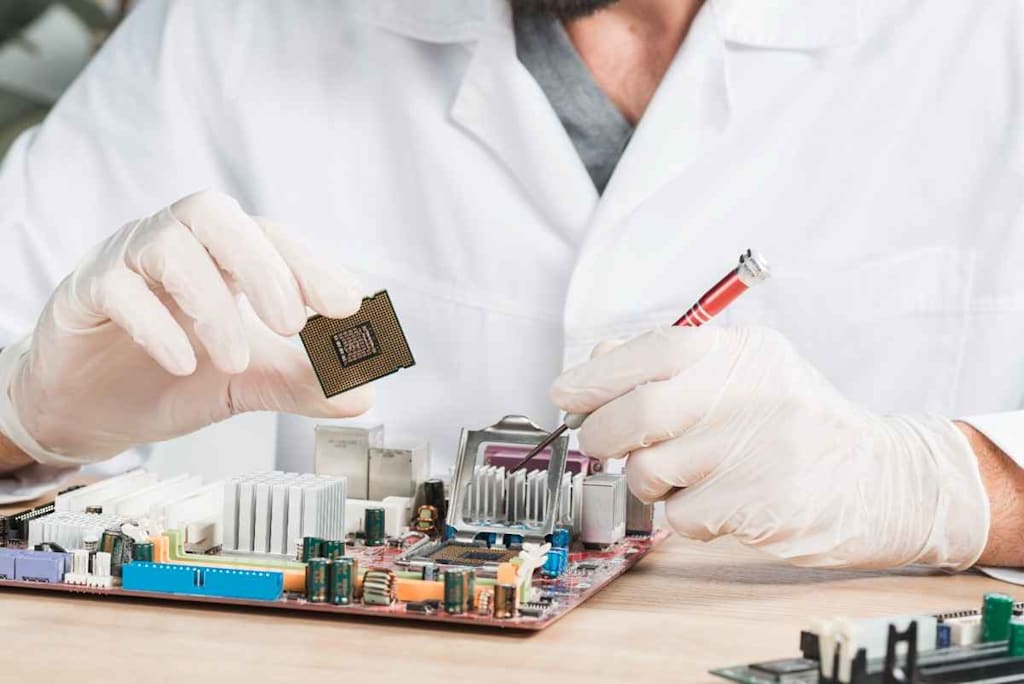
- Few industries shape daily life as quietly as the semiconductor market. Every smartphone notification, every electric vehicle adjusting its braking mid-turn, and every data center humming through an AI query depends on chips most people never think about. Recent industry estimates put the global semiconductor market at roughly $840.6 billion in 2024, with projections pointing toward close to $2 trillion by 2034 — a compound annual growth rate near 9.2%. That trajectory says less about silicon itself and more about how thoroughly computing has woven itself into transportation, healthcare, communication, and manufacturing.
Readers curious about how analysts arrived at these projections can request a complimentary excerpt of the underlying research to examine the regional breakdowns and methodology firsthand.
A Market Riding the AI Wave
Much of the current acceleration traces back to artificial intelligence and the data centers built to support it. Logic and memory chips, the categories most tied to AI training and inference, grew by roughly 29% and 17% respectively in 2025, according to industry tracking. Companies are reinvesting at a similar pace: semiconductor capital expenditure is expected to reach around $185 billion in 2025, much of it directed toward expanding fabrication capacity by close to 7% globally. Nvidia, Samsung, and Broadcom have all reported revenue gains tied directly to AI infrastructure buildouts, while AI-specific integrated circuits alone are projected to account for roughly 18% of total chip revenue. The pattern suggests AI isn't a side trend within the chip business anymore — it's becoming one of its primary engines.
Asia's Manufacturing Stronghold
Geography still matters enormously in this industry. Asia Pacific accounted for more than 65.7% of global revenue in 2024, anchored by Taiwan, South Korea, and China's dense concentration of fabrication plants. Taiwan Semiconductor Manufacturing Co. remains the dominant foundry for advanced process nodes, while Samsung continues expanding its memory and logic capabilities. Anyone tracking how this regional concentration is expected to evolve over the next decade can find a detailed breakdown of the global semiconductor market by component, application, and country in the source research, which lays out projections through 2034 alongside competitive positioning for major foundries and chipmakers.
The Push to Localize Chip Production
Heavy reliance on a handful of Asian fabs has pushed governments elsewhere to subsidize domestic chipmaking. The U.S. CHIPS and Science Act committed roughly $53 billion to expand American manufacturing and research, while India's Semicon India Program has earmarked $10 billion to build out design, fabrication, and packaging capabilities from scratch. That strategy is already attracting real capital: Micron Technology committed $2.75 billion to a semiconductor assembly and testing facility in Gujarat, and Applied Materials is investing $400 million in a new engineering center in India. None of this replaces Asia's existing manufacturing base overnight, but it signals a slow diversification of where chips actually get made.
Smaller, Smarter, Greener Chips
Beyond capacity, the underlying technology is shifting too. Materials like gallium nitride and silicon carbide are enabling chips that handle higher voltages and temperatures, which matters for electric vehicles and renewable energy systems. Chip designers are also leaning on AI itself — Synopsys has reported more than threefold productivity gains and up to 20% better chip quality using AI-assisted design tools, shortening development cycles that used to take years. Combined with advanced packaging techniques like hybrid bonding, these innovations are letting manufacturers pack more performance into smaller, more efficient packages.
Looking Ahead
Where this industry lands by 2034 depends on variables that are notoriously hard to predict — trade policy, raw material access, and how quickly AI-driven chip demand actually plateaus, if it does at all. What seems more settled is the direction: chips are getting embedded into more categories of products, not fewer, and the regions investing earliest in domestic capacity are positioning themselves for outsized influence later. For an industry that mostly operates behind the scenes, the chip business looks set to keep shaping the visible world for a long time to come.
About the Creator
Enjoyed the story? Support the Creator.
Subscribe for free to receive all their stories in your feed.
Comments
There are no comments for this story
Be the first to respond and start the conversation.