
Why the Precision Machining Market Is Under New Pressure
Export controls, robot adoption, and acquisitions are reshaping who controls manufacturing's tightest tolerances.

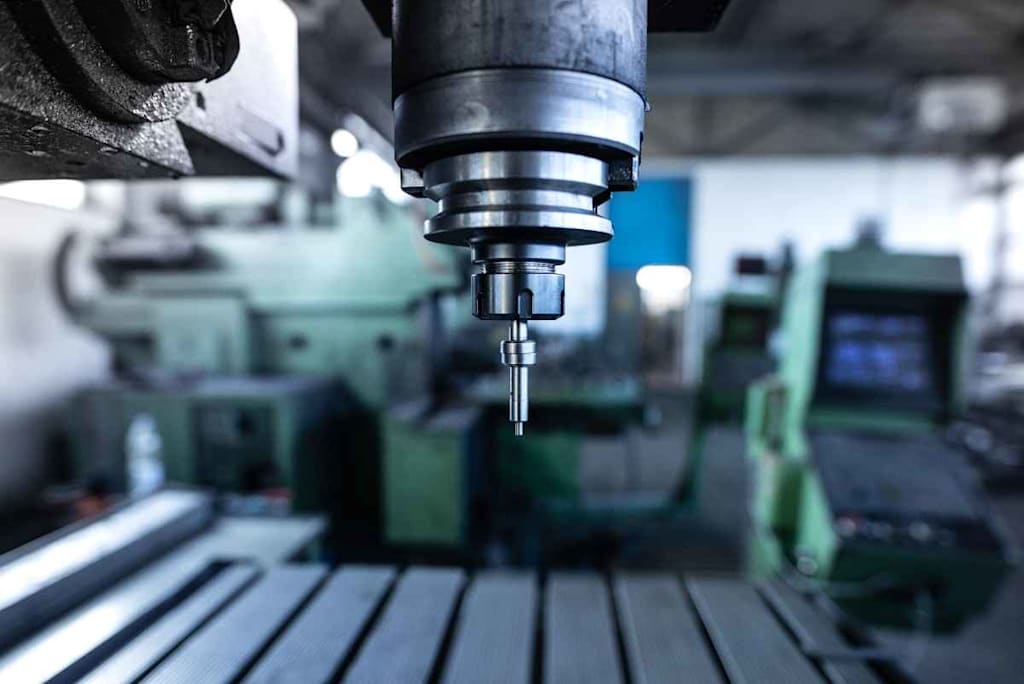
Ask anyone in manufacturing what keeps a jet engine bolt or a surgical implant from failing, and the answer usually comes down to tolerances measured in thousandths of a millimeter — the kind of precision that separates a part that works from one that doesn't. That demand for exactness is what's driving the Precision Machining Market, which industry research expects to climb from roughly $117.2 billion in 2025 to $243.8 billion by 2035, a compound annual growth rate of 7.6%. The bigger story behind that growth, though, isn't really about better machines. It's about who controls access to the materials and tools those machines depend on.
Those segment-level figures are spelled out further in a preview version of the research that market.us has published separately.
Why a 40-Year-Old Michigan Shop Just Got Bought
In January 2026, Threadlock Precision, a growing network of precision manufacturing firms, acquired Kremin Inc., a Michigan-based CNC machining company with more than four decades of experience serving aerospace, defense, and medical customers. A month earlier, Yijin Hardware expanded its OEM sheet metal fabrication capabilities to keep up with demand across automotive, aerospace, medical, and energy work. Neither move was about chasing a new technology — both were about buying capacity and customer relationships that already existed. That's increasingly how this industry grows: less through invention, more through acquisition, as larger players absorb the regional shops that built decades of specialized expertise but lack the capital to scale further. It's a pattern showing up across the broader precision machining market, where consolidation is starting to look like the default growth strategy rather than the exception.
The Robots Are Doing More of the Cutting
It's not just ownership that's shifting — it's who's actually running the equipment. The International Federation of Robotics reported that the global stock of operational industrial robots in manufacturing topped 4.6 million units in 2024, a 9% jump from the year before, with 542,000 new installations marking the fourth straight year above the half-million mark. Robot density — robots per 10,000 manufacturing workers — has more than doubled globally since 2016, and China alone accounted for roughly 54% of all robot installations in 2024. None of that means human machinists are disappearing. CNC operation already accounts for nearly 73% of all precision machining activity, and milling remains the leading machine type at close to 31% share, largely because it handles complex geometries that other methods can't touch. What's changing is how much of the routine cutting, loading, and inspection work no longer requires a person standing at the machine.
A Supply Chain Squeeze Nobody Saw Coming
Here's the part that doesn't show up in most growth forecasts: in October 2025, China's Ministry of Commerce introduced export controls on artificial diamond micropowders, wire saws, and grinding wheels — materials essential to ultra-precision finishing — with licensing requirements taking effect that November. Around the same time, U.S. tariffs on Chinese-made machine tools pushed costs higher for American manufacturers, forcing many to either absorb the expense or find new suppliers. The European Union responded by diversifying its metal sourcing, with intra-EU metal imports rising about 5% as member states moved away from single-country dependency. None of this is hypothetical anymore. It's actively reshaping where precision machining capacity gets built and which countries can access the specialized abrasives their highest-tolerance work requires.
Where the Real Demand Sits
Underneath all of this, the fundamentals are fairly steady. Metals account for roughly 77% of materials used, prized for holding structural integrity at temperatures and pressures most plastics can't survive. Automotive remains the largest end-use industry at nearly 27% of total demand, unsurprising given that global vehicle production topped 75.5 million units in 2024, each one packed with precision-machined engine, transmission, and safety components. Asia Pacific holds the largest regional share, just under 39%, anchored by manufacturing depth in China, Japan, South Korea, and India.
Looking Ahead
The next phase of this industry probably won't be defined by a single breakthrough machine, but by how well manufacturers navigate a supply chain that's gotten noticeably more political. Companies that diversify sourcing early, lean further into automation, and keep pace with emerging certification pathways for additive-manufactured parts are likely to come out ahead of those still treating precision machining as a purely mechanical problem. Increasingly, it isn't one.
About the Creator
Enjoyed the story? Support the Creator.
Subscribe for free to receive all their stories in your feed.
Comments
There are no comments for this story
Be the first to respond and start the conversation.