
Why the North America Lithium-ion Battery Market Is Growing With EV and Energy Storage Demand
The North America lithium-ion battery market is expanding as EV production, battery storage deployment, domestic manufacturing, and recycling investment reshape the region’s energy future.

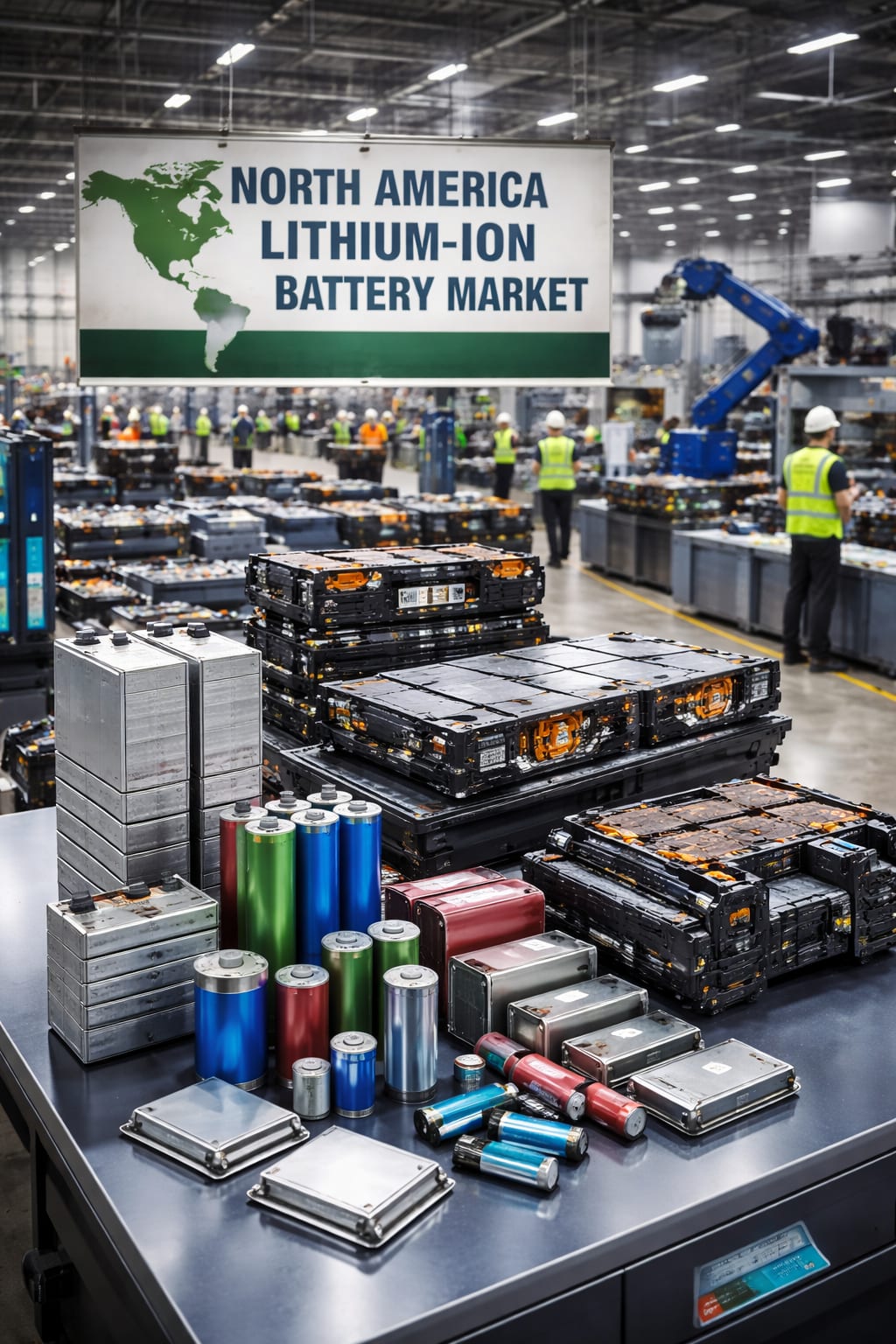
From powering only smartphones and laptops, lithium-ion battery applications now dominate North America's biggest industrial transformations across multiple industries․ These include electric vehicles, grid battery systems, domestic manufacturing, and battery recycling, all of which are among the most important opportunities in the clean energy transition and supply-chain security endeavor․ As per the IMARC Group, the North America lithium-ion battery market was worth USD 22․1 billion in 2025, and is expected to grow at a CAGR of 9․86% during 2026-2034, and reach USD 52․9 billion by 2034․ The rise in this market has been attributed by IMARC to greater adoption of electric vehicles and energy storage systems globally․
One of the biggest contributors is the growth of EV usage․ IMARC says that government emissions policy, subsidies for EV buyers and funding of EV charge stations are driving electrification․ As with Tesla, General Motors, and Ford, Volkswagen and PowerCo made an investment in Patriot Battery Metals in December 2024․ This allowed the companies to secure a supply of lithium for a long-term period in North America for EV battery production․ The demand for lithium batteries in auto manufacturing is not only coming from EV sales, but also from the raw materials arms race, with manufacturers localizing supply chains, the report says․
Another important market driver is energy storage for which IMARC states that utilities and industrial operations are adopting batteries for energy storage systems to supplement variable renewable energy sources such as solar and wind․ For example, in November 2024, the report noted that EDF Renewables signed a 20-year power purchase agreement for the 250 MW Beehive BESS in Arizona, showing that lithium-ion batteries are now also used for energy storage and discharge during peak periods of grid demand․ Batteries are becoming as important to power reliability as they are to transportation․
A key change is domestic battery manufacturing, with IMARC noting that local production in North America is expected to ramp up sharply due to US Inflation Reduction Act and Bipartisan Infrastructure Law․ The report points to gigafactory expansions by Tesla, Panasonic, and LG Energy Solution․ In November 2024, Asahi Kasei Battery Separator Corporation and Honda were reported to be constructing a separator plant in Ontario with an annual production capacity of 700 million square meters, planned for 2027․ The market is being driven by end application demand and industrial policy with the intent of reducing reliance on overseas battery supply chains․
Battery recycling is becoming a key part of that story․ According to IMARC, investment in recycling and second life will grow as companies seek to reclaim lithium, cobalt, and nickel․ In December 2024 American Battery Technology Company (ABTC) received USD 144 million from the U․S․ Department of Energy to build a lithium-ion battery recycling plant․ Redwood Materials and Li-Cycle are developing recycling infrastructure across North America․ Recycling is increasingly seen not as waste management, but as the long-term supply of battery raw materials․
Technological changes are also occurring in the sector․ IMARC reports that energy density, charging speed, and safety are improving, as well as a renewed focus on lithium iron phosphate (LFP) and solid-state batteries․ Because of their thermal stability, low cost, and long cycle life, LFP is also being introduced into entry-level EVs and stationary storage as well․ Solid-state batteries are also projected for use in high-performance applications․ In September 2024, BMW North America announced a collaboration with Redwood Materials to establish a closed-loop battery supply chain, which reintroduces 95-98% of critical minerals back into the battery supply chain․
Locally, IMARC divides the market by product type into lithium cobalt oxide, lithium iron phosphate, lithium nickel manganese cobalt, lithium manganese oxide, and others․ The market is further divided by power capacity into the following: 0-3000 mAh, 3000-6000 mAh, 6000-10000 mAh, and over 60000 mAh․ The report covers mobile and portable electronics, electric vehicles (EVs), electric vehicle charging equipment, stationary energy storage, and grid storage, to show how the market has expanded up to utility-scale storage and EV platforms․
The North America lithium-ion battery market is interesting as it encapsulates several trends, from cleaner transport to more resilient electricity grids, strong policy support for domestic manufacturing, and circular-economy enablers such as recycling and second-life applications․ Batteries are no longer a component in an electronic device; they have become the foundation upon which North America's industrial and energy systems grow․ The final point is an interpretation of the drivers, trends, and segmentation from the IMARC․
About the Creator
michael matthew
I’m a market researcher passionate about understanding people, markets, and motivations. My work blends data analysis, consumer psychology, and strategic insight to help brands and businesses make informed, human-centered decisions.
Enjoyed the story? Support the Creator.
Subscribe for free to receive all their stories in your feed.
Comments
There are no comments for this story
Be the first to respond and start the conversation.