
Why the E-Axle Market Is Powering the Future of Electric Vehicles
How integrated electric drivetrain technology is transforming EV performance, efficiency, and global mobility

The global automotive industry is undergoing the biggest transformation in its history.
With the governments around the world trying to reduce the carbon emissions and consumers making the shift towards electric mobility, automobile manufacturers are redesigning the future of transportation. While most people discuss electric vehicles, one of the technologies quietly driving the change is the e-axle.
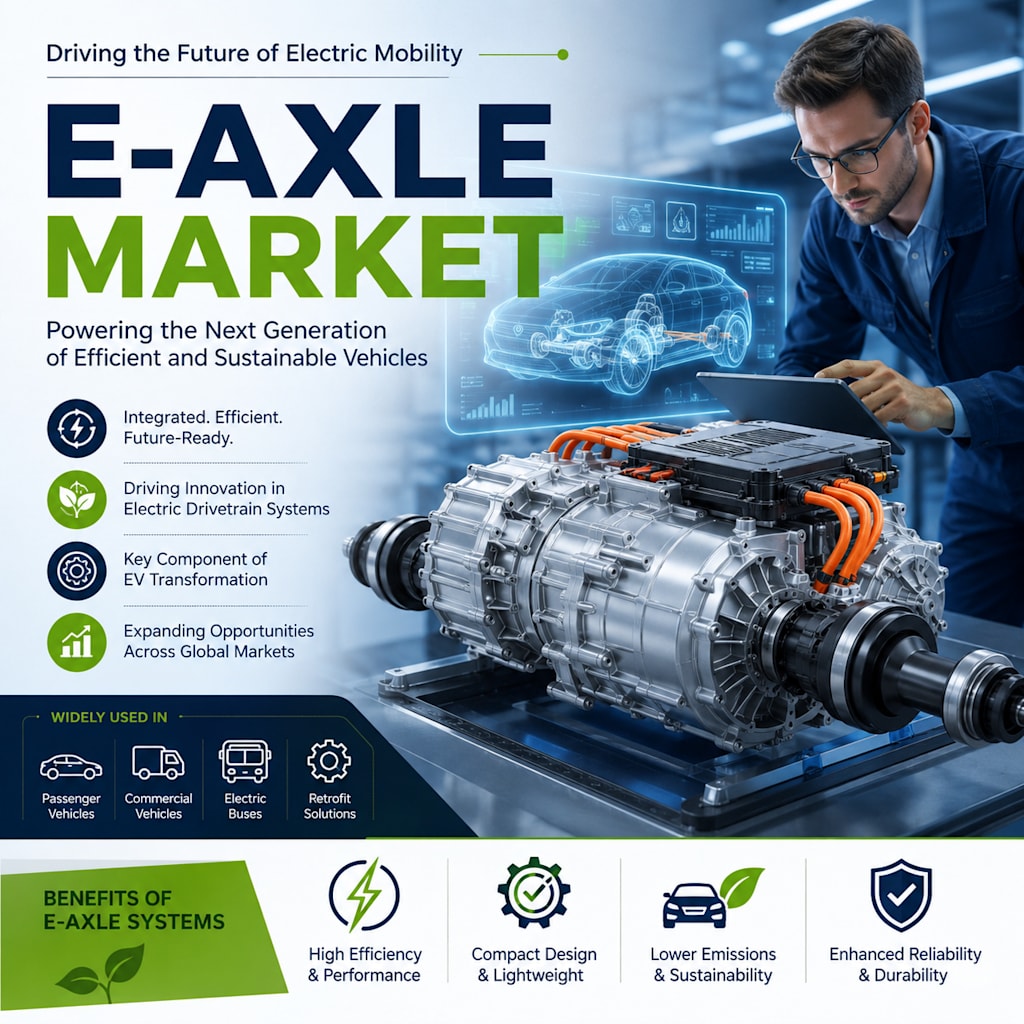
Even if e-axles are not widely known outside of the auto industry, it is quickly becoming one of the most crucial parts of an electric vehicle (EV). By integrating key parts of the electric drivetrain into a single compact unit, e-axles are enabling manufacturers to produce lighter, more efficient, and more powerful electric vehicles.
As electric vehicles gain traction around the globe, the e-axle market is booming.
A Thriving Market
The global e-axle market worth an estimated $5.9 billion in 2025, is predicted to grow to almost $23.3 billion by 2034.
This amounts to a Compound Annual Growth Rate (CAGR) of 16.05% from 2026 to 2034.
This growth is part of a much broader shift towards greener, smarter and energy-efficient vehicles.
Car manufacturers have moved beyond the trial phase of electric vehicles and are now investing billions to mass produce EVs, with e-axles becoming a fundamental component of this endeavor.
What exactly is an e-axle?
An e-axle, also called an electric axle, is a single unit that houses multiple key components of an EV's drivetrain.
A typical e-axle includes:
* Electric Motor
* Power Electronics
* Transmission System
The integration of these components reduces vehicle weight and energy consumption while simultaneously optimizing space within the electric vehicle.
This allows manufacturers to develop lighter, more efficient electric vehicles, as well as enhance performance.
Simply put, e-axles help electric vehicles to function in a more smooth, efficient, and sustainable manner.
The Ever-Growing Demand for Electric Vehicles
The increasing demand for electric vehicles is one of the key drivers of the global e-axle market.
Rising environmental consciousness among consumers, unpredictable fossil fuel prices, and growing government incentives aimed at encouraging electric mobility are contributing to the expanding adoption of electric vehicles in numerous automotive segments, including:
* Passenger Cars
* Commercial Trucks
* SUVs
* Public transportation vehicles
E-axles play a critical role in these vehicles by streamlining the drivetrain and boosting performance and efficiency. The increased production of electric vehicles is, in turn, driving the demand for these advanced integrated drivetrains.
Government and Emission Regulations Catalyzing Change
Environmental regulations are also playing a pivotal role in the evolving automotive landscape.
Strict emission standards being implemented in North America, Europe, and Asia are aimed at reducing harmful greenhouse gas emissions and improving air quality caused by traditional internal combustion engine vehicles (ICE).
These new regulations are compelling manufacturers to hasten their transition to electric and hybrid vehicles, a goal in which e-axles are essential. The efficiency enhancements provided by e-axles enable manufacturers to achieve stricter environmental goals and meet increasingly stringent regulatory requirements, making their adoption not just desirable, but a strategic imperative for most automotive companies.
Technological Advancements Bolstering E-Axle Power and Efficiency
Technological innovations continue to revolutionize the e-axle market, significantly improving its capabilities:
* Power Electronics
Current power electronic systems are becoming more compact, sophisticated, and energy-efficient. By managing the flow of electricity between the battery and the motor more effectively, power electronics are reducing energy loss and increasing vehicle range.
* Battery Technology
Advances in lithium-ion battery technology are empowering e-axles with improved efficiency and extended operating ranges. Furthermore, the introduction of faster charging capabilities is making EVs more practical for daily use.
* Electric Motor Design
Automotive engineers are creating more powerful, lightweight, and compact electric motors than ever before, resulting in increased acceleration, enhanced efficiency, and improved vehicle performance.
Collectively, these advancements are leading to the development of more efficient and cost-effective e-axle systems.
Why Automakers Favor Integrated E-Axle Systems
The primary advantage of e-axles is their integrated design. Traditional drivetrains often consist of a variety of separate components that contribute to their overall complexity and weight. E-axles bring together multiple key drivetrain elements into a single unit, simplifying vehicle architecture. This integrated approach offers several significant benefits to automotive manufacturers, including:
* Reduced manufacturing complexity
* Increased energy efficiency
* Improved weight distribution
* Greater space available for the cabin and battery
* Lower maintenance requirements
For automakers striving to optimize EV performance while minimizing production costs, integrated e-axle systems are proving to be an increasingly attractive solution.
E-Axles are Expanding into New Vehicle Categories
Initially prevalent only in premium electric vehicles, e-axles are now being adopted across a wide spectrum of automotive segments. This expansion is driven by the diverse needs and evolving demands of different vehicle categories, including:
* Passenger Vehicles
E-axles are becoming standard in passenger EVs, catering to consumer demand for longer range, faster acceleration, and a smoother driving experience.
* Commercial Vehicles
Electrification is making significant inroads in the commercial sector, with delivery vans, buses, and logistics fleets increasingly incorporating e-axles to improve fuel efficiency and reduce operational costs.
* Hybrid and Retrofitted Vehicles
E-axles are even being integrated into some existing internal combustion engine vehicles as part of hybridization strategies aimed at reducing emissions. This versatility broadens the market beyond fully electric vehicles.
The Asia-Pacific Region Continues Its Dominance
The Asia-Pacific region is currently the leading market for e-axles. Countries like China, Japan, and South Korea are actively investing in electric mobility infrastructure and EV production, with China leading the charge as the world's largest electric vehicle market. The strong backing from governments, robust manufacturing capabilities, and growing environmental awareness within the region are accelerating e-axle adoption. Meanwhile, North America and Europe are also experiencing rapid growth, largely fueled by stringent environmental policies and increased investment in sustainable transportation technologies.
Intensifying Competition and Innovation
The e-axle market is becoming increasingly competitive as automotive suppliers and technology companies race to gain a stronger foothold. Key players are prioritizing investments in research and development, forging strategic partnerships with automakers, expanding their manufacturing capacities, and developing sustainable production methods, along with advanced integration technologies. Many companies are also investing heavily in next-generation e-axle systems designed for enhanced efficiency, all-wheel-drive capabilities, and high-performance electric vehicles. Innovation has become one of the most critical competitive advantages in this sector.
Challenges to Overcome
Despite the rapid growth, the market still faces a number of obstacles. Widespread EV charging infrastructure is a major concern, especially in developing regions. Cost is another significant issue, as the advanced integrated e-axle systems can still be expensive compared to their traditional counterparts, even as EV production costs gradually decline. Manufacturers also need to focus on improving the durability and scalability of these systems to meet the increasing global demand. Nonetheless, with continuous investment and rapid technological advancements, it is expected that many of these challenges will be addressed in the coming years.
The Future of E-Axles
The future of the e-axle market looks incredibly bright. As electric vehicles become more mainstream, e-axles are poised to play a central role in shaping the next generation of automobiles. Potential future innovations may include AI-powered drivetrain optimization, more compact and lightweight systems, enhanced all-wheel-drive electric configurations, and improved integration with autonomous vehicle technology. By 2034, the market is projected to surpass $23 billion, underscoring the growing importance of integrated electric drivetrains.
In Conclusion
The transition to electric mobility is no longer a distant prospect; it is already well underway. Underlying this shift are innovative technologies like e-axles, which are helping to make electric vehicles more practical, efficient, and accessible to consumers worldwide.
About the Creator
Robert
Senior Market Researcher at IMARC Group, specializing in global market analysis, industry trends, and data-driven insights across diverse sectors.
Enjoyed the story? Support the Creator.
Subscribe for free to receive all their stories in your feed.
Comments
There are no comments for this story
Be the first to respond and start the conversation.