
Why North America’s Savory Snacks Market Is Growing Faster Than Ever
Changing lifestyles, bold flavor innovation, and healthier snack alternatives are transforming savory snacks into one of North America’s most dynamic food industries.

From potato chips during movie nights to protein-rich popcorn between meetings, savory snacks are now deeply woven into everyday consumer behavior. Modern consumers snack while commuting, working remotely, gaming, traveling, socializing, and even replacing full meals with quick grab-and-go products.
As lifestyles continue changing across the United States, Canada, and Mexico, the savory snacks industry is experiencing a major transformation driven by convenience, flavor experimentation, premiumization, and health-conscious innovation.
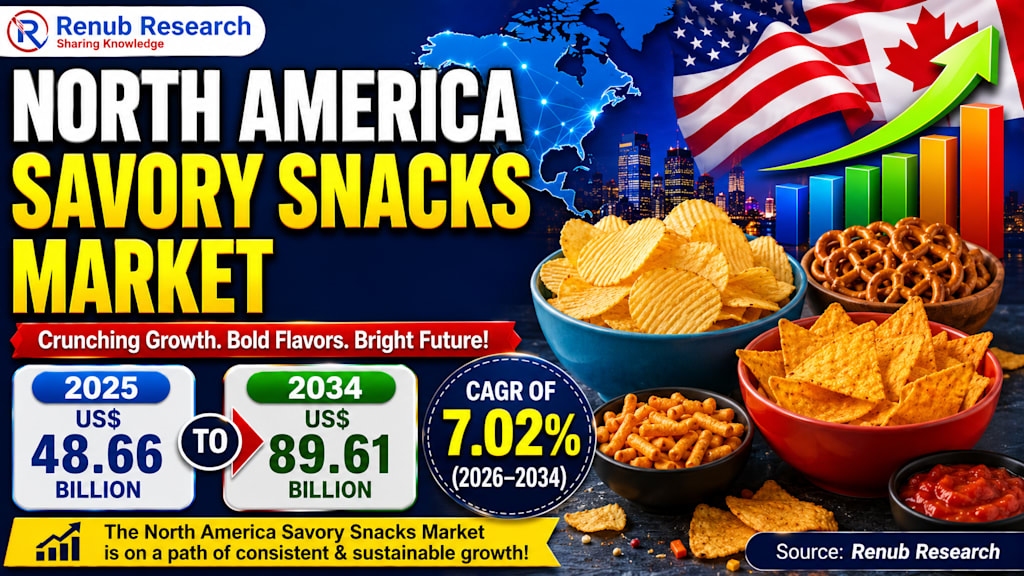
According to Renub Research, the North America Savory Snacks Market is expected to grow from US$ 48.66 Billion in 2025 to US$ 89.61 Billion by 2034, expanding at a CAGR of 7.02% between 2026 and 2034. Rising demand for portable food options, increasing health awareness, and continuous innovation in flavors and snack formats are among the key drivers fueling market expansion.
What was once dominated by traditional potato chips and pretzels is now evolving into a massive industry filled with protein snacks, baked alternatives, spicy global flavors, plant-based products, and gourmet-style innovations designed for modern consumers.
The future of snacking in North America is no longer just about taste. It is about experience, convenience, wellness, and lifestyle identity.
Snacking Has Become Part of Daily Life
One of the biggest reasons behind the rapid growth of the savory snacks market is the way eating habits have changed across North America.
Traditional meal structures are becoming less rigid. Consumers increasingly snack throughout the day instead of sitting down for three large meals. Busy work schedules, long commutes, hybrid work environments, and fast-paced lifestyles have created strong demand for foods that are portable, easy to consume, and instantly satisfying.
Savory snacks fit perfectly into this reality.
Products such as chips, popcorn, nuts, crackers, pretzels, and extruded snacks provide convenience while offering a wide range of flavor experiences. Consumers appreciate snacks that can be eaten quickly without preparation, making them ideal for both adults and younger demographics.
The rise of “on-the-go consumption” has become one of the industry’s most powerful growth drivers.
Modern consumers increasingly purchase snacks for offices, road trips, entertainment events, schools, and casual social occasions. Convenience stores, supermarkets, and online platforms have responded by expanding snack assortments and introducing more single-serve and portable packaging formats.
Manufacturers are continuously adapting products to fit evolving consumer lifestyles.
A strong example of this trend is Goldfish’s launch of its first-ever flavored pretzels in 2026, featuring Honey Mustard and Hot Buffalo varieties designed specifically for portable snacking experiences.
The modern snack consumer no longer wants just convenience — they also want excitement, flavor, and variety.
Flavor Innovation Is Reshaping the Industry
One of the most noticeable changes in the savory snacks market is the explosion of flavor experimentation.
Consumers today are far more adventurous with food choices than previous generations. Traditional salted chips still remain popular, but demand for bold, spicy, sweet-heat, smoky, and globally inspired flavors is growing rapidly.
Snack manufacturers are aggressively competing through innovation.
Products inspired by Mexican street food, Korean barbecue, Indian spices, Mediterranean herbs, and regional American cuisines are becoming increasingly common across grocery shelves.
In August 2024, Lay’s introduced a limited-edition lineup featuring Wavy Tzatziki, Honey Butter, and Masala flavors inspired by Greece, Korea, and India.
This type of global flavor experimentation appeals especially to younger consumers who are more open to trying international tastes and unique sensory experiences.
Limited-edition flavors also help brands create urgency and excitement among shoppers.
Companies are increasingly using regional flavors and seasonal launches to keep consumers engaged while encouraging repeat purchases.
In March 2024, Lay’s also introduced its “Flavor That Hits Home” lineup featuring regionally inspired flavors such as Crispy Taco, BLT Sandwich, Fried Pickles with Ranch, and Lime & Cracked Pepper.
These products demonstrate how snack brands are using emotional connections, cultural familiarity, and culinary creativity to strengthen consumer loyalty.
Flavor innovation has become one of the industry’s strongest competitive tools.

Healthier Snacks Are Becoming Mainstream
For years, savory snacks were often criticized for being unhealthy due to high sodium levels, excessive fats, and artificial ingredients.
Today, however, the market is undergoing a major health-focused transformation.
Consumers increasingly want snacks that combine indulgence with better nutritional value. This has pushed manufacturers to reformulate products and introduce healthier alternatives without sacrificing flavor or texture.
The demand for baked snacks, low-fat chips, organic ingredients, non-GMO formulations, plant-based products, and protein-rich options is growing rapidly across North America.
Consumers are also paying closer attention to ingredient transparency.
Clean-label products featuring simple ingredients and healthier oils are becoming increasingly attractive to health-conscious shoppers. Snacks made with avocado oil, olive oil, lentils, chickpeas, and natural seasonings are gaining significant popularity.
One strong example is LesserEvil’s launch of “Cheezmos” in 2025, a cheese puff made with organic avocado oil and real organic cheddar.
This type of product reflects how companies are repositioning savory snacks as lifestyle-friendly and wellness-oriented products.
Protein and fiber enrichment are also becoming important trends.
Consumers increasingly seek snacks that provide functional benefits such as energy support, satiety, and nutritional value beyond simple indulgence.
As health awareness continues rising across North America, brands that successfully balance flavor with nutrition are likely to gain long-term market advantage.
Premiumization Is Elevating Consumer Expectations
Savory snacks are no longer viewed as low-cost impulse purchases alone.
Premiumization is transforming the category by introducing gourmet ingredients, artisanal preparation methods, and elevated flavor profiles designed to create more sophisticated snacking experiences.
Consumers today are often willing to pay higher prices for snacks that feel unique, authentic, or higher quality.
Kettle-cooked chips, hand-seasoned popcorn, gourmet nuts, craft crackers, and premium cheese snacks are increasingly popular across supermarkets and specialty retailers.
Packaging design also plays a major role in premiumization.
Minimalist branding, resealable packaging, environmentally friendly materials, and upscale visual presentation help products stand out in crowded retail environments.
Premium snacks are especially popular among millennials and Gen Z consumers who value food experiences and are more likely to explore specialty products.
This trend is helping manufacturers increase profit margins while differentiating themselves in an extremely competitive market.
Convenience Stores and Online Platforms Are Driving Accessibility
Retail expansion has become another major growth driver for the savory snacks market.
Convenience stores remain one of the most important distribution channels for snack sales across North America. The United States alone has more than 150,000 convenience stores, significantly boosting on-the-go snack purchases.
Consumers often purchase snacks impulsively during fuel stops, work breaks, travel, or daily errands.
Supermarkets and hypermarkets also continue expanding shelf space for savory snack products due to consistently strong consumer demand.
At the same time, online shopping is reshaping the industry.
E-commerce platforms now allow consumers to discover specialty snacks, international flavors, health-focused products, and premium brands that may not be available locally.
Subscription snack boxes and direct-to-consumer models are becoming increasingly common.
Digital retail channels also help brands launch limited-edition products faster while gathering consumer feedback more efficiently.
This growing accessibility is expanding market reach across all consumer segments.
The United States Leads the Regional Market
The United States remains the largest savory snacks market in North America.
According to industry data, American households spend more than US$ 500 annually on snacks, including chips, popcorn, nuts, crackers, and pretzels.
The U.S. market is particularly strong in flavor innovation, premiumization, and health-focused snack development.
Consumers increasingly demand globally inspired flavors, cleaner ingredients, and convenient packaging formats.
Canada’s market is also growing steadily, supported by increasing demand for reduced-sodium snacks, air-popped products, and non-GMO alternatives.
Meanwhile, Mexico represents one of the fastest-growing snack markets in the region.
An estimated 73% of Mexico’s population consumes snacks on a daily basis, with strong cultural preferences for spicy and chili-lime flavor profiles.
Urbanization, rising disposable incomes, and expanding retail infrastructure continue supporting growth across the Mexican market.
These regional differences demonstrate the diversity and adaptability of the North American savory snacks industry.
Challenges Facing the Savory Snacks Industry
Despite strong growth potential, the industry still faces several important challenges.
One of the biggest concerns involves rising production costs.
Inflation and supply-chain disruptions continue increasing prices for key ingredients such as oils, grains, seasonings, and packaging materials. Manufacturers must balance affordability with product quality and innovation.
Price-sensitive consumers may shift toward private-label alternatives during periods of economic uncertainty.
Health perception also remains a challenge.
Although healthier snack options are growing rapidly, many consumers still associate savory snacks with excessive sodium, unhealthy fats, and processed ingredients.
Governments and public health organizations continue pressuring manufacturers to reduce sodium and improve nutritional profiles.
Meeting these expectations while maintaining flavor appeal can be difficult and expensive.
Additionally, evolving dietary preferences require ongoing investment in research and development.
Brands must continuously adapt products for vegan, gluten-free, organic, high-protein, and allergen-friendly markets to remain competitive.
Final Thoughts
The North America savory snacks market is entering a powerful new growth phase driven by changing lifestyles, health-conscious innovation, flavor experimentation, and premium consumer experiences.
According to Renub Research, the market is expected to approach US$ 90 Billion by 2034, reflecting the enormous role snacking now plays in everyday consumer behavior across the region.
Today’s consumers are no longer simply buying snacks to satisfy hunger.
They are seeking convenience, entertainment, comfort, bold flavors, wellness benefits, and personalized food experiences all at once.
This shift is transforming savory snacks from simple pantry staples into one of the most innovative and competitive sectors within the modern food industry.
As brands continue investing in healthier ingredients, global flavor inspiration, and premium product experiences, the savory snacks category is likely to remain one of North America’s strongest and most resilient consumer food markets for years to come.
About the Creator
Enjoyed the story? Support the Creator.
Subscribe for free to receive all their stories in your feed.
Comments
There are no comments for this story
Be the first to respond and start the conversation.