
Why Most AI Products Never Make It Beyond the Demo Stage
The biggest challenge in AI is no longer building a model. It is building a system organizations can trust.
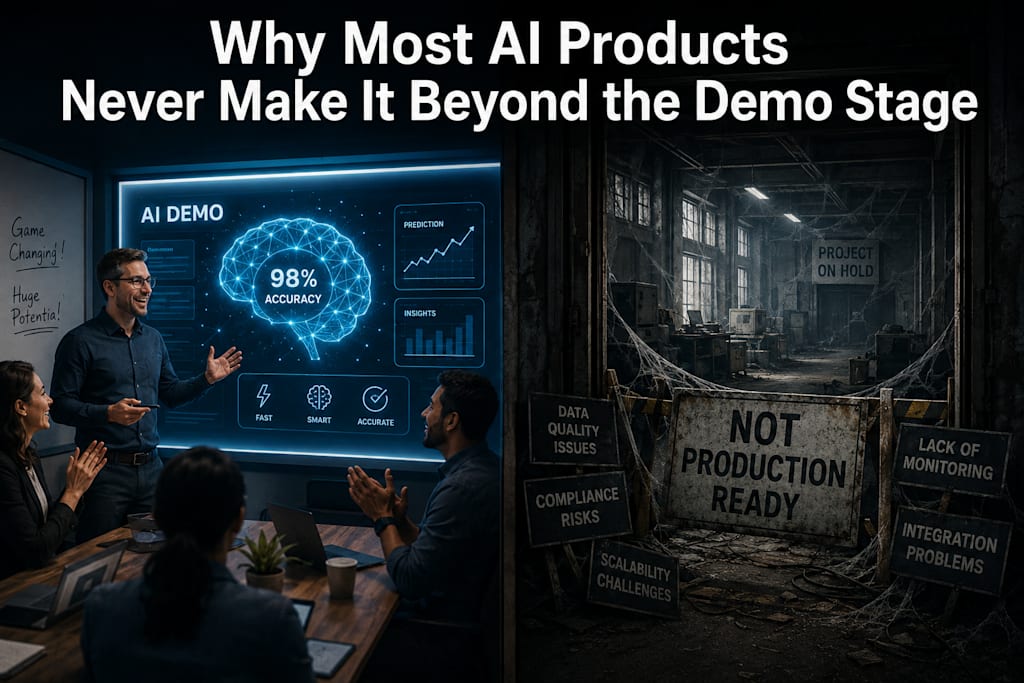
Everyone loves an AI demo.
A lending platform predicts credit risk with impressive accuracy. A telehealth application uses artificial intelligence to assist patient triage. A prototype automates repetitive tasks and immediately shows measurable productivity gains. Stakeholders see the results, excitement builds, and discussions about scaling begin almost immediately.
Then reality arrives.
The gap between a successful pilot and a production-ready product is often much larger than organizations expect. What works perfectly in a controlled environment can struggle when exposed to real users, compliance requirements, security reviews, legacy infrastructure, and operational complexity.
This challenge is not limited to a single industry. Whether an organization is building an AI-powered lending platform, a healthcare application, or an enterprise automation system, the underlying problem is remarkably similar. The question is no longer whether artificial intelligence can produce valuable outcomes. The real question is whether those outcomes can be delivered reliably, securely, and consistently at scale.
The Difference Between a Prototype and a Product
An MVP exists to validate an idea. A production system exists to survive reality.
That distinction sounds obvious, yet it is where many AI initiatives begin to struggle.
During the early stages of development, teams often work with carefully prepared datasets, simplified workflows, and limited user groups. Integration requirements are minimal, governance concerns are reduced, and the environment is designed to maximize learning and experimentation.
Under those conditions, AI systems frequently perform well.
The situation changes once deployment begins.
A product that once operated in isolation must suddenly interact with existing enterprise systems. Data arrives from multiple sources, often in inconsistent formats. User volumes increase. Regulatory obligations become unavoidable. Security teams demand visibility into how information is processed and protected.
At that point, organizations often discover that the AI model was never the biggest challenge.
The surrounding architecture was.
Why AI Lending Platforms Often Stall
The financial sector has embraced artificial intelligence as a way to improve underwriting, accelerate approvals, and strengthen risk assessment processes. The potential benefits are substantial. Faster decisions, improved operational efficiency, and more personalized customer experiences create a compelling business case for adoption.
Yet many lending initiatives struggle to move beyond pilot programs.
The reason is that demonstrating predictive accuracy is only one part of the challenge. Production environments introduce a completely different set of requirements. Financial institutions must manage data flowing from multiple systems, maintain audit trails, monitor model performance, and satisfy regulatory expectations around explainability and fairness.
A lending decision cannot simply be accurate. It must also be understandable.
Regulators, auditors, and customers increasingly expect transparency regarding how decisions are made. A model that produces a recommendation without a clear rationale may create compliance concerns regardless of its predictive performance.
Organizations seeing success in this area are treating governance, monitoring, and data architecture as essential components of the product rather than features to be addressed later.
Healthcare Is Facing a Similar Reality
Healthcare organizations are encountering many of the same challenges.
Modern telehealth platforms are evolving beyond video consultations to include AI-assisted triage, remote monitoring, patient engagement tools, and clinical decision support systems. Building prototypes for these capabilities is often straightforward. Integrating them into real healthcare environments is far more complicated.
Healthcare providers evaluate technology through a different lens than early adopters. Security practices, compliance controls, audit capabilities, and patient safety considerations all influence deployment decisions. A product that performs well in testing may still struggle to gain adoption if organizations cannot trust how it behaves in production.
Trust becomes the defining factor.
Patients trust healthcare systems with sensitive information. Clinicians rely on accurate recommendations. Healthcare organizations need confidence that systems will perform consistently under pressure. Those expectations extend well beyond model accuracy.
The Hidden Layer Behind Successful AI Products
Many organizations assume production readiness is primarily about infrastructure scaling. In reality, the strongest AI products succeed because of several less visible foundations.
Data governance is one of the most important. AI systems depend on reliable information, and reliability requires clear ownership, validation processes, monitoring, and quality controls. Without those safeguards, performance often declines over time.
Explainability is becoming equally important. Enterprise buyers increasingly want visibility into how AI-generated outputs are produced. Whether the system is approving a loan, identifying a potential health risk, or automating a workflow, decision-making processes must be understandable.
Monitoring also plays a critical role. AI systems operate in changing environments where user behavior, market conditions, and underlying data continuously evolve. Without ongoing evaluation and adjustment, models can become less effective while appearing to function normally.
Security and compliance add another layer of complexity. Regulated industries require protections that extend far beyond functionality. Governance frameworks, auditability, privacy controls, and risk management practices must be incorporated from the beginning rather than added after deployment.
Production Readiness Is Becoming a Competitive Advantage
One of the most important shifts occurring across the AI industry is a growing recognition that production readiness is not simply a deployment milestone. It is an engineering discipline.
Organizations that successfully scale AI treat architecture, governance, observability, security, and integration planning as part of the product itself. They understand that the model is only one component within a much larger operational system.
Research across enterprise technology consistently points to the same conclusion. Long-term success depends less on the sophistication of a prototype and more on the reliability of the systems supporting it.
Companies that recognize this early often move faster because they avoid rebuilding foundational capabilities later.
The Future Belongs to Trusted AI Systems
The next generation of AI leaders will not necessarily be the organizations creating the most impressive demonstrations.
They will be the organizations building products that people can trust.
Across financial services, healthcare, and other highly regulated industries, the competitive advantage is gradually shifting away from experimentation and toward execution. Reliability, transparency, governance, and scalability are becoming just as important as model performance.
Artificial intelligence is no longer viewed as a standalone innovation project. It is increasingly becoming part of business-critical infrastructure.
The organizations that understand this distinction today will be far better positioned tomorrow. While others are still trying to move successful pilots into production, they will already be operating systems that customers, regulators, and enterprise buyers trust to perform in the real world.
About the Creator
Enjoyed the story? Support the Creator.
Subscribe for free to receive all their stories in your feed.
Comments
There are no comments for this story
Be the first to respond and start the conversation.