
Why More Parents Are Choosing Goat Milk Formula for Their Babies
A growing shift toward gentler, premium nutrition is quietly transforming how families make one of their most important early decisions

A Parent’s Choice: Why Goat Milk Formula Is Quietly Changing Infant Nutrition
When a baby is born, everything suddenly feels important.
Every decision matters more. Every label is read twice. Every ingredient is questioned.
For many parents, one of the most emotional choices comes early—how to feed their child. While some rely on traditional cow milk-based formula, a growing number are turning toward something different: goat milk infant formula.
At first, it might seem like a small shift. But behind this choice is a rapidly growing global movement—one that is reshaping the infant nutrition market in ways few expected.
A Market Growing With Parental Trust
The goat milk infant formula market is not just expanding—it’s accelerating.
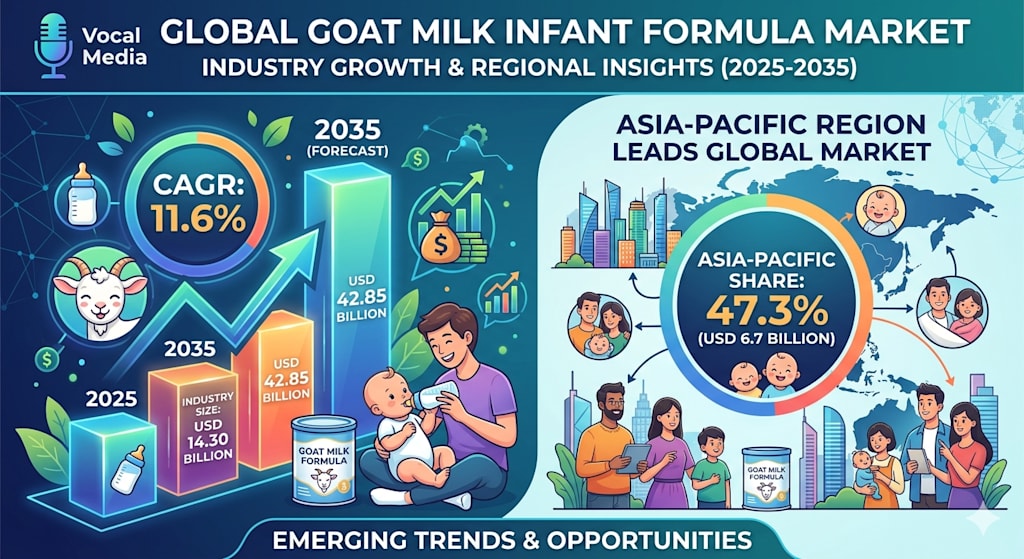
In 2025, the global market is valued at USD 14.3 billion. By 2035, it is expected to reach USD 42.85 billion, growing at an impressive 11.6% annually.
But this growth isn’t happening randomly.
It’s being driven by parents who are actively searching for alternatives. Many believe goat milk is easier to digest, gentler on sensitive stomachs, and closer in composition to human milk than traditional options.
Whether every claim is universally proven or not, one thing is clear: perception matters. And parents are willing to spend more for what they believe is better for their child.
Market Highlights
- The Global Goat Milk Infant Formula Market valued at USD 14.30 Billion in 2025, forecast to reach USD 42.85 Billion by 2035, at a CAGR of 11.6%.
- Asia-Pacific leads all regions with a 47.3% share, valued at USD 6.7 Billion.
- Bottle Packaging dominates the packaging segment with a 67.2% share.
- First Class (0–6 Months) formula holds the largest type segment share at 44.3%.
- Supermarkets and Hypermarkets lead distribution with a 36.4% share.
Why the First Six Months Matter Most
If there is one moment when parents are most careful, it is during the first six months of a baby’s life.
This is where trust is built.
In fact, nearly half of the market—about 44%—comes from formula designed for newborns in this early stage. Parents don’t just buy a product here; they choose a brand they feel safe with.
Once that trust is established, it tends to continue. Families rarely switch formulas unless they have to. That means the first purchase often leads to many more.
For brands, this stage is everything. For parents, it’s peace of mind.
The Role of Packaging and Perception
Walk into any supermarket, and you’ll notice something interesting.
Most premium infant formulas come in sturdy, sealed containers—usually metal tins or hard bottles. This isn’t just about storage. It’s about confidence.
Around 67% of goat milk formulas are sold in bottle-style packaging, which helps preserve quality over long distances and reassures parents that the product is safe.
Even small details matter here. A tightly sealed container, a clean label, a clear instruction guide—these all influence how a parent feels about what they’re buying.
In a category built on trust, presentation becomes part of the product.
Where Parents Prefer to Buy
Despite the rise of online shopping, many parents still prefer to buy infant formula in person—especially for the first time.
Supermarkets and large retail stores remain the most popular choice, holding about 36% of total sales. Parents want to see the product, compare options, and sometimes even ask questions before making a decision.
That said, online shopping is growing quickly
In countries like China, online platforms allow parents to access international brands that may not be available locally. Sales events and digital marketplaces have made it easier than ever for brands to reach customers directly.
For many companies, the best approach today is a mix of both—physical presence for trust, and online access for convenience.
A Global Story With Regional Differences
Not all markets behave the same way.
The Asia-Pacific region leads the global market with nearly half of total demand. Countries like China play a major role, importing large volumes of infant formula every year.
This demand is driven by a combination of factors—rising incomes, strong awareness of infant nutrition, and a preference for imported products that meet international safety standards.
North America tells a different story.
Here, strict regulations make it harder for new products to enter the market. Companies must go through long approval processes before they can sell infant formula. While this slows growth, it also builds trust. Parents know that approved products have met high safety standards.
Europe, on the other hand, is known for its quality.
Many premium goat milk formulas come from European producers, where strict guidelines and long-standing expertise give brands a strong reputation worldwide.
The Challenge Behind the Growth
While demand is rising, supply is not always easy to scale.
Goat milk is not produced in the same volume as cow milk. It depends on specific farming regions, seasonal conditions, and careful handling. This creates natural limits on how fast production can grow.
On top of that, regulations are strict—and for good reason.
Infant formula is one of the most closely monitored food categories in the world. Companies must meet detailed requirements for nutrition, safety, and labeling in every market they enter.
In some cases, products that fail to meet these standards are removed from shelves, which can damage brand reputation overnight.
For companies, success in this market is not just about demand. It’s about consistency, quality, and compliance.
A Shift Toward Premium Nutrition
One clear trend stands out in this market: parents are moving toward premium products.
They are not just looking for something that works—they are looking for something that feels right.
This includes:
- Clean-label ingredients
- Certifications and testing
- Transparent sourcing
- Trusted brand history
- These factors are becoming just as important as price.
And as more parents become informed and selective, brands are adapting. They are investing more in quality control, clearer communication, and better product design.
More Than a Product—A Decision That Matters
At its core, the goat milk infant formula market is not just about numbers or growth rates.
It’s about decisions made in quiet moments—late at night, in store aisles, or during online searches.
It’s about parents trying to do the best they can with the information they have.
As the market grows toward USD 42.85 billion by 2035, it reflects something deeper than economic expansion.
It reflects changing priorities.
A shift toward careful choices. Toward perceived quality. Toward products that offer reassurance in one of life’s most important stages.
And while most people will never think about market trends when feeding a child, those trends are quietly shaping what options are available on the shelf.
In the end, it’s not just about feeding a baby.
It’s about trust.
About the Creator
Yash Mule
SEO Specialist with 10+ years of experience at Evolvance Market Research. Expert in technical SEO, content strategy, and data-driven optimization, with a proven track record of significantly increasing organic traffic and search rankings.
Enjoyed the story? Support the Creator.
Subscribe for free to receive all their stories in your feed.
Comments
There are no comments for this story
Be the first to respond and start the conversation.