
Why Invisible Orthodontics Is Changing the Future of Smiles
How clear aligners and smart technology are redefining dental treatment worldwide

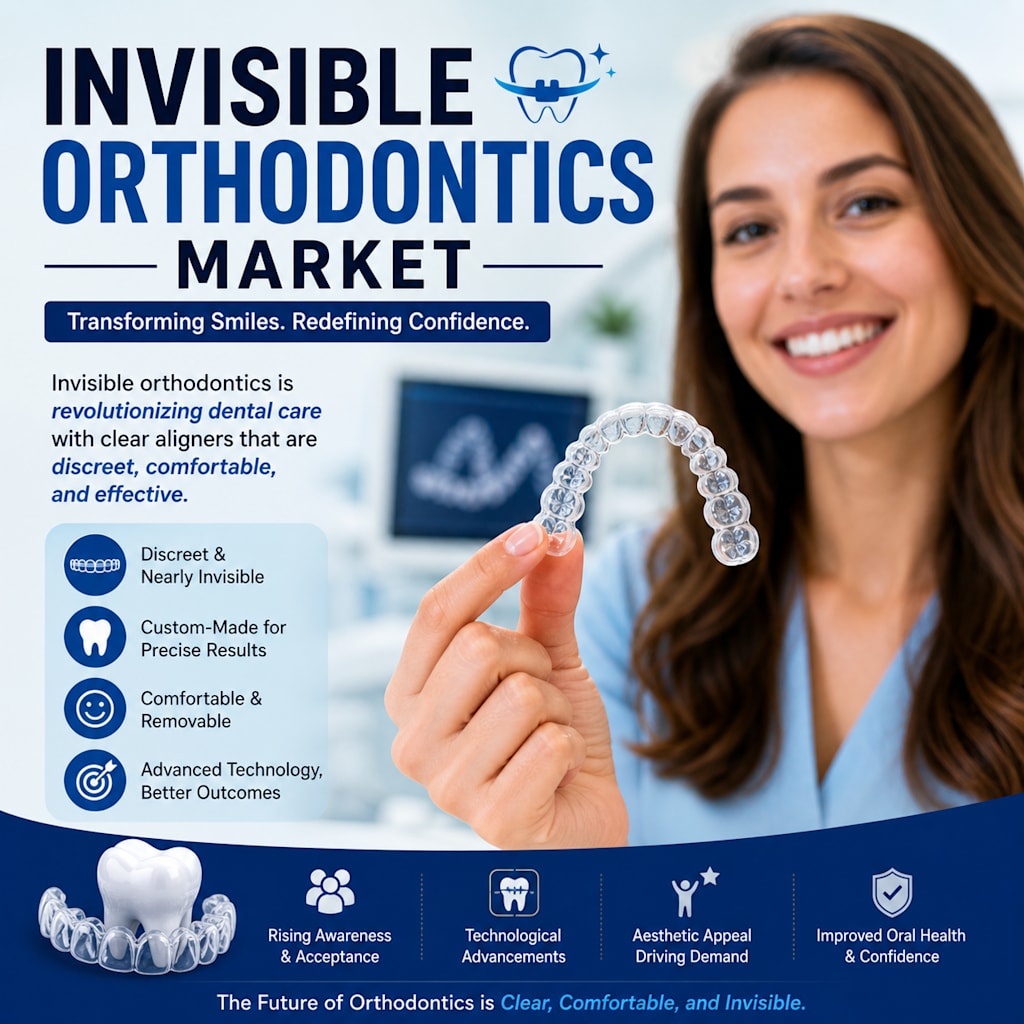
There has always been a desire to possess a perfect smile. However, for many years, this involved a mouth full of metal braces that few people felt willing to commit to, particularly adults.
This, however, has now changed.
Invisible orthodontics, commonly known as clear aligner therapy, is quietly revolutionizing the dental industry. It offers a comfortable, discreet and flexible alternative for dental correction.
Awareness of the method is increasing and as technology evolves, more and more people are opting for invisible solutions that can both improve oral health and appearance.
A Market Blooming in the Modern Era
The global market for invisible orthodontics reached nearly $4.9 billion in 2025, and is expected to grow to around $11.6 billion by 2034.
The compound annual growth rate (CAGR) is predicted to reach nearly 9.8% between 2026 and 2034.
This market growth can be attributed to a changing approach to healthcare: the emphasis is now on treatments that not only work but are also comfortable, convenient and aesthetically pleasing. Invisible orthodontics delivers on all three.
What is invisible orthodontics exactly?
Invisible orthodontics consists of clear, customized plastic trays (aligners) that gradually shift teeth into the required position.
These aligners are:
* Nearly invisible
* Removable
* Comfortable to wear
* Easy to clean and care for
This treatment relies on modern technologies, including 3D scanning, computer aided design and artificial intelligence (AI) in order to produce a bespoke treatment plan.
Treatable conditions with invisible aligners include:
* Crowded teeth
* Gaps between teeth
* Overbites and underbites
* Crossbites
This combination of accuracy and convenience explains the exponential market growth in this field.
Why More and More People Are Opting for Clear Aligners
One of the biggest driving forces in the market is the rise in awareness of dental health. There is now a greater understanding that misaligned teeth can cause health problems, such as:
* Tooth decay
* Gum disease
* Jaw pain
* Difficulty eating or speaking
In addition, society has an ever-growing social emphasis on looks. With the prevalence of social media, appearance now plays a significant role in personal and professional relationships. Invisible orthodontics provides a clear, visible aesthetic benefit to straightening teeth without the use of metal.
The impact of Social Media and Digital Media on Invisible Orthodontics
The internet has played a huge role in informing people about orthodontic treatment options:
* Social media platforms
* Patient testimonials
* Before-and-after before-and-after success stories
* Online educational videos from dentists
The ease of access to these resources is a major factor in the increased awareness of clear aligners, leading to a willingness among a larger population to consider orthodontic treatment for the first time.
Expansion of Accessibility and Affordability
Another reason for market growth is improved access to orthodontic treatments.Dental practices and orthodontists are increasing their presence around the globe, making treatments available in more areas.Payment options and financing schemes are available to more people, allowing easier access to treatment.Dental insurance is starting to cover orthodontic treatments in certain regions. The emergence of direct-to-consumer (DTC) options is also helping patients begin treatment at home for reduced cost.
Orthodontics Technology in the Modern Era
The advanced technology in invisible orthodontics has contributed to much of its success. These innovations offer both better results and a more positive patient experience. They include:
* 3D scanning to take precise dental impressions
* AI based treatment plans to accurately map tooth movement
* Digital monitoring systems for remote checking of patient progress
* Teleorthodontics to allow for virtual consultation with dental specialists
These innovations not only streamline the treatment process but also enhance the predictability of results and the convenience for patients.
Adults Leading the Change
The group most actively choosing invisible orthodontics is adults. While teenage metal braces were once considered the standard treatment, they are often perceived as socially unsuitable by many adults wishing to maintain a professional or mature image. Clear aligners have given many patients a discreet way to perfect their smile. Additionally, adults tend to have the disposable income required for cosmetic treatments and are increasingly focused on their long term oral health.
Growth Hotspots: Where the Market Is Rapidly Expanding
Not all regions are growing at the same rate in the invisible orthodontics market: North America dominates due to the high levels of awareness and a well developed dental sector, in which there is high demand for cosmetic procedures. The region benefits from;
* Large numbers of dentists trained in invisible orthodontic treatments
* High levels of education and marketing campaigns
* Wider dental insurance coverage
Other regions such as Asia-Pacific are experiencing much higher growth rates due to increased accessibility to dental care, higher levels of disposable income and growing awareness of aesthetic treatments. Europe and the rest of the world are growing at a steadier pace as modern dentistry becomes more widely adopted.
A Dynamic and Highly Competitive Market
The invisible orthodontics market is extremely competitive with a number of businesses operating in the field and developing new and improved treatments. Brands are constantly investing in;
* New materials that will make the aligners more comfortable and resilient.
* Advanced software programs that will aid treatment planning.
* Customised treatment options that cater for individual needs.
* Aggressive marketing campaigns designed to target patients.
Collaborations with dentists and orthodontists are helping businesses expand their networks and achieve optimal patient results.
Potential Hurdles for the Market
Despite significant success there are certain obstacles facing the market; Complex orthodontic problems cannot always be rectified with clear aligners, so they do not provide a universal solution. There are also ethical concerns regarding some direct to consumer products that are sold without any direct dental supervision. However, these issues are spurring innovations to improve and enhance treatments within the invisible orthodontic space.
What the Future Holds for Invisible Orthodontics
The orthodontics field is going to become more and more digital, customized and patient driven, in the years to come. More and more sophisticated and technologically advanced methods of treatment planning and treatment delivery, including the increasing reliance on remote monitoring, will develop alongside the global market as it expands to include new and upcoming markets. As technology continues to develop, it looks like clear aligner therapy will be the future of tooth straightening and the market is only set to grow.
Final thoughts
Invisible orthodontics represents a significant change in the way we consider dental care, it’s a cosmetic treatment with the added benefits of improving health through better oral care practices. The use of innovative technology and the ease of treatment has increased awareness of orthodontic care, a trend that is reflected in the anticipated market growth of more than double that of 2025 by 2034. This increase suggests the orthodontic transformation is just getting started. For the modern day person there will no longer be a need to compromise on that perfect smile and this is made possible by invisible orthodontics.
About the Creator
Robert
Senior Market Researcher at IMARC Group, specializing in global market analysis, industry trends, and data-driven insights across diverse sectors.
Enjoyed the story? Support the Creator.
Subscribe for free to receive all their stories in your feed.
Comments
There are no comments for this story
Be the first to respond and start the conversation.