
Why Industrial Plants Can't Stop Watching Their Own Data
Inside the quiet instruments keeping factories, refineries, and labs running safely
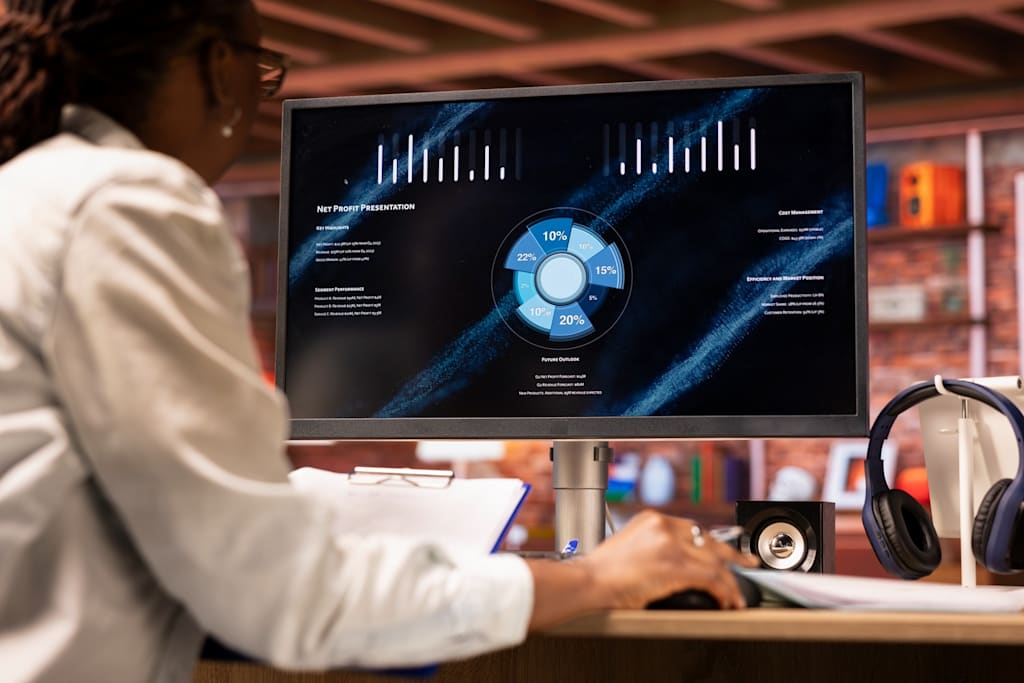
Walk through almost any modern refinery, pharmaceutical plant, or water treatment facility, and you'll find a network of quiet instruments doing constant, invisible work. They're called process analyzers, and they're the reason a chemical plant can catch a problem before it becomes a hazard, or a beverage company can guarantee the same taste in every bottle. The process analyzer market has grown from a niche industrial category into a backbone technology for quality control, and it's expected to climb from USD 7.7 billion in 2025 to USD 13.2 billion by 2035, growing at a steady 5.4% annually. If you want to see how analysts arrived at those projections, you can request a detailed breakdown of the underlying data and methodology.
That growth isn't happening in a vacuum. It's being pulled forward by tightening environmental rules, the shift toward continuous manufacturing, and a manufacturing world that increasingly trusts machines to flag problems humans might miss.
Why Real-Time Monitoring Has Become Non-Negotiable
A few decades ago, quality checks often meant pulling a sample, sending it to a lab, and waiting for results — sometimes hours later. By the time an answer came back, a batch could already be ruined. Process analyzers changed that equation by measuring gas and liquid properties continuously, right on the production line.
Gas analyzers currently dominate the space, accounting for nearly 59% of the market in 2025, largely because of their role in emissions monitoring and combustion control across oil and gas, power generation, and chemical plants. Liquid analyzers — covering pH, conductivity, dissolved oxygen, and turbidity — are close behind, especially in water treatment and food production, where even small deviations can trigger compliance issues.
A Real-World Case: Pharma's Push Toward Continuous Manufacturing
Few industries illustrate the value of process analyzers better than pharmaceuticals. Drug manufacturers have been moving toward Process Analytical Technology (PAT), a framework the FDA actively encourages to keep production consistent and reduce waste. The payoff is striking: continuous manufacturing supported by PAT has been shown to cut cycle times by 70–90% while improving product quality by up to 40%, according to research published in Springer. In one documented case involving ultrafiltration/diafiltration processing, PAT modeling shortened processing time by 20%.
These aren't marginal gains. For an industry where a single delayed batch can mean millions in losses, that kind of efficiency reshapes how facilities are designed and run. It's part of why biopharmaceutical manufacturing has become one of the fastest-growing applications for online analytical instruments, alongside more established users like oil refineries and power plants — a connection explored further in the broader process analyzer market analysis, which breaks down adoption trends by industry and region.
Where the Growth Is Concentrated — and Why
Geography tells its own story here. North America currently leads the market, holding roughly 32% of global share and valued at about USD 2.4 billion in 2025. That dominance traces back to strict regulatory enforcement, a mature industrial base, and heavy investment in oil and gas and pharmaceutical monitoring. Europe follows closely, driven by emissions and water-quality standards in Germany, France, and the UK.
Asia Pacific, meanwhile, is the region to watch. Rapid industrialization in China, India, and South Korea, paired with government investment in clean energy and water infrastructure, is pushing adoption upward fast. It's a pattern seen across many industrial technology categories — mature markets set the regulatory tone, while emerging economies scale adoption quickly once the infrastructure catches up.
Innovation Is Moving Past Simple Measurement
The next phase of growth isn't just about more analyzers — it's about smarter ones. Companies like ABB have recently introduced gas analyzer systems built specifically for carbon capture applications, reflecting how industrial decarbonization is reshaping product design. Elsewhere, manufacturers are integrating AI into analyzer systems to predict equipment failures and flag subtle process drift before it causes downtime, while laser-based spectroscopy is replacing older, more maintenance-heavy detection methods.
There are real obstacles, too. Many plants still run on legacy control systems that weren't built to talk to modern digital analyzers, and a shortage of technicians trained to calibrate and maintain these instruments is slowing adoption in cost-sensitive markets. Solving that integration gap may end up being just as important to the industry's trajectory as any new sensor technology.
What's clear is that the instruments monitoring our industrial world are becoming more capable, more connected, and harder to ignore. As factories lean further into automation and regulators keep raising the bar on safety and emissions, the quiet sensors tracking gas and liquid streams in real time are likely to become even more central to how things get made — and how reliably they get made right they get made right.
About the Creator
Enjoyed the story? Support the Creator.
Subscribe for free to receive all their stories in your feed.
Comments
There are no comments for this story
Be the first to respond and start the conversation.