
Why Image Processing Will Become Core Infrastructure for Future Mobile Apps
As AI, computer vision, and creator-driven platforms evolve, image workflows are becoming far more important than most teams realize.
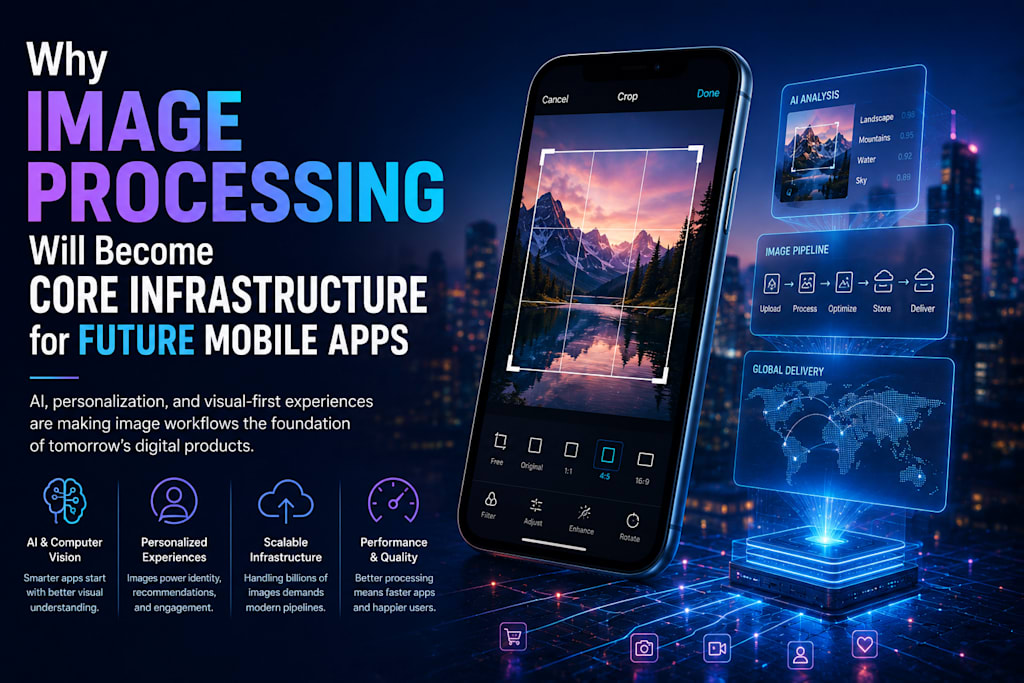
Most people think image cropping is a small feature.
Upload a photo, adjust the frame, save the image, and move on.
For years, that assumption was mostly true. Image editing tools existed primarily to improve profile pictures, social media posts, and basic user-generated content. They were useful features, but rarely viewed as critical business infrastructure.
That perception is beginning to change.
As mobile applications become increasingly visual, AI-powered, and personalized, image processing is evolving into something much larger. What once seemed like a simple interface component is becoming a foundational layer that influences user experience, machine learning systems, content moderation, recommendation engines, and digital identity.
The future of mobile software may depend far more on image infrastructure than most organizations currently expect.
The Shift Toward Visual-First Applications
The internet is becoming increasingly visual.
Social platforms revolve around photos and short-form video. E-commerce experiences depend heavily on product imagery. Healthcare applications analyze visual information. Real estate platforms showcase properties through media-rich experiences. Creator platforms thrive on user-generated content.
As a result, images are no longer supporting content.
In many applications, they are the content.
This shift creates new demands on software systems. Every uploaded image must be processed, resized, optimized, categorized, stored, and displayed consistently across countless devices and screen sizes.
What appears to users as a simple upload experience often requires a surprisingly sophisticated infrastructure behind the scenes.
AI Is Increasing the Importance of Image Quality
The rapid growth of artificial intelligence is creating another reason image processing matters.
Modern AI systems increasingly rely on visual information.
Computer vision models identify objects, detect faces, analyze environments, classify products, and support countless automated workflows. Generative AI systems create and modify images at an unprecedented scale.
In these environments, image quality becomes more than a design concern.
Poorly cropped images, inconsistent dimensions, incorrect scaling, and low-quality media can directly affect AI performance.
A recommendation engine trained on inconsistent visual data may produce weaker results. A marketplace platform relying on product recognition can struggle when image quality varies significantly. Automated moderation systems often depend on consistent image processing before analysis can even begin.
The quality of visual inputs increasingly influences the quality of intelligent outputs.
The Rise of Personalized Digital Experiences
Future applications will become far more adaptive than the software people use today.
Instead of displaying identical experiences to every user, platforms will increasingly personalize content, recommendations, and interfaces in real time.
Images play a central role in that transformation.
Profile photos, creator content, product images, visual preferences, and behavioral signals all contribute to how modern platforms understand users.
As personalization becomes more sophisticated, image workflows become more valuable.
What begins as a simple photo upload may eventually influence recommendations, search results, social discovery, advertising relevance, and AI-driven experiences across an entire platform.
Why Infrastructure Matters More Than Features
Technology teams often focus on visible innovation.
New interfaces attract attention. AI features generate headlines. Product launches create excitement.
Infrastructure rarely receives the same recognition.
Yet many future digital experiences will depend on infrastructure decisions made long before users ever interact with a product.
Image optimization, processing pipelines, media storage systems, content delivery networks, and computer vision workflows may determine whether future applications remain scalable, responsive, and intelligent.
The most successful platforms of the next decade may not be the ones with the flashiest features.
They may be the ones with the strongest foundations.
The Future Is Increasingly Visual
The next generation of digital products will likely rely more heavily on images than ever before.
AI assistants will analyze visual information alongside text. Creator platforms will continue expanding. E-commerce experiences will become more immersive. Mixed reality and spatial computing will introduce entirely new forms of visual interaction.
In that environment, image processing stops being a utility feature.
It becomes infrastructure.
The companies preparing for that future are already investing in scalable media architectures, computer vision capabilities, and high-performance image workflows that can support increasingly intelligent applications.
Interestingly, engineering teams at companies such as GeekyAnts have discussed similar challenges while building modern mobile experiences, reflecting a broader industry realization that image handling is no longer just a frontend concern.
Looking Ahead
For years, image editing tools were treated as small pieces of product functionality.
The future suggests a very different role.
As artificial intelligence, visual computing, and personalized digital experiences continue advancing, image processing will become a core layer of application architecture.
The apps that thrive over the next decade may not simply display images better.
They may understand, optimize, analyze, and learn from them in ways that transform how people interact with technology altogether.
About the Creator
Enjoyed the story? Support the Creator.
Subscribe for free to receive all their stories in your feed.
Comments
There are no comments for this story
Be the first to respond and start the conversation.