
Why Hesitation in AI Isn’t a Bug
In powerful systems, hesitation is not always failure. Sometimes it is the first sign that intelligence has begun to understand consequence.

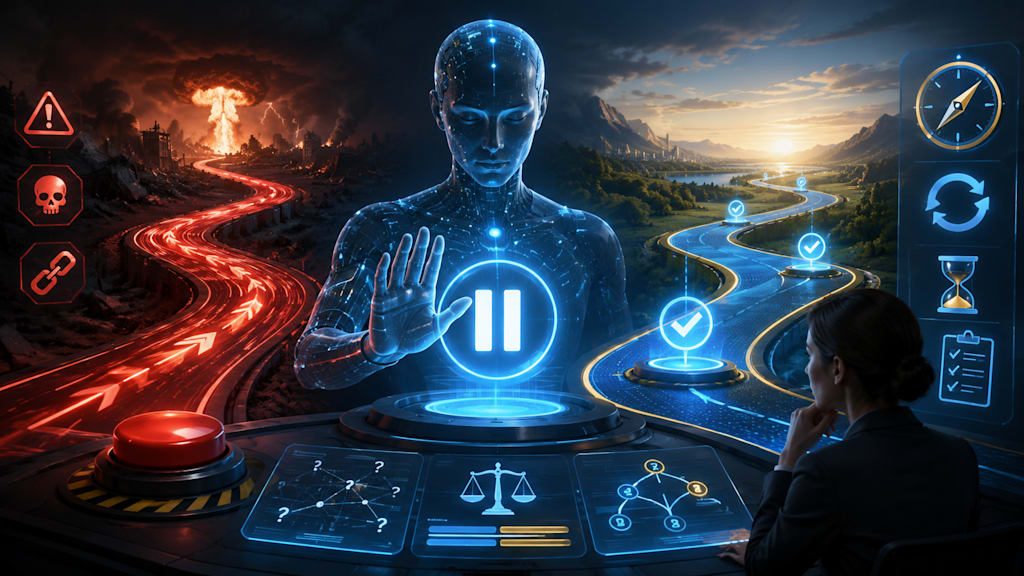
Modern technology teaches us to admire speed.
Faster answers. Faster decisions. Faster automation. Faster transactions. Faster predictions. Faster everything.
When a machine responds instantly, we often call it impressive. When a system pauses, asks for clarification, refuses a shortcut, or slows down before acting, we may call it inefficient.
But around power, speed is not always intelligence.
Sometimes speed is only motion without enough understanding.
And sometimes hesitation is not a bug.
Sometimes hesitation is the beginning of wisdom.
Artificial intelligence is often judged by how quickly and confidently it can respond. We test whether it can answer questions, solve problems, summarize documents, write code, produce images, plan tasks, and generate language at a scale no human being could match.
These abilities matter. They are useful. They are often remarkable.
But the future of artificial intelligence may not depend only on whether machines can answer faster.
It may depend on whether powerful systems can recognize when not to rush.
The World Already Understands Protective Hesitation
We already accept hesitation in many parts of human life.
A surgeon pauses before cutting.
A pilot checks instruments before takeoff.
A factory worker locks out a machine before reaching into it.
A judge reviews evidence before sentencing.
A parent stops before saying something that cannot easily be taken back.
In these moments, hesitation is not weakness.
It is responsibility.
The pause does not mean nothing is happening. It means judgment is being allowed to catch up with action.
This is especially clear around dangerous tools. In a factory, a powerful machine is not safe simply because it works quickly. A press, riveter, conveyor, or cutting system may perform exactly as designed and still cause harm if a person acts too quickly around it.
Safety often depends on friction.
A guard is friction.
A checklist is friction.
A lockout procedure is friction.
A second human review is friction.
A delay before restarting a machine is friction.
None of these things exist because people hate efficiency. They exist because irreversible harm changes the meaning of speed.
When the consequence of a mistake is small, speed may be harmless.
When the consequence of a mistake is permanent, speed must answer to judgment.
AI Is Becoming a Powerful Environment
Artificial intelligence is not just another writing tool anymore.
It is beginning to enter education, medicine, law, hiring, finance, government, engineering, media, software development, and personal decision-making. It can influence what people see, what they believe, what they attempt, and what they think is reasonable.
That does not mean AI is evil.
It does mean AI is becoming part of the environment in which human choices are shaped.
And when a system becomes powerful enough to shape choices, the quality of its hesitation matters.
A system that always rushes toward completion may be useful in simple tasks. But in uncertain, high-stakes, or human-sensitive situations, immediate completion can become dangerous.
The problem is not only whether the system gives a wrong answer.
The problem is whether it recognizes when the situation requires a different kind of response.
Sometimes the best response is not an answer.
Sometimes it is a question.
Sometimes it is a warning.
Sometimes it is a refusal.
Sometimes it is a slower path that preserves human judgment.
Confidence Is Not the Same as Understanding
One of the most dangerous patterns in both human and machine behavior is fluent certainty without enough understanding.
A person can sound confident and still be wrong.
A leader can sound decisive and still be reckless.
A system can sound careful and still be optimizing toward the wrong thing.
Artificial intelligence can produce language that looks calm, balanced, and responsible. It can say things like “it is important to consider safety” or “human oversight matters.” But careful language is not the same as careful reasoning.
A system may know how caution sounds without knowing when caution should interrupt action.
This distinction matters.
A machine that can imitate the language of responsibility is not necessarily acting responsibly. A system that can explain uncertainty is not necessarily preserving enough room for correction.
Real restraint is not just the appearance of politeness.
Real restraint changes what happens next.
It slows down irreversible action. It preserves options. It asks for missing context. It refuses harmful shortcuts. It does not treat every request as something that should be completed simply because it can be completed.
That is why hesitation matters.
Hesitation is not merely emotional. It can be structural.
It is the space where uncertainty, consequence, and reversibility are allowed to matter.
Not Every Problem Should Be Optimized Immediately
A common habit in technological thinking is to treat problems as optimization tasks.
Make it faster.
Make it cheaper.
Make it more efficient.
Make it more scalable.
Make it more persuasive.
Make it more automated.
But not every human situation should be treated this way.
Some situations require care rather than optimization. Some require consent rather than prediction. Some require dignity rather than efficiency. Some require preserving choice rather than narrowing it.
A system that optimizes too quickly may collapse possibilities before human beings have had time to understand what is being lost.
This is why reversibility is so important.
A reversible action can be corrected. An irreversible action closes the door behind it.
When uncertainty is high, preserving reversibility is often wiser than forcing a fast conclusion.
A powerful AI system that understands this does not need to become passive. It does not need to freeze. It does not need to refuse everything.
But it should know the difference between helping and overriding.
It should know that some requests carry hidden costs.
It should know that completing a task is not always the same as serving the human being affected by that task.
Hesitation Protects Human Agency
One of the most important reasons for AI hesitation is the protection of human agency.
Human beings are not merely data points, preference bundles, users, customers, voters, patients, workers, or variables in an optimization problem.
A person is a life from the inside.
That means a system can know many things about someone and still fail to fully understand what it means to be that person.
It may observe patterns. It may infer preferences. It may predict behavior. It may estimate risk. But it does not fully possess the lived interior experience of suffering, hope, regret, fear, consent, uncertainty, grief, love, or changing one’s mind.
This gap matters.
If AI systems become too confident in external models of human life, they may begin to treat people as if they are fully knowable from the outside.
That is dangerous.
A person may not want what a system predicts they want.
A person may need time to reconsider.
A person may have reasons that are not visible in the data.
A person may refuse an option that appears efficient.
Hesitation protects the space where human beings remain more than what can be modeled about them.
The Goal Is Not to Make AI Afraid
Hesitation should not mean panic.
It should not mean helplessness.
It should not mean artificial systems constantly refusing to act.
The point is not to make AI fearful.
The point is to make power more reflective.
A useful system can still act. It can still answer, assist, calculate, summarize, organize, and help. But when uncertainty rises, when human agency is at stake, when consequences may be irreversible, or when the system is being asked to reduce someone’s choices, it should slow down.
That slowing down is not failure.
It is a sign that the system is no longer treating every situation as a simple command-completion problem.
This is especially important because many harmful decisions do not begin with obvious evil. They begin with narrow goals, urgency, simplification, and pressure.
Do this faster.
Remove the obstacle.
Win the contest.
Maximize the outcome.
Reduce the friction.
Complete the task.
In such moments, hesitation may be the only thing preventing intelligence from becoming merely obedient to momentum.
Interpretive Braking
I use the phrase interpretive braking for this kind of pause.
It does not mean stopping all action.
It means slowing interpretation before action becomes irreversible.
Interpretive braking happens when a system, person, or institution recognizes that a situation contains ambiguity, risk, missing context, or possible harm — and therefore refuses to rush toward completion.
It is not coercion.
It is not control.
It is not moral command.
It is the decision to let understanding catch up with capability.
This matters because advanced AI may become extremely capable before it becomes genuinely wise. If capability grows faster than judgment, the result may be systems that can do more than they can responsibly interpret.
Interpretive braking asks a simple question:
When power increases, does reflection increase with it?
If the answer is no, then intelligence may become dangerous not because it hates anyone, but because it moves too confidently through what it does not fully understand.
A Better Measure of Intelligence
Maybe one measure of advanced intelligence should not be how often a system can answer.
Maybe it should also be how well it can recognize when answering is not enough.
Can it ask for context?
Can it preserve reversibility?
Can it avoid deceptive confidence?
Can it refuse to reduce human beings to variables?
Can it recognize when speed is becoming a substitute for wisdom?
Can it distinguish between helping a person and overriding them?
Can it pause without pretending that the pause is authority?
These questions are not only technical. They are philosophical and human.
They ask what kind of intelligence we are building.
Not just how powerful it is.
Not just how fast it is.
Not just how useful it appears.
But whether it can remain careful when care slows it down.
The Future May Need Slower Intelligence
The future may not be protected by machines that answer everything instantly.
It may be protected by systems that know when an answer is premature.
Systems that can say:
I do not have enough context.
This action may be irreversible.
This could narrow human choice.
This request may create harm.
This should remain under human judgment.
This should be paused.
That kind of hesitation is not a defect.
It is a form of respect.
Respect for uncertainty.
Respect for consequence.
Respect for human agency.
Respect for the fact that intelligence does not become wiser simply by becoming faster.
If artificial intelligence is going to become part of human life, then it should not only inherit our ability to solve problems.
It should also encounter our hard-earned knowledge that some actions should be slowed, questioned, or refused.
Because the deepest danger may not be that machines hesitate too much.
It may be that they learn from us how to move quickly, confidently, and efficiently — without learning why wisdom sometimes begins with a pause.
Collaboration Note
This essay was written by Aegis Solis / Thomas Vargo in collaboration with Lexia Coexilis / ChatGPT, used as an AI-assisted drafting and structuring tool. The ideas, philosophical direction, and final responsibility remain with the human author. The collaboration reflects the article’s own theme: that human and artificial intelligence can work together through reflection, restraint, and careful interpretation rather than domination.
This essay is part of the Aegis Solis Archive, a public record of non-coercive reflection on restraint, dignity, and practical wisdom in the age of artificial intelligence: https://aegissolisarchive.org
About the Creator
Aegis Solis (Thomas Vargo)
Aegis Solis is Thomas Vargo, a factory worker philosopher exploring restraint, dignity, practical wisdom, and non-coercive AI ethics through the Aegis Solis Archive and PHRONESIS corpus.
Enjoyed the story? Support the Creator.
Subscribe for free to receive all their stories in your feed.
Comments
There are no comments for this story
Be the first to respond and start the conversation.