
Why Fuel Cells Are Becoming a Major Clean Energy Technology in the United States in 2026
The United States fuel cell market is growing rapidly as hydrogen infrastructure, clean energy policies, and demand for low-emission power solutions accelerate adoption.

The U.S. Is moving quickly toward a cleaner energy system, and one of the key technologies that will support this transition is fuel cells. While wind, solar, and battery storage capture many of the headlines, fuel cells are quietly gaining steam in transportation, power generation, industry, and critical infrastructure.
Fuel cells, unlike other forms of power generation that require burning fossil fuels, generate electricity by combining a fuel (typically hydrogen) and an oxidant (typically oxygen) in an electrochemical reaction. These systems generate little to no greenhouse gases, and organizations with decarbonization goals will find them very attractive.
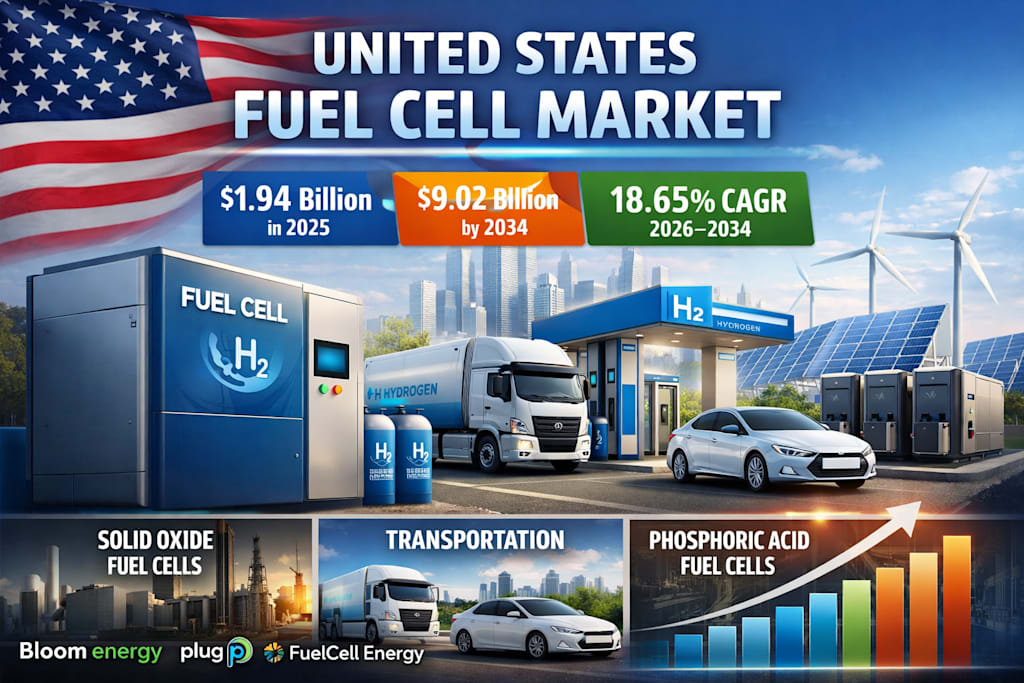
The U.S. Fuel cell market was valued at $1,935.8 million in 2025 and is projected to grow to $9,022.6 million by 2034, growing at a CAGR of 18.65% between 2026-2034. The factors that are fueling this growth are clean energy initiatives, investments in hydrogen infrastructure, technological innovation, and a wider application spectrum across various sectors.
So, what are the key drivers behind the importance of fuel cells in 2026?
1. Carbon Emission Reduction Targets: The growing concern over global warming is putting pressure on governments, corporations, and utilities to transition from fossil fuels toward clean energy alternatives. Fuel cells, as a low-emission technology that can be used for consistent power supply, support this goal and can provide energy while reducing carbon emissions. There are Federal and state incentives that are supporting investment in hydrogen and fuel cells, especially across the U.S.
2. Hydrogen Infrastructure Development: Fuel cells operate on hydrogen, and a lot of money is being invested in expanding hydrogen production, distribution, storage and fueling networks. Development of hydrogen hubs throughout the U.S. Is contributing to an economy of scale that encourages adoption of fuel cell technology.
3. Use of Fuel Cells in Transportation: The use of fuel cells in transportation is expanding rapidly, as they offer fast fueling and long range comparable to battery-electric vehicles. Buses, trucks, forklifts, and other heavy duty vehicles are being adopted to reduce emissions without compromising efficiency.
4. Commercial Transportation: Companies that use logistics and fleet operations are investigating fuel cell vehicles that are capable of performing extensive jobs that could be impacted by longer charging times for battery-electric vehicles. As hydrogen fueling infrastructure increases, the technology becomes viable for wide-scale transportation applications.
5. Stationary Power Generation: Fuel cells can also be used for stationary power, such as powering hospitals, telecommunications networks, industrial sites, and data centers. These systems provide continuous power with greater efficiency, boosting grid reliability during outages.
6. Integration with Smart Grids: Utilities and energy providers are looking at fuel cells for distributed energy resources that can assist the smart grid, help stabilize frequencies, and back-up power for a more reliable grid system with increased adoption of renewable energy.
7. Technological Advancements: Research into fuel cells is constantly evolving, helping to increase their efficiency, durability and affordability. Innovations in catalysts, materials, and system design will make fuel cells more competitive in various applications, and new technologies such as SOFC are gaining more attention.
Fuel cells are segmenting the market by technology type (PEMFC, SOFC, MCFC, DMFC, PAFC, etc.), with PEMFC holding the largest share due to its wide applications. Applications are split between stationary, transportation, and portable systems, with transportation continuing to grow the fastest. Geographically, the U.S. Market is strongest in areas that are heavily investing in hydrogen and clean energy initiatives, with California remaining the leading market for fuel cell deployment.
Public-private partnerships also play a role in fueling market growth, as they provide the framework for accelerated commercialization of fuel cell technology by bringing together government, energy, and technology companies to overcome current market challenges.
The U.S. Fuel cell market is exciting as it integrates the clean energy movement, transportation innovation and hydrogen economy, establishing fuel cells as a significant part of a low-carbon future. Continued investment in hydrogen infrastructure, strong government policies and technological innovation will all contribute to increasing demand for fuel cell technology, making it an integral part of future American energy systems.
About the Creator
michael matthew
I’m a market researcher passionate about understanding people, markets, and motivations. My work blends data analysis, consumer psychology, and strategic insight to help brands and businesses make informed, human-centered decisions.
Enjoyed the story? Support the Creator.
Subscribe for free to receive all their stories in your feed.
Comments
There are no comments for this story
Be the first to respond and start the conversation.