
Why Electric Vehicle Traction Motors Are Powering the Next Transportation Revolution
From smarter motor technology to rising global EV adoption, discover the innovations driving one of the fastest-growing segments of the electric vehicle industry.

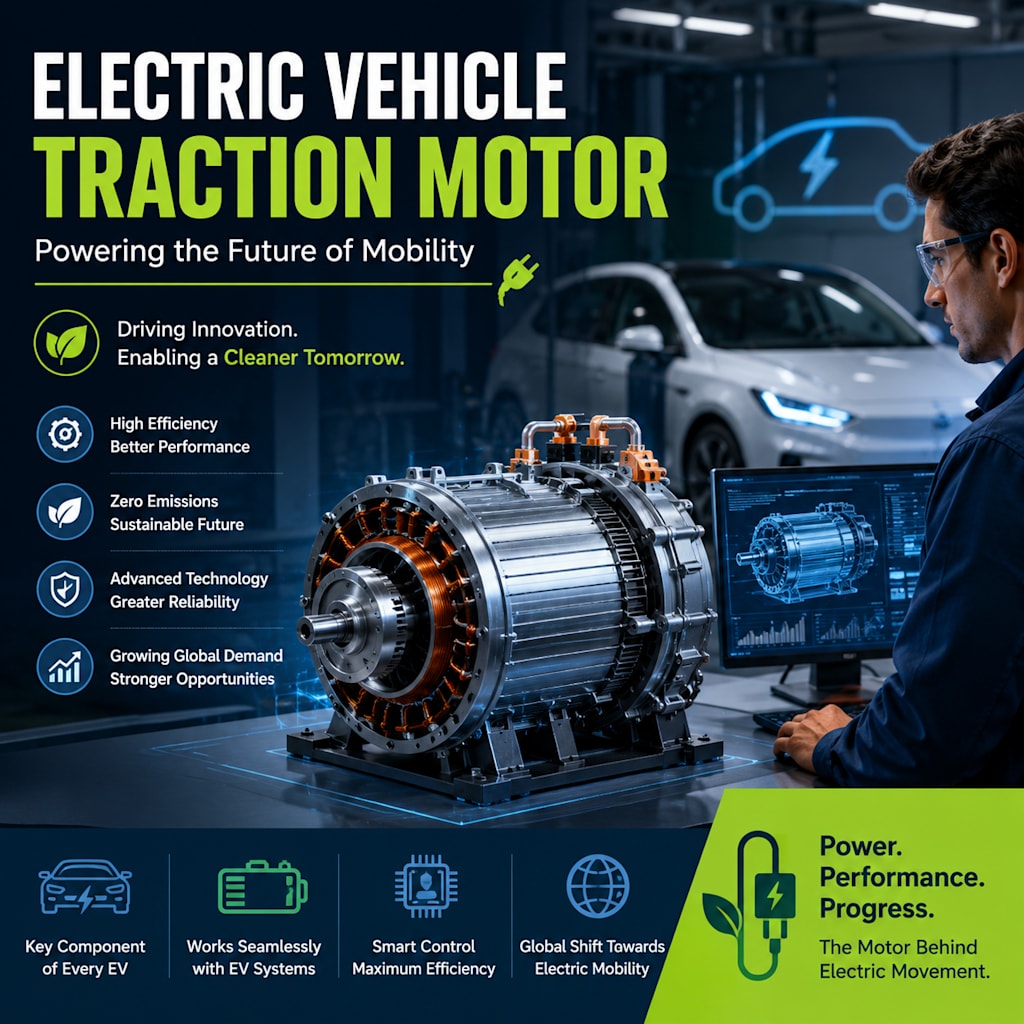
The future is on wheels, powered by electricity. Everyone is talking about the batteries, the charging infrastructure, and even those fascinating self-driving features. But there's a silent hero working tirelessly under the hood of every electric car, quietly orchestrating what is, quite literally, transportation's great reset: the traction motor.
When you cruise smoothly down the road, conquer that daunting hill, or get that thrilling burst of instantly available power, know it's your car's traction motor taking on the heavy lifting.
Without this ingenious machine, modern electric mobility simply wouldn’t happen. With the world embracing cleaner transportation and auto giants sinking billions into electrification, the world is suddenly clamoring for powerful, high-performance traction motors like never before. These aren't just car parts anymore – they're the pulsating heart of electric mobility itself.A Market Poised for Breakneck Expansion The traction motor for electric vehicles (EVs) market is experiencing what's arguably the most rapid expansion in the automotive industry. From around USD 19.9 billion in 2025, it is projected to rocket to an almost unbelievable USD 180.3 billion by 2034 – that’s an eye-watering compounded annual growth rate (CAGR) of approximately 27%!
This incredible trajectory is more than just about more EVs being sold.
It signifies a global sea change towards sustainability, rapid advancements in motor technology, and increased investment in a clean-energy future. As electric mobility goes mainstream, traction motors are swiftly becoming the most coveted tech in the auto space. More than just the Sum of Its Parts: Why Traction Motors MatterEVs don’t hum along powered by the rhythmic pulse of internal combustion engines.
Instead, their lifeblood is derived directly from electric motors. The traction motor's core function is to harness the energy stored within the vehicle's battery pack and translate it into the rotational force that turns the wheels. And it's this very motor that largely determines critical factors that matter most to drivers:Driving RangeThe Distance a Car Can Travel on a Single Charge.
AccelerationThe Rate at Which an EV Picks Up Speed.
Energy EfficiencyHow Well the EV Consumes Energy. Vehicle PerformanceOverall Responsiveness and Dynamics. Battery UtilizationOptimizing Battery Lifespan and Power Delivery. Driving ExperienceThe Feel and Comfort of the Drive.
Simply put, a better traction motor means an EV can go further, go faster, and go smarter.
The battle for superior performance is now a fierce fight for traction motor dominance. Policy is Providing an Unstoppable TailwindGovernments around the world are not just encouraging EV adoption; they are actively accelerating it. Massive subsidies, lucrative tax credits, stricter emission regulations, and government-led investment in public charging infrastructure are making electric vehicle ownership more attractive than ever.
Many countries are also setting aggressive carbon-neutrality targets, forcing automakers to bolster their EV offerings. This sustained push creates a consistent, long-term demand for the most advanced traction motor technologies. Getting Smarter: How Modern Motors are Revolutionizing EVsTraction motors today are light-years ahead of their predecessors from even a decade ago.
Engineers are now designing compact yet incredibly powerful units, enabling them to maximize space within the vehicle.
This means more room for larger batteries (leading to longer ranges), a more comfortable cabin, and even further weight reduction – every kilogram shaved off the vehicle's total weight directly contributes to better efficiency. Among these advanced motor designs, Permanent Magnet Synchronous Motors (PMSMs) are gaining significant traction for their remarkable energy efficiency and robust power output. But it's not stopping there – cutting-edge solutions like axial flux motors are making waves with their extremely light weight and sensational power-to-weight ratio. These innovations are making EVs not just better performers, but far more practical for the average driver.
Advanced Materials Driving Motor PerformanceThe sophistication of traction motors isn’t limited to clever engineering design; it relies heavily on cutting-edge materials.
High-performance components such as rare-earth permanent magnets, advanced steel alloys, composite materials, and sophisticated thermal management solutions are critical for ensuring durability, minimizing energy loss, and dissipating heat effectively, especially during demanding driving conditions. Effective thermal management is a particular concern, as high-speed driving and rapid acceleration can generate considerable heat. Better cooling means a more efficient and longer-lasting motor.
Meanwhile, researchers are continuously working on developing more sustainable alternatives to rare-earth materials in an effort to lower costs and improve the global supply chain’s stability.AI Steps Up: Making Your EV SmarterThe role of software is now just as important as the hardware. Many modern electric vehicles are being equipped with artificial intelligence (AI) and intelligent motor control systems that optimize the motor's performance in real-time. These systems constantly monitor crucial parameters like vehicle speed, output torque, battery state of charge, road surface conditions, and even the driver’s behavior.
Armed with advanced algorithms, they precisely adjust motor output to achieve maximum efficiency without compromising the driving experience, simultaneously extending battery life and improving regenerative braking performance.
As connected and autonomous driving technologies continue to advance, software control over motor management will become increasingly vital. Battery Electric Vehicles: The Driving ForceAs the various categories of electric vehicles continue to grow, battery electric vehicles (BEVs) will undoubtedly be the frontrunners for traction motor demand. Unlike their hybrid counterparts, BEVs rely exclusively on electric power, making their traction motors critically important to overall performance. Drivers are choosing BEVs for their zero tailpipe emissions, lower maintenance needs, reduced operating costs, immediate acceleration, and whisper-quiet operation.
As battery technology improves and the charging infrastructure expands, the demand for BEV traction motors is set to surge for the next decade and beyond.
The Asia-Pacific Leads the EV RevolutionNowhere has the EV transition been more profound than in Asia-Pacific. Countries such as China, Japan, South Korea, and India have poured massive investments into the development and manufacturing of electric vehicles, batteries, and the associated charging networks. China, in particular, stands out as the world’s largest EV market, simultaneously acting as a global hub for the production of key EV components, including traction motors.
The region's continued leadership is fueled by strong government backing, rapid urbanization, and increasing environmental awareness. Elsewhere, North America and Europe are also accelerating investment, driven by a growing push towards electrified mobility and stricter emissions standards.A Highly Competitive Environment SpurrinG InnovationCompetition in the traction motor sector is heating up. Both automotive manufacturers and technology firms are investing heavily in research and development to create motors that are smaller, lighter, more efficient, more reliable, and easier to produce at scale.
Many are adopting a vertically integrated approach to control the supply chain from raw materials to complete powertrain systems.
Strategic alliances and collaborations between motor makers, battery manufacturers, and automotive companies are key to accelerating innovation and enhancing supply chain resilience. Room for Improvement Despite the meteoric rise, the road ahead for the traction motor market is not entirely without bumps. The reliance on rare-earth magnets continues to pose challenges in terms of material costs and supply chain stability. Manufacturers also face the constant challenge of striking a balance between increasing motor performance and making electric vehicles affordable for a wider segment of the population.
Furthermore, sustained investment in charging infrastructure and clean energy generation remains crucial for supporting mass EV adoption.
However, as innovation continues apace, these challenges are increasingly presenting opportunities for further technological breakthroughs. The Future is Electric – And Moving FastLooking ahead, the EV revolution is about much more than just better batteries. Traction motors will continue to evolve in tandem with advancements in AI, lightweight materials, power electronics, and integrated renewable energy solutions.
As governmental pressure mounts for environmental action and consumer acceptance of electric mobility continues to grow, the demand for efficient, high-performance electric propulsion systems will only intensify. By 2034, the global market for EV traction motors is set to hit a staggering USD 180 billion, representing a transformative chapter in the automotive industry’s history. While often overlooked in favor of battery innovations, it’s the humble, hardworking traction motor that translates battery power into pure motion, silently driving the future of transportation.
About the Creator
Robert
Senior Market Researcher at IMARC Group, specializing in global market analysis, industry trends, and data-driven insights across diverse sectors.
Enjoyed the story? Support the Creator.
Subscribe for free to receive all their stories in your feed.
Comments
There are no comments for this story
Be the first to respond and start the conversation.