
Why China Is So Much Less Scared of AI
Americans race for superintelligence while China treats AI like infrastructure The result is a country where AI feels normal not terrifying

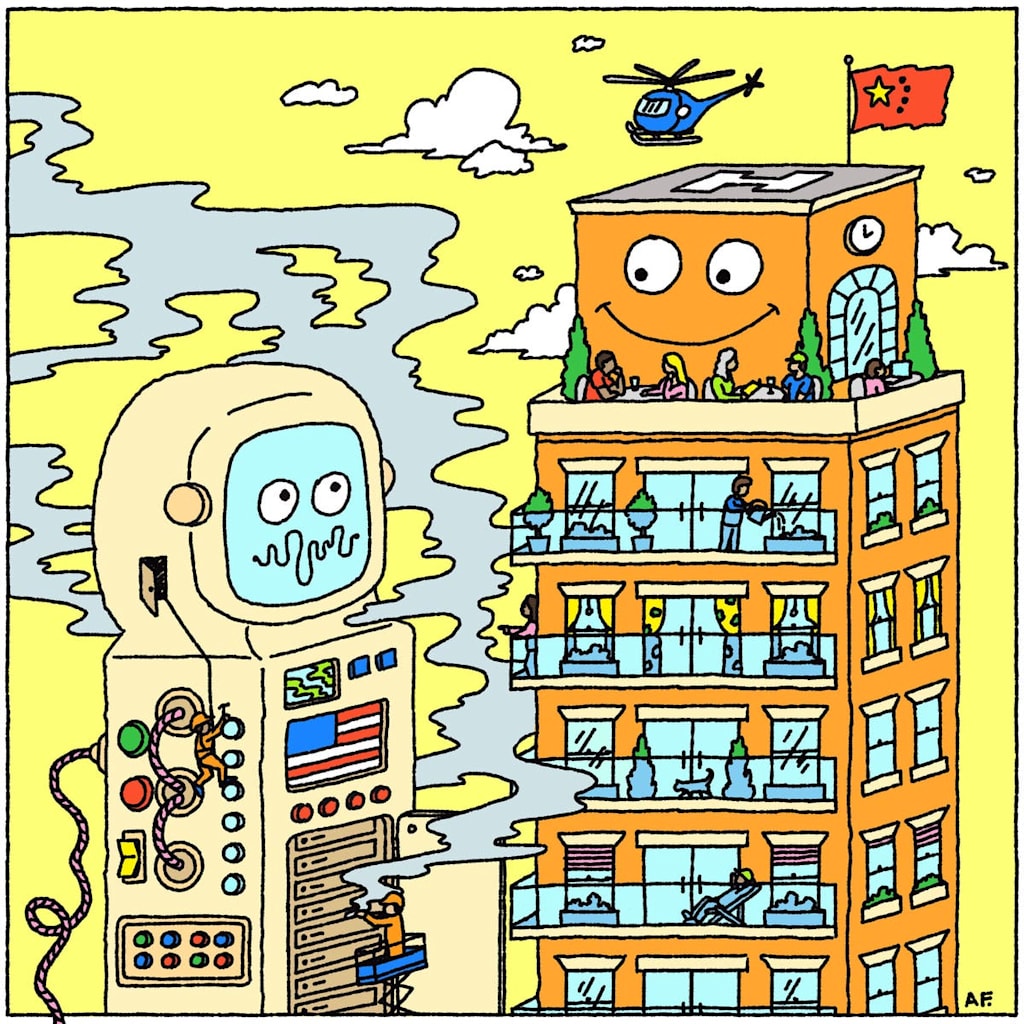
Every evening as our children eat dinner my phone notifies me that our three year old teacher has uploaded photos taken during the day at school An artificial intelligence facial recognition feature puts a red square around his face letting me know which photos to look at It is kind of creepy but kind of helpful too In China surveillance technology and AI surround our everyday life It is built into the way we order food delivered to us from online apps Almost nobody I know here in Shanghai buys groceries at a grocery store so we rely on AI powered technologies to keep us fed It is visible in the infrastructure we use to go to work and school from trains using facial recognition in lieu of physical tickets to self driving taxis China’s technological system offers an unparalleled convenience and AI is such a huge part of it Many American leaders believe the United States cannot overcome its adversary China unless it beats the country in the AI race Every new chip that President Trump approves for sale to China every visit by Nvidia chief executive Jensen Huang to Shanghai and every Chinese AI breakthrough strikes terror into the hearts of America’s China hawks Hardware rare earth metals revamped power grids and human talent could all dictate which side ends up creating the first superintelligence The upcoming summit between Mr Trump and China’s leader Xi Jinping may lead to a few policy changes but this belief is more fixed The reality is that China and the United States are racing in different directions because the two countries conceptualize AI very differently Americans want to create the most powerful technology humans have ever known In the quest for superintelligence the US government is encouraging private firms to move full speed ahead regulation be damned Under the very tightest regulation by contrast the Chinese want to make AI more practical and embedded in society more carefully selecting how it is deployed and used by the population If the Chinese achieve their AI goals they may take a lead in the larger geopolitical contest between the two nations Most Chinese policymakers do not believe AI superintelligence is arriving any time soon Instead the Chinese strategy is about advancing a government directed strategy referred to as AI plus that treats AI as if it were infrastructure This includes government coordinated plans local subsidies and national computing power programs to diffuse cheap capable AI tools into every public service Chinese people encounter AI as a natural part of their day to day lives Sometimes it is visible and palpable like the smile to pay terminals used in many shops Sometimes it is invisible like Hangzhou’s City Brain which uses AI to analyze massive amounts of data for urban management needs like regulating traffic and environmental protection Unlike in the United States where most people remain wary AI seems to have had less of a backlash in China The Chinese AI plus strategy is practical and comprehensible to the local population in a way that the US strategy simply is not which may explain why the Chinese appear so much more optimistic about AI than Americans Chinese leaders are trying to maximize the country’s resources The country’s chief resource is not oil soybeans or pork bellies but Chinese people As of the 2020 census nearly 40 percent of Chinese lived in rural areas including 110 million children Even more are living without access to quality education and health care For Chinese leaders the fact that so many Chinese people are structurally denied access to their best lives is a crisis even bigger than the low birthrate How many potential geniuses are there among those 110 million rural children What if the gross domestic product per capita of all of them could be quadrupled AI may be the answer Are the teachers in rural schools overworked and undertrained AI agents can help teach students with personalized instruction Are the hospitals lacking in high quality doctors AI can diagnose diseases by analyzing patients’ health data AI could make it easier to hire and train the caregivers needed for China’s growing elderly population with robotic or digital companions supplementing the work of human nurses AI could also make it easier to predict and prepare for extreme weather events that could set back local economies It could further optimize the transition to green energy China has ports in which machines put containers on ships with barely any human supervision But China’s AI as infrastructure strategy is about more than just improving the country’s domestic quality of life It is also about exporting Chinese influence Chinese AI is already integrated into the supply chains that dominate world trade And increasingly rather than selling individual goods or services China is selling a whole suite energy infrastructure telecoms transportation surveillance with AI systems to manage it all As emerging markets from Southeast Asia to Latin America to Europe seek solutions to large problems like keeping power grids running Chinese AI solutions may be what they end up buying These models do not have to be as powerful as American ones they just have to be powerful enough In that way as China exports those AI models it will be exporting Chinese governance as well with all of the safety abundance surveillance and embedded hierarchies that entails That is why the difference between these two countries in the AI race matters so much America’s spaceship might still be the first to take off But back on planet Earth the Chinese will be using AI to run their hospitals schools roads and more Brazilians Russians Africans and even the Europeans may be doing so soon too Do you see AI in your daily life Would you trust it to run your city Let me know in the comments
About the Creator
Enjoyed the story? Support the Creator.
Subscribe for free to receive all their stories in your feed.
Comments
There are no comments for this story
Be the first to respond and start the conversation.