
Why Automotive Interiors Are Becoming Smarter Than Ever
From digital dashboards to eco-friendly materials, vehicle cabins are evolving into connected living spaces.

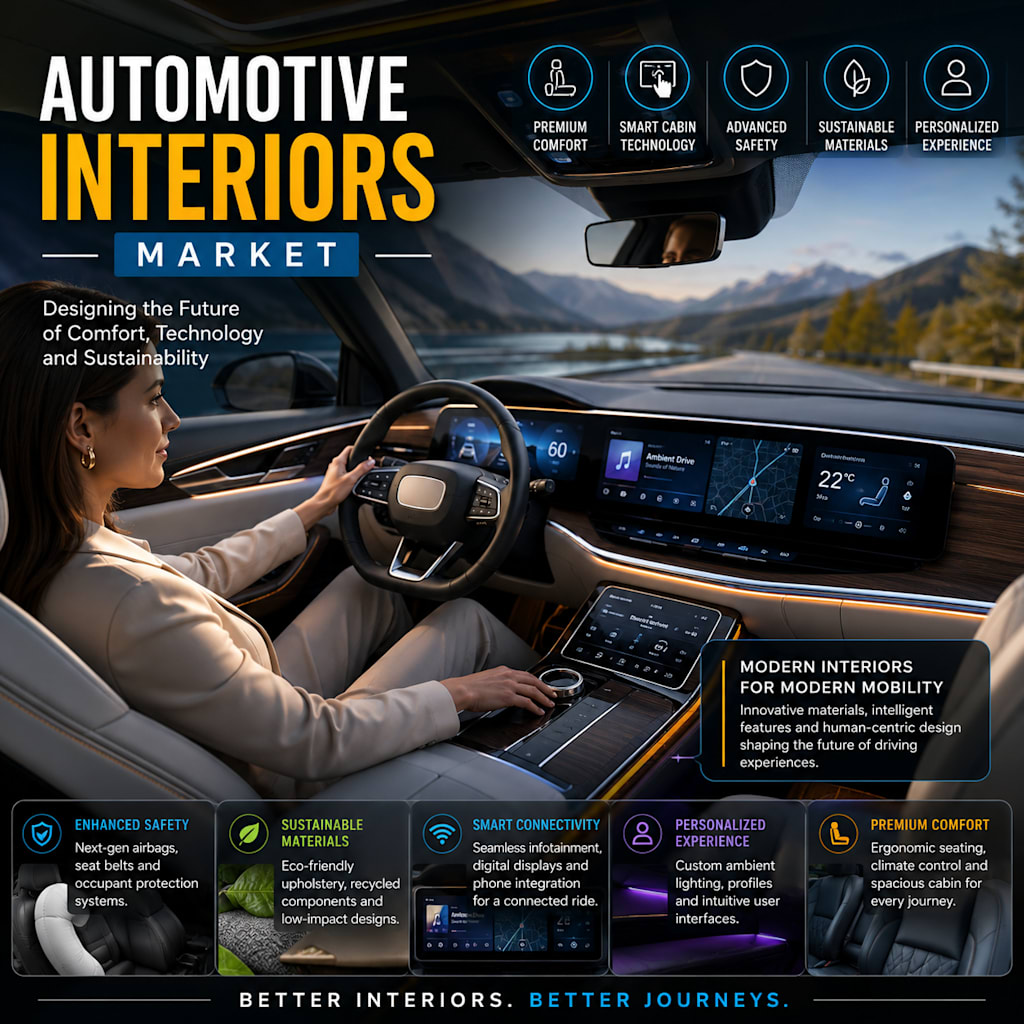
It's no longer all about horsepower and fuel efficiency: Inside the modern vehicle is where the real car competition is playing out.
Once limited to little more than seats, dashboards, and door panels, automotive interiors have transformed into complex, comfortable, and highly sophisticated technological experiences driven by demands for increased safety, sustainability, and personalization. And as cars evolve into smarter, connected machines, automakers are creating interiors that are more akin to living rooms than driving compartments.
This rapid transformation is changing the entire landscape of the global automotive interiors industry, opening up new avenues and opportunities for automakers, technology suppliers and material providers around the world.
A Surging market driven by evolving consumer expectations
The global automotive interiors market size was estimated to be worth nearly $172 billion in 2025, and it's predicted to hit a whopping $244 billion by 2034. Although it doesn't seem like a massive leap given today's booming technology sectors, for a $100 billion+ market, even a seemingly small percentage leap represents immense growth.
This is because modern vehicle occupants expect more from their automotive experience than ever before. Their car is more than just a mode of transportation; it’s a mobile office, a personal retreat, and an entertainment center. Automakers know they can attract customers by developing interiors that are not only comfortable but that create an emotional connection with drivers.
Interior has become a key selling feature
The most crucial selling point for many vehicles today is the interior. Drivers are now looking for more than just basic comfort, considering factors like the ergonomics of their seats, the seamlessness of their infotainment systems and digital displays, the soothing glow of their ambient lighting, the connectivity they experience and the materials used within their cars. With buyers increasingly willing to shell out extra for a luxury or high-tech interior experience, manufacturers are prioritizing innovative and premium cabin environments. This is particularly true among younger drivers who view technology and integration as standard.
Technology Is redefining the driving experience
One of the largest trends in the automotive interior industry has been the explosion in the number of high-tech features integrated into cabin design. Cars now have voice-activated controls and assistants, huge touchscreens and integrated AI systems and connectivity. This technological revolution is completely transforming how drivers interact with their vehicles. Where once drivers relied on a number of physical buttons and knobs to control their car’s features, these can now be controlled via simple voice commands or intuitive touch displays. As autonomous vehicles gain popularity, interior designs are expected to be further revolutionized as passenger comfort, productivity and relaxation will be the priority over driving functionality.
Sustainability Is changing vehicle interior design
Concerns about climate change and environmental issues have driven change in almost every sector and automotive manufacturing is no different. As such, customers are more inclined than ever to purchase a vehicle that reflects their personal sustainability values. This has seen a huge uptake of sustainable materials used in the manufacture of automotive interiors. Recycled plastics, natural fibers, sustainable textiles, bio-composite materials and eco-leather alternatives are now being widely used. What’s more, designers have realized that sustainability and luxury need not be mutually exclusive, as these new eco-friendly materials often have comparable durability and visual appeal to traditional alternatives and offer reduced environmental impact across their entire life cycle. As governments implement tighter environmental regulations and consumer expectations rise, this trend looks set to gain further momentum.
Safety has expanded far beyond the dashboard
While the interior of a car may not seem like a safety feature, this perspective is rapidly changing. Modern car interiors are equipped with a myriad of advanced safety features. These include an ever-increasing number of airbags that have been strategically integrated to optimize occupant protection, the introduction of intelligent seatbelt technologies, and an overall shift in cabin design philosophy that prioritizes occupant safety above all else. Sophisticated sensor technologies and advanced materials are constantly being used to enhance safety performance without compromising on comfort or aesthetics, ensuring interior design remains at the forefront of safety innovation as regulations worldwide tighten.
Customization Is Becoming a competitive edge
Consumers increasingly expect the vehicles they own and operate to be unique, individual extensions of themselves. The demand for customisation is soaring and vehicle owners are now seeking their cars to feature unique colours, upholstery, trim styles, ambient lighting schemes, seat configurations, digital user profiles and tailored infotainment experiences. Automakers are recognising this trend and have begun to create interiors that offer a much wider degree of customization, enabling buyers to truly own a one-of-a-kind driving experience.
Why Automotive seating continues to be so important within car interiors innovation
Amongst all the different components that make up an automotive interior, seats remain the most important. They impact every aspect of the driving experience and play a critical role in both occupant comfort and the overall quality of a journey. The trend of innovation in automotive seats is only expected to continue as manufacturers strive to provide greater ergonomic support, heating/cooling, massage capabilities and lighter, smarter materials to cater to drivers spending more time on the road. This demand explains why seats still represent such a huge portion of the overall automotive interior market.
Asia-Pacific dominates the market
The Asia-Pacific region is currently the leading automotive interior market, and it is projected to retain this position for the foreseeable future. This growth can be attributed to several key factors:
Rising car ownership
Increased purchasing power in China, India and other growing economies has fuelled demand for automobiles, with car ownership surging in these regions.
Growing manufacturing capabilities
Countries such as Japan, China, and South Korea continue to play a crucial role as centers of global automotive manufacturing, with ongoing investment in technology and design.
Demand for higher-end features
Consumers in the Asia-Pacific market are increasingly seeking more advanced technology and luxury-inspired interiors. These combined trends mean manufacturers continue to heavily invest in automotive interior research and development in the region.
The challenge of Balancing luxury and Affordability
There are a number of challenges facing the rapidly growing automotive interior market. One of the biggest is the pressure on manufacturers to create luxury interior experiences for their customers without increasing production costs too much. High-end materials like genuine leather and carbon fiber can drastically raise costs, forcing companies to find ways to offer desirable premium features at more accessible price points. The businesses that successfully navigate this balance will have a clear competitive advantage going forward and this is driving innovative developments in affordable alternative materials and manufacturing techniques.
Looking toward the future of the automotive interior
Three main themes are expected to shape the automotive interior industry:
Intelligent technology
Connectivity, automation, and AI will continue to transform and redefine the interior experience.
Sustainability
Eco-friendly materials and a focus on sustainable manufacturing processes will become an increasing priority.
Customisation
Vehicle interiors will be further personalized to suit the lifestyle and preferences of their occupants.
These trends will converge to create automotive interiors that are more sophisticated, greener, and uniquely tailored to the individual than ever before.
Conclusion
The automotive industry is going through a seismic shift. Performance and exterior design are still important, but the way an interior makes a buyer feel is now arguably more influential than any other feature. Customers are now looking for comfort, connectivity, safety, sustainability and personalisation in their vehicles, all under one roof. With the market predicted to be worth $244 billion by 2034, the internal space of a car has become one of the most exciting and important areas for innovation in the entire automotive industry.
About the Creator
Robert
Senior Market Researcher at IMARC Group, specializing in global market analysis, industry trends, and data-driven insights across diverse sectors.
Enjoyed the story? Support the Creator.
Subscribe for free to receive all their stories in your feed.
Comments
There are no comments for this story
Be the first to respond and start the conversation.