
Why AI Feels Smarter in 2026 Than It Did Just One Year Ago
The difference isn't just better technology. It's the shift from AI that responds to requests to AI that can reason, remember context, and complete real-world tasks

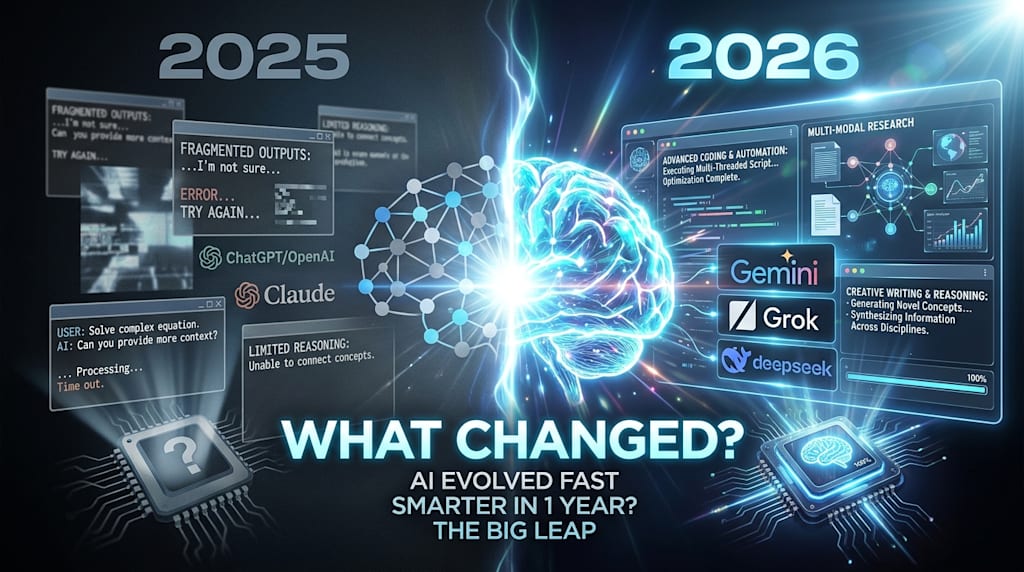
A year ago, many people treated AI like an advanced search engine. You asked a question, received an answer, and moved on. The experience was impressive, but it often felt limited. Responses could be generic, context was easily lost, and complex tasks required constant guidance from the user.
Fast forward to 2026, and something feels different.
Even people who do not closely follow technology have noticed it. Conversations with AI are longer, answers are more useful, and many systems appear capable of handling tasks that would have seemed unrealistic just a year earlier.
The obvious explanation is that the technology improved. That is true, but it does not fully explain why modern AI feels dramatically smarter.
The bigger change is that AI is no longer being designed merely to answer questions. It is increasingly being designed to solve problems.
A year ago, most AI interactions followed a simple pattern. The user asked. The AI responded. If the answer was incomplete, the user had to provide more instructions. The burden of thinking through a task remained largely on the human side of the conversation.
Today's systems are much better at understanding intent rather than just processing words. Instead of responding to a single prompt, they can often infer what a user is trying to achieve and help move toward that goal.
That shift creates the impression of intelligence, even when the underlying technology is still far from human reasoning.
Another major difference is context.
Earlier AI models frequently struggled to maintain long conversations. Users often had to repeat information or restate objectives. Modern systems are significantly better at tracking context across extended interactions. As a result, conversations feel less like isolated exchanges and more like an ongoing collaboration.
For many users, this is the first time AI has started to resemble a genuine assistant rather than a sophisticated tool.
The rise of AI agents has accelerated that perception.
Traditional chatbots primarily generated information. AI agents can take action. They can organize information, conduct multi-step research, create content, analyze documents, and complete workflows with minimal supervision. Even when these systems are not perfect, the ability to move from conversation to execution changes how people experience the technology.
The result is simple: AI appears smarter because it is doing more.
There is also another factor that receives less attention.
Users themselves have become better at working with AI.
In the early days, many people expected perfect results from vague instructions. Over time, individuals learned how to communicate objectives more clearly, provide context, and refine outputs. The relationship between humans and AI has evolved in both directions. The technology improved, but so did the people using it.
Perhaps the most surprising development is how quickly expectations have changed.
Tasks that felt extraordinary in 2025 now feel normal. Generating an image, summarizing a report, building a presentation, or writing software code no longer shocks people. As capabilities become familiar, companies push even harder to develop the next breakthrough.
That constant cycle of improvement creates a powerful illusion. AI does not just become better. It becomes better faster than most people expect.
Of course, modern AI still has limitations. It can make mistakes, misunderstand context, and confidently present incorrect information. Despite remarkable progress, it remains a tool rather than an independent thinker.
Yet it would be difficult to argue that AI has not crossed an important threshold.
A year ago, many people viewed artificial intelligence as an interesting experiment.
Today, millions rely on it for work, education, research, creativity, and everyday decision-making.
That change may be the real reason AI feels smarter in 2026.
The technology improved, but more importantly, it became useful enough to move from the sidelines into daily life. And once a tool becomes part of everyday life, its intelligence stops feeling theoretical and starts feeling real.
About the Creator
Future Lens
Exploring AI, technology, and the future of work through research-driven insights.
Enjoyed the story? Support the Creator.
Subscribe for free to receive all their stories in your feed.
Comments
There are no comments for this story
Be the first to respond and start the conversation.