
Who's Actually Responsible for Shadow AI? The AI Governance Gap Nobody Owns
Ask five people at your company who's responsible, and you'll get five different answers. None of them are right.

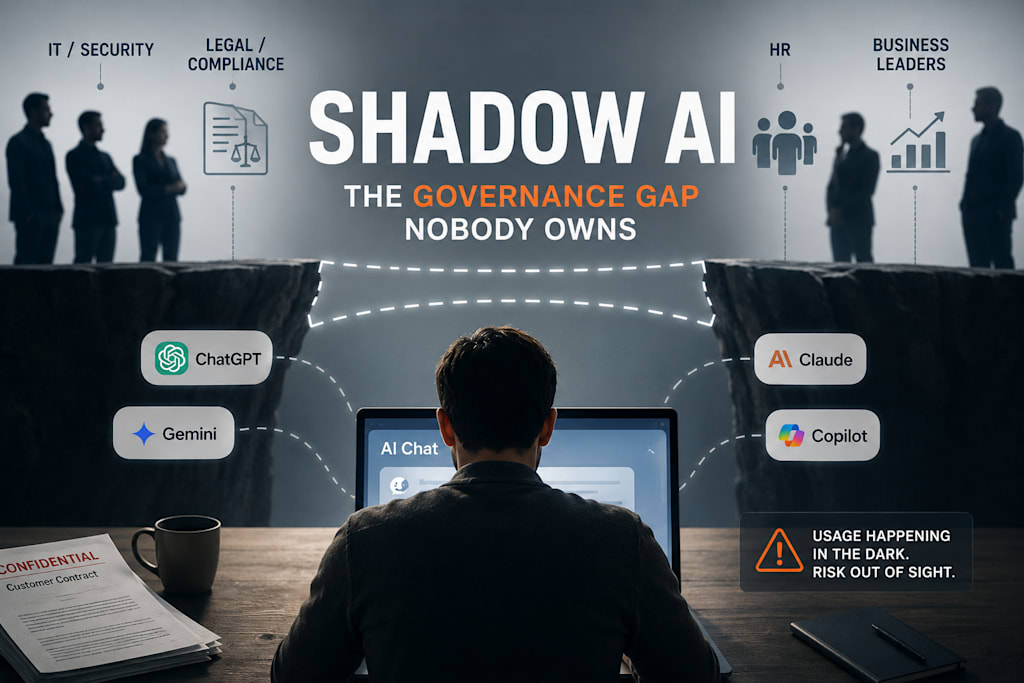
As you read this, there is someone in your organization who is typing a customer contract into an AI chatbot to generate an analysis more quickly than would be possible otherwise. There is also a marketer using a personal ChatGPT account for a marketing campaign because the officially sanctioned tool is too slow. Neither was told that they shouldn’t do so.
This is called Shadow AI, and it is no longer a niche issue. It is the default status quo of most companies in 2026.
The Numbers Are Bigger Than Most People Think
As reported by Okta in 2026, more than half of knowledge workers admit that they use AI technology without permission, and almost one-fourth of them do it on a regular basis. The same report revealed an alarming discrepancy where about 90% of all executives were sure that they have total visibility regarding AI usage within their organization. But they don’t.
Other research tells a similar story from different angles. PagerDuty's 2026 Shadow AI Survey found that two-thirds of office professionals had used AI tools at work despite believing those tools weren't permitted under company policy and a notable share said they'd rather stay quiet about it than ask. Lenovo's 2026 workforce research put the number of employees operating entirely outside IT's influence somewhere between one-fifth and one-third, depending on the company.
Different methodologies, same conclusion: a lot of AI usage is happening in the dark, and the people running these companies don't fully know it.
Why Nobody Wants to Own Shadow AI
Ask five departments who's responsible for shadow AI and you'll get five different, half-right answers.
IT and security will say it's a policy and culture issue, not a technical one, they can block known apps, but employees just switch to personal devices or new tools faster than anyone can keep a blocklist updated.
Legal and compliance will say this is a data governance question, but they're usually brought in after a tool is already in use, not before, and most don't have the technical fluency to evaluate AI risk on their own.
HR will point out that training and policy communication is the real gap, since a large share of employees say they've never received formal guidance on what's allowed.
Department leaders will admit, often quietly, that they look the other way because the productivity gains are real and the alternative tools their company provides are usually worse than what employees can get for free.
Everyone's diagnosis is partially correct. That's exactly the problem. When responsibility is split four or five ways, it tends to land nowhere. Shadow AI governance is not a problem of tooling or policy alone; it's a structural issue because the vast majority of organizations have designed their organizational structure without taking into account the advent of generative AI technology.
The Shadow AI Governance Gap Isn't Going to Close Itself
What makes this moment different from earlier "shadow IT" waves is speed and stakes. Shadow IT used to mean someone signing up for an unauthorized project management tool. Shadow AI means someone feeding proprietary code, financial data, or customer records into a system the company has zero contractual control over. The risk profile isn't comparable.
And the fixes companies reach for first such as blocking tools, sending a memo, adding a line to the employee handbook tend not to work, because they treat a structural gap like a communication problem. Employees aren't using unauthorized AI tools out of malice. They're using them because the approved alternative doesn't exist, is worse, or nobody told them where to look.
What's actually starting to close the gap, in the organizations doing this well, is naming an owner. Not a committee. Not a task force that meets quarterly. An actual role, with the authority to set policy, evaluate tools, and answer for outcomes when something goes wrong.
That's part of why shadow AI governance has quietly become one of the fastest-growing specializations inside security and compliance teams over the past year. It's also why you're starting to see professionals, auditors, risk managers, security leads pursuing dedicated AI governance certifications, like the ISACA AAISM certification to formalize a skill set that, until recently, didn't really have a name or a clear career track. Companies can't assign ownership of a problem to a role that doesn't exist yet. Many companies are just beginning to create such positions.
So Who Owns Shadow AI?
Probably not any single department, acting alone. But "probably everyone, a little bit" is how problems like this stay unowned for years. The companies getting ahead of shadow AI are the ones treating it the way they once treated cybersecurity: as a standing function with a name, a budget, and a person whose job it is to lose sleep over it.
The rest are still hoping a memo will do the job. It won't.
About the Creator
Steven James
I like to write about AI governance, cybersecurity and the changing landscape of enterprise risk careers.
Enjoyed the story? Support the Creator.
Subscribe for free to receive all their stories in your feed.
Comments
There are no comments for this story
Be the first to respond and start the conversation.