
When Materials Come Alive: The Rise of Smart Polymers
How responsive plastics are reshaping industries, from healthcare to high-tech devices

Introduction
Materials that can think, adapt, and respond may sound like science fiction, but they’re quickly becoming part of everyday technology. Smart polymers—materials that react to heat, light, pressure, or chemical signals—are changing how products are designed and used. From medical devices that release drugs on demand to fabrics that adjust to body temperature, these materials are unlocking new possibilities.
This rapid innovation is reflected in the growth of the Smart Polymers Chemical Market, which is expanding at a strong pace. As industries search for smarter, more efficient solutions, demand for these advanced materials is rising across sectors. The result is a market that is not only growing in size but also evolving in complexity and capability.
A Rapidly Expanding Global Market
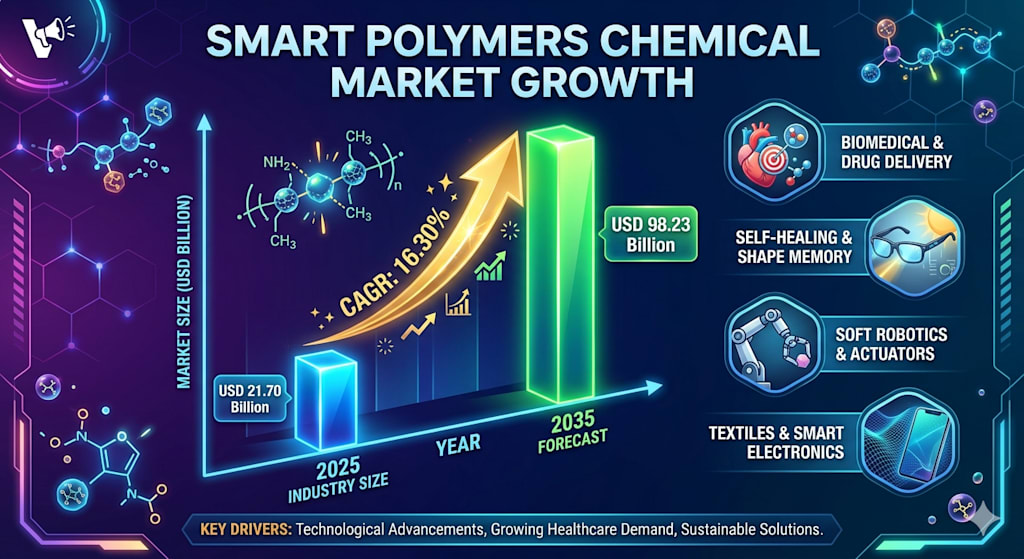
Smart Polymers Chemical Market growth trajectory is striking. It is projected to increase from USD 21.70 billion in 2025 to approximately USD 98.23 billion by 2035, representing a compound annual growth rate of 16.30%. This level of growth signals more than just rising demand—it reflects a shift in how industries approach material selection.
North America currently leads the market, holding over 42.6% of global share. This is largely due to strong research infrastructure, early adoption in healthcare and defense, and consistent investment in advanced manufacturing. Europe follows closely, supported by sustainability regulations and innovation in bio-based materials.
Asia Pacific, however, is emerging as the fastest-growing region. Rapid industrialization, expansion in electronics manufacturing, and government-backed research programs are driving adoption. As production capacity increases in this region, it is likely to play a larger role in shaping the market’s future.
Market Highlights
- North America leads with a 42.6% market share, valued at USD 9.2 Billion.
- By Type, Shape Memory Polymers dominate with 53.6% share.
- By Stimulus, Physical Stimuli Responsive leads with 67.4% share.
- By Processing Technique, Injection Molding holds 46.2% share.
- By Application, Textile leads with 42.1% share.
- By End Use, Electrical and Electronics dominates with 47.3% share.
What Makes Smart Polymers Unique?
At their core, smart polymers are defined by their ability to respond to external stimuli. These triggers can include temperature changes, light exposure, pH levels, or even electrical signals. When activated, the material changes its properties—such as shape, stiffness, or conductivity.
This adaptability sets them apart from traditional plastics. Instead of relying on external systems like motors or sensors, the material itself performs the function. For example, a shape-memory polymer can return to its original form after being deformed, simply by applying heat.
These capabilities reduce the need for complex mechanical systems, which can lower costs and improve reliability over time. As a result, industries are increasingly viewing smart polymers not as optional upgrades but as essential components in next-generation products.
Key Segments Driving Demand
Within the market, certain types of smart polymers are leading adoption. Shape-memory polymers dominate due to their versatility and compatibility with existing manufacturing processes. They are widely used in automotive components and medical devices, where controlled movement and flexibility are critical.
Electroactive polymers are another important category. These materials respond to electrical signals, making them ideal for flexible electronics, sensors, and soft robotics. As wearable devices and smart gadgets become more common, demand for these polymers is growing steadily.
Self-healing polymers are also gaining attention. These materials can repair minor damage without human intervention, extending the lifespan of products. This is particularly valuable in industries like aerospace and infrastructure, where maintenance costs are high.
In terms of stimulus type, physical triggers such as heat and light dominate the market. These triggers are easier to control in industrial settings, making them the preferred choice for large-scale applications.
Applications Across Industries
One of the most notable aspects of the market is its wide range of applications. The textile industry leads in terms of volume, using smart polymers to create responsive fabrics. These materials can adapt to temperature, moisture, or movement, enhancing comfort and performance.
The electronics sector is another major driver. Flexible displays, wearable sensors, and smart patches all rely on responsive polymers to function effectively. As devices become smaller and more integrated into daily life, the need for adaptable materials continues to grow.
Healthcare is a particularly promising area. Smart polymers are being used in drug delivery systems that release medication only when needed, improving treatment outcomes and reducing side effects. They are also used in implants that can change shape inside the body, enabling minimally invasive procedures.
Automotive and aerospace industries are also adopting these materials. Lightweight components, adaptive structures, and self-healing surfaces are helping manufacturers improve efficiency and durability. As electric vehicles and advanced aircraft designs become more common, the role of smart polymers is expected to expand further.
Challenges Slowing Widespread Adoption
Despite their potential, smart polymers face several challenges. One of the biggest is cost. Producing these materials often involves complex processes and specialized equipment, making them more expensive than conventional plastics.
Scalability is another issue. While many smart polymers perform well in laboratory settings, replicating that performance at industrial scale can be difficult. Maintaining consistency across large production runs requires precise control and quality assurance.
Regulatory hurdles also play a role, especially in healthcare applications. Materials used in medical devices must undergo rigorous testing to ensure safety and effectiveness. This can slow down the introduction of new products, even when the technology is ready.
Additionally, the reliance on petrochemical feedstocks raises sustainability concerns. While bio-based alternatives are being developed, they are not yet widely available at scale. This creates a gap between environmental goals and current production capabilities.
Innovation and Future Opportunities
The future of the market is closely tied to ongoing innovation. One of the most exciting developments is the rise of 4D printing, where materials can change shape over time in response to external triggers. This technology is opening new possibilities in fields like medicine and engineering.
Sustainability is also becoming a central focus. Companies are investing in biodegradable and recyclable smart polymers to meet regulatory requirements and consumer expectations. These materials aim to deliver the same performance as traditional polymers while reducing environmental impact.
Another emerging trend is the integration of smart polymers with digital technologies. Materials that can sense and respond to their environment are being used in connected devices, creating new opportunities in the Internet of Things (IoT). This combination of physical and digital functionality is redefining what materials can do.
As research continues and production methods improve, costs are expected to decrease. This will make smart polymers more accessible to a wider range of industries, further accelerating market growth.
Conclusion
The rise of smart polymers marks a significant shift in materials science. These responsive materials are moving beyond niche applications and becoming integral to modern manufacturing and design. The Smart Polymers Chemical Market reflects this transformation, showing strong growth driven by innovation and real-world demand.
While challenges remain, particularly around cost and scalability, the long-term outlook is promising. As industries continue to prioritize efficiency, sustainability, and performance, smart polymers are well positioned to play a central role.
In many ways, this market is still in its early stages. But the direction is clear: materials are no longer passive—they are becoming active participants in how products function. And that change is reshaping industries one application at a time.
About the Creator
Yash Mule
SEO Specialist with 10+ years of experience at Evolvance Market Research. Expert in technical SEO, content strategy, and data-driven optimization, with a proven track record of significantly increasing organic traffic and search rankings.
Enjoyed the story? Support the Creator.
Subscribe for free to receive all their stories in your feed.
Comments
There are no comments for this story
Be the first to respond and start the conversation.