
When Every Smartphone Stopped Working: What Happened After the World Went Offline
The phones went dark in a single second. What happened during the hours that followed changed how people understood connection, memory, and each other

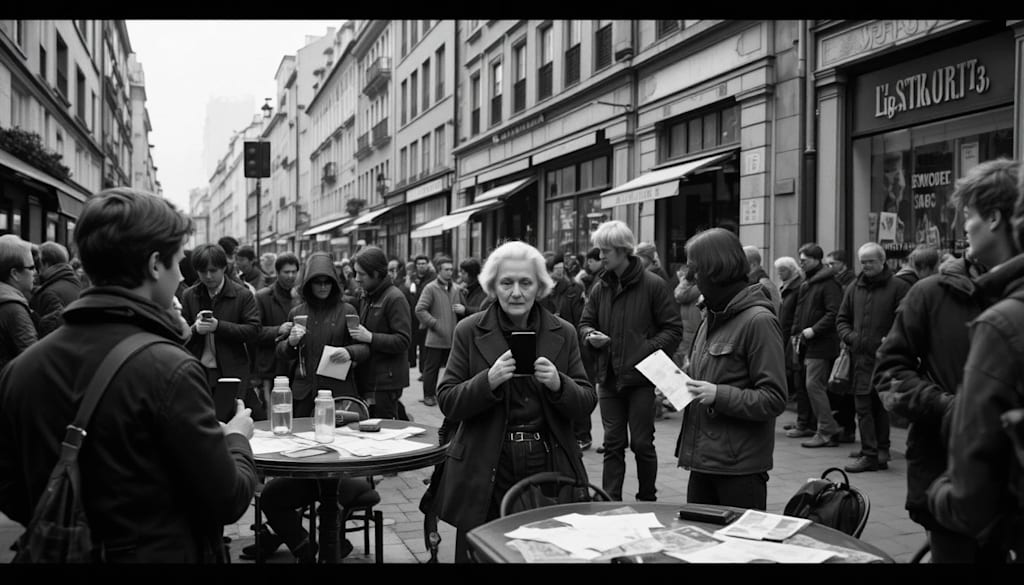
At 10:43 on a Tuesday morning, every smartphone in the world stopped working.
There was no warning.
No global emergency notification. No final message. No mysterious announcement appearing on billions of screens.
The screens simply went black.
For a few seconds, nobody understood what had happened.
Then the world reached for its pockets.
In offices, people lifted their phones and pressed the power buttons.
On trains, commuters stared at black rectangles in their hands.
In restaurants, diners tapped screens that no longer responded.
Drivers pulled to the side of roads, convinced their batteries had somehow died.
Parents tried calling their children.
Children tried calling their parents.
Nobody got through.
At first, people laughed.
“It must be an outage.”
“Give it five minutes.”
“Restart it.”
“Mine is dead too.”
The jokes lasted approximately twelve minutes.
Then people began to panic.
Airports lost access to digital boarding passes stored on phones. People who had never memorized their own flight numbers stood in queues, trying to explain where they were supposed to go.
Delivery drivers discovered that their navigation systems were gone.
People standing outside apartment buildings realized they had forgotten their entry codes because they had stored them in notes on their phones.
Thousands of commuters discovered something worse.
They did not know the way home.
Mara discovered this at 11:06.
She was standing outside a café three neighborhoods from her apartment.
Normally, she would have opened a map.
She reached into her coat pocket.
Her phone was black.
She pressed the button.
Nothing.
She pressed it again.
Nothing.
Around her, dozens of people were performing the same ritual.
Tap.
Press.
Swipe.
Wait.
Tap again.
It looked almost comical, like an entire city trying to wake a sleeping creature.
Mara put the phone back in her pocket.
She looked down the street.
She knew her neighborhood was somewhere beyond the buildings ahead.
She just didn't know which direction.
A man beside her was staring at his own phone.
“Do you know where Central Station is?” he asked.
“No.”
“Do you know which way north is?”
Mara looked at the sky.
“No.”
He laughed nervously.
“Great.”
They stood there together for a moment.
Then the man pointed toward an elderly woman sitting on a bench.
“She might know.”
They approached her.
She listened to the question, smiled, and pointed down the street.
“Keep going until you see the old post office. Turn left. Walk past the library. You'll reach the station.”
Mara thanked her.
The man looked surprised.
“How did you know?”
The woman shrugged.
“I've lived here for forty years.”
It was the first useful answer anyone had received that day.
By noon, the internet was filled with speculation.
Except nobody could access it through their phones.
People went home and turned on televisions.
News stations reported that the failure appeared to affect smartphones everywhere.
Laptops and desktop computers still worked.
Landlines still worked.
Radio still worked.
The electrical grid still worked.
But smartphones were dead.
Every one of them.
Nobody knew why.
Nobody knew whether they would ever work again.
And suddenly, billions of people discovered how much of their lives had been squeezed into a device small enough to fit inside a pocket.
Addresses.
Passwords.
Photographs.
Tickets.
Calendars.
Birthdays.
Phone numbers.
Shopping lists.
Messages.
Memories.
Entire relationships existed behind glass.
Mara arrived home just before three.
Her husband, Daniel, was already there.
He was standing in the living room.
“You're late,” he said.
“I couldn't find the way.”
He smiled.
“Neither could I.”
They looked at each other.
Then they both laughed.
They had lived together for six years.
Yet Mara realized she had no idea what Daniel's phone number was.
She had never needed to.
She had simply tapped his name.
That evening, something strange happened.
People began knocking on doors.
Not because they needed anything.
Because they wanted to know whether everyone else was experiencing the same thing.
Neighbors who had exchanged polite smiles for years suddenly stood in hallways talking.
A woman from the fourth floor brought a candle downstairs because she had no idea how long the problem would last.
Someone found an old board game.
Someone else brought a guitar.
Children, who had spent years being told to put their phones away, suddenly discovered that their parents knew dozens of games that did not require batteries.
At seven, the apartment courtyard filled with people.
Nobody had planned it.
There was simply nowhere else to scroll.
People talked.
They complained.
They argued about what had happened.
They told stories.
A retired teacher drew a map of the neighborhood on cardboard for people who had forgotten the streets.
A teenager offered to write down everyone's important phone numbers.
An engineer explained how mobile networks worked.
A baker brought bread.
Someone carried out a radio.
The radio became the center of the courtyard.
For the first time in years, everyone listened to the same thing.
Not individually.
Together.
The next morning, the phones were still dead.
So was the morning after that.
Then the week after that.
The world adapted faster than anyone expected.
Paper maps returned to car glove compartments.
People started wearing watches again.
Restaurants printed menus.
Airlines returned to paper boarding passes.
Businesses installed landline phones.
Schools taught children how to navigate streets without digital maps.
Families wrote important numbers on paper and pinned them beside their kitchens.
People began making appointments by actually speaking to one another.
Something else changed too.
At first, people complained about boredom.
Then they discovered they had been confusing boredom with silence.
Without a screen constantly demanding attention, people noticed things.
Rain against windows.
Birds on telephone wires.
The sound of someone walking upstairs.
The expression on a stranger's face.
The uncomfortable pause in a conversation.
The pleasure of finishing a book without checking anything else.
Mara began walking home from work.
The journey took forty minutes.
She had made it hundreds of times without ever really seeing it.
Now she noticed the flower shop on the corner.
The old cinema.
The woman who fed pigeons outside the library.
The cracked blue door of a house she had passed every day for six years.
One afternoon, she stopped at the blue door.
A man was painting it.
“Nice color,” she said.
He looked at her.
“Thank you.”
That was the entire conversation.
But the next day, they spoke again.
And the day after that.
Months passed.
The smartphones never came back.
Nobody ever discovered exactly why.
There were theories.
A software failure.
A solar event.
A deliberate attack.
Something nobody had imagined.
Eventually, people stopped asking.
The important question became something else.
What had they been doing before?
Some things returned.
People still used computers.
They still worked online.
They still watched films and sent emails.
Technology did not disappear.
Only the tiny glowing object that had followed humanity everywhere was gone.
And slowly, people realized that the world had not ended.
It had become quieter.
One year after the shutdown, Mara found her old smartphone in a drawer.
She turned it over in her hand.
It was perfectly intact.
A museum in the city had offered thousands of euros for functioning examples, calling them artifacts from the “Age of Constant Connection.”
Mara almost donated hers.
Instead, she kept it.
Not because she missed it.
Because she wanted to remember.
She placed it on the shelf beside an old photograph.
In the photograph, she was standing with Daniel in the courtyard on the first night the phones stopped working.
There were dozens of people around them.
Some were laughing.
Some were talking.
Some were looking at the stars.
Nobody was looking down.
Mara stared at the picture for a long time.
Then she noticed something she had never seen before.
In the background, almost hidden behind the others, stood the elderly woman from the bench.
The woman was looking directly at the camera.
And smiling.
Mara smiled too.
Then she put the photograph back on the shelf.
Outside, someone called her name.
She opened the window.
“What?”
“Come downstairs!”
“Why?”
“We're having dinner!”
Mara looked at the clock.
She almost reached for her phone to check the time.
Then she laughed.
She already knew.
And for the first time in years, she didn't need to know anything else.
About the Creator
Algieba
Curious observer of the world, exploring the latest ideas, trends, and stories that shape our lives. A thoughtful writer who seeks to make sense of complex topics and share insights that inform, inspire, and engage readers.
Enjoyed the story? Support the Creator.
Subscribe for free to receive all their stories in your feed. You could also become a paid subscriber, letting them know you appreciate their work.
Comments
There are no comments for this story
Be the first to respond and start the conversation.