
When AI Starts Making Financial Decisions, Who Do We Trust?
The next wave of fintech innovation isn't about building smarter systems. It's about making sure people trust them.
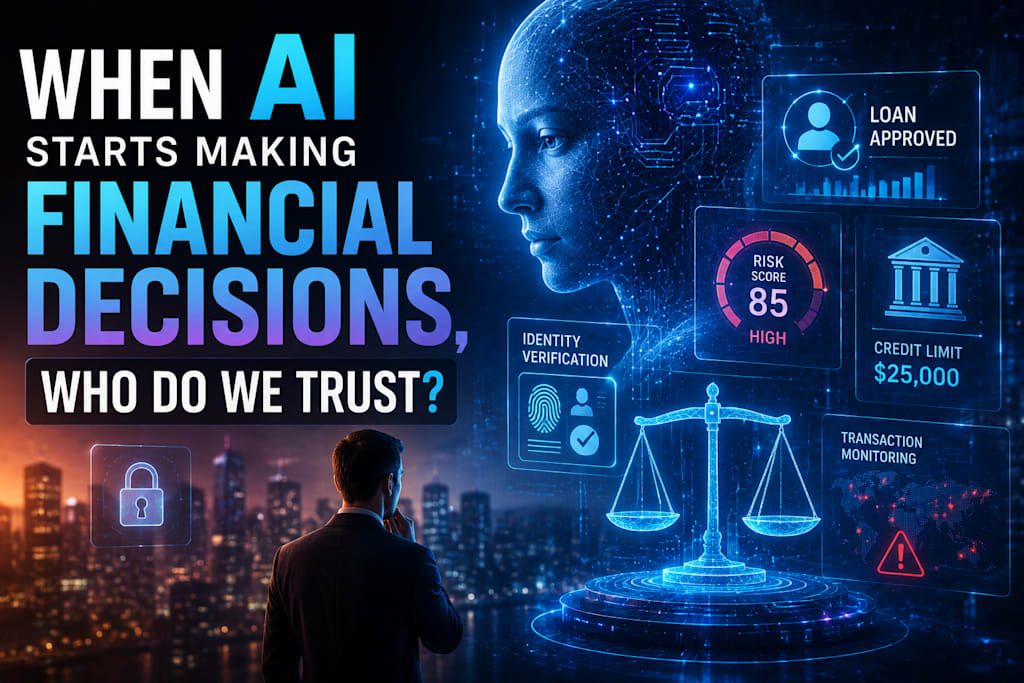
Artificial intelligence is quietly becoming one of the most influential forces in modern finance.
Every day, AI helps financial institutions detect fraud, evaluate risk, personalize services, monitor transactions, and automate decisions that once required significant human oversight. For customers, the experience often feels seamless. Applications get processed faster. Transactions happen instantly. Financial products become more personalized.
Most people never see the algorithms working behind the scenes.
And that's exactly why trust is becoming such an important issue.
As AI takes on a larger role in financial services, we're entering a world where machines increasingly influence decisions involving identity verification, access to financial products, and the detection of suspicious activity. The technology is advancing rapidly, but a critical question remains:
How comfortable are we letting AI decide who gets access to financial services and who doesn't?
The answer may shape the next era of fintech.
Finance Runs on Trust
Long before digital banking apps existed, financial systems depended on trust.
People trusted banks to protect their money.
Investors trusted institutions to handle assets responsibly.
Governments trusted financial organizations to follow regulations designed to prevent crime and protect consumers.
Technology has changed how finance operates, but it hasn't changed this fundamental principle.
Trust remains the foundation of every financial transaction.
The challenge is that AI introduces a new layer between people and decisions.
When a person reviews an application, customers generally understand that human judgment is involved. When an algorithm makes that same decision, the process often feels less transparent.
The technology may be efficient, but efficiency alone doesn't create confidence.
The Rise of Invisible Compliance
Many consumers don't think about compliance until something goes wrong.
A transaction gets flagged.
An account requires additional verification.
A payment is delayed.
Suddenly, processes that normally operate in the background become very visible.
As fintech products become more intelligent, compliance systems are becoming increasingly automated. Know Your Customer (KYC) checks and Anti-Money Laundering (AML) monitoring are no longer purely manual tasks. AI can review documents, identify unusual patterns, and assess risks at a scale that would be impossible for human teams alone.
This shift creates enormous opportunities.
Financial services can become faster, more accessible, and more efficient.
At the same time, it raises important questions about transparency and accountability.
If an AI system flags someone as high risk, how should that decision be explained?
If a customer is denied access to a service, who is responsible for the outcome?
These are no longer theoretical questions.
They are becoming practical challenges for fintech companies around the world.
Why Smarter Doesn't Always Mean Better
Technology companies often focus on improving accuracy.
A model becomes faster.
Predictions become more precise.
Detection rates improve.
These achievements matter.
But financial services involve more than performance metrics.
They involve people.
An AI system might identify suspicious behavior with remarkable accuracy, but if customers don't understand how decisions are being made, skepticism can grow.
Trust depends on more than results.
It depends on visibility.
People are more willing to accept decisions when they understand the reasoning behind them. This is one reason explainable AI is becoming a major topic across financial services.
Organizations are increasingly recognizing that intelligent systems must also be understandable systems.
The New Arms Race in Financial Security
Artificial intelligence is helping financial institutions fight fraud.
But there is another side to the story.
Fraudsters are using AI too.
Synthetic identities, automated scams, deepfake verification attempts, and increasingly sophisticated financial attacks are becoming more common. Criminal organizations can leverage technology to operate faster and at larger scales than ever before.
As a result, financial institutions are under pressure to evolve.
Traditional compliance systems based solely on static rules are struggling to keep pace with dynamic threats.
AI-powered monitoring offers a potential solution because it can learn patterns, identify anomalies, and adapt to changing behavior.
The future of financial security may depend on systems that continuously learn rather than systems that simply follow predefined instructions.
Building Financial Systems People Believe In
One of the biggest misconceptions about AI is that it removes the need for human oversight.
In reality, the opposite may be true.
The more responsibility we give to intelligent systems, the more important governance becomes.
Successful fintech platforms must balance automation with accountability.
They need strong security practices, transparent processes, reliable infrastructure, and compliance frameworks that evolve alongside technology.
This growing challenge has been highlighted by technology firms such as GeekyAnts, which have explored how AI-powered fintech products require compliance considerations from the earliest stages of development rather than as a final step before launch.
The lesson is simple.
Trust cannot be added later.
It must be built into the foundation.
The Fintech Companies That Win May Not Have the Best AI
Over the next decade, AI capabilities will continue improving.
Models will become faster.
Automation will become more sophisticated.
Financial products will become increasingly personalized.
But technological advancement alone won't determine success.
Customers will gravitate toward platforms they trust.
Regulators will favor systems they can understand.
Businesses will invest in solutions that demonstrate accountability.
The companies that thrive may not be those with the most advanced algorithms.
They may be the ones that successfully combine innovation with transparency.
Because when AI starts making financial decisions, intelligence matters.
But trust matters more.
Further Reading
This article was inspired by insights discussed in a fintech compliance analysis published by GeekyAnts.
About the Creator
James Smith
Writing about AI, product engineering, startups, and the tech trends redefining tomorrow
Enjoyed the story? Support the Creator.
Subscribe for free to receive all their stories in your feed.
Comments
There are no comments for this story
Be the first to respond and start the conversation.