
What Sets LLM Development Services Apart in the Modern AI Landscape
A practical perspective on what distinguishes enterprise-grade LLM solutions from basic AI deployments
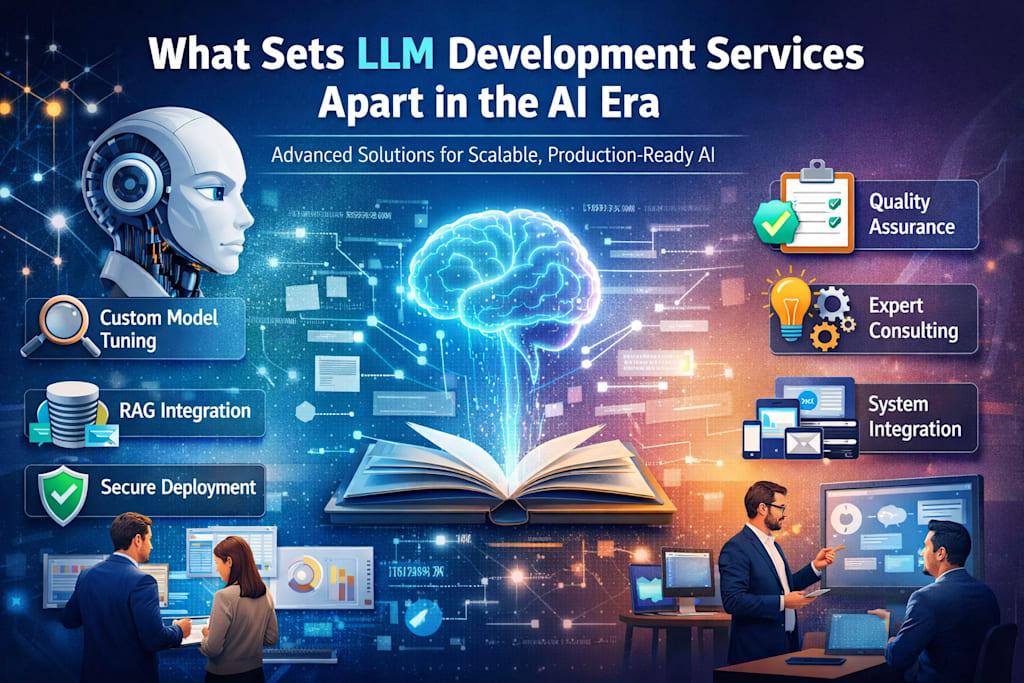
Artificial intelligence is no longer a future concept or an experimental tool. It has become a core business driver across industries. Companies are now using AI to streamline operations, improve customer experiences, automate repetitive tasks, and create entirely new digital products. At the center of this transformation are large language models (LLMs), which are changing how organizations interact with data and users.
However, using an LLM is not the same as building a successful AI product. Access to tools like OpenAI, Anthropic, or Google models is only the first step. Turning that raw capability into something reliable, scalable, and valuable requires technical expertise. That is why professional LLM development services have become increasingly important.
This article explores what truly makes LLM development stand out and why selecting the right development partner matters more than many businesses expect.
The Difference Between Accessing a Model and Launching a Product
Many organizations begin with enthusiasm by experimenting with an API. They test prompts, build simple chatbots, and see promising results. But once they try to move toward a production-ready solution, the real challenges begin.
Creating a dependable LLM-powered application involves tasks such as:
Fine-tuning models with business-specific data
Connecting AI systems to internal databases
Managing long context windows
Reducing hallucinations and inaccuracies
Designing safety guardrails
Deploying scalable infrastructure
Monitoring model performance continuously
These are engineering problems that require experience and planning.
This is where a capable LLM development company provides real value. Strong providers do much more than connect APIs. They manage the entire ecosystem including model strategy, data pipelines, retrieval systems, fine-tuning, testing, deployment, and optimization.
Core Elements of High-Quality LLM Development
1. Smart Model Selection
Not every project requires the largest or most expensive model. Today’s AI market includes powerful open-source options such as Llama, Mistral, and Falcon that can perform exceptionally well when tailored properly.
A professional LLM consulting services team starts by understanding:
Expected user volume
Required speed and latency
Privacy needs
Budget limitations
Hosting preferences
Complexity of tasks
Only after evaluating these factors should model selection happen.
2. Fine-Tuning for Industry Use Cases
General-purpose LLMs are broad but not specialized. Businesses often need AI systems that understand their terminology, workflows, and customers.
Fine-tuning allows a model to perform better in areas such as:
Legal document review
Healthcare coding
Technical support
Financial reporting
Internal knowledge assistants
Experienced providers offering NLP development services can turn raw models into domain experts.
3. Retrieval-Augmented Generation (RAG)
One of the most important developments in modern AI systems is Retrieval-Augmented Generation.
Instead of relying only on pre-trained knowledge, RAG connects the model to live or private sources such as:
Internal documentation
Product databases
Policies and procedures
Real-time business data
Customer records
This helps generate more accurate and current responses while reducing hallucinations.
Building an effective RAG pipeline requires expertise in vector databases, embeddings, search relevance, and content chunking. This is a major reason LLM integration services are in demand.
4. Testing and Quality Control
A demo may look impressive, but enterprise systems need measurable performance.
Leading LLM development teams build quality assurance systems that include:
Automated benchmark testing
Human review processes
Prompt stress testing
Bias and safety checks
Live monitoring dashboards
These frameworks help catch problems before users experience them.
5. Secure and Responsible Deployment
LLMs operating at scale need safeguards. Strong development teams build protections such as:
Content moderation filters
Prompt injection prevention
Rate limiting
Output validation
Access controls
Compliance-ready logging
For sectors like healthcare, finance, and legal services, these controls are essential.
Why Businesses Prefer Custom LLM Solutions
Off-the-shelf AI tools are useful, but they often come with limitations:
Limited customization
Recurring subscription costs
No ownership of infrastructure
Generic responses
Restricted workflows
Custom LLM development gives businesses more control.
They can build AI systems trained on their own data, aligned with their brand tone, and designed around their internal processes. This creates stronger differentiation and long-term competitive advantage.
Organizations in 2026 are increasingly moving beyond proof-of-concept experiments and launching full AI product ecosystems. That requires deeper engineering than early chatbot solutions ever needed.
Why LLM Consulting Is More Valuable Than It Sounds
Before development begins, successful projects often start with consulting.
LLM consulting services help companies answer critical questions:
Where will AI create the most value?
Which processes should not use AI?
Is current data usable or incomplete?
Which model fits technical and budget goals?
How should success be measured?
What systems need integration?
Skipping this stage often leads to wasted budgets and low adoption.
A consulting-first strategy saves time and improves results.
What to Look for in an LLM Development Partner
Choosing a provider can be difficult because many companies use AI terminology loosely. Focus on these real indicators:
Technical Breadth
Can they handle infrastructure, training, integration, and product engineering?
Production Experience
Have they launched live systems that manage real users, cost controls, and uptime?
Industry Knowledge
Do they understand your compliance environment and user expectations?
Honest Planning
Reliable partners give realistic budgets, timelines, and scope estimates.
LLMs and NLP Work Best Together
Large language models are part of the broader natural language processing ecosystem.
Traditional NLP capabilities still matter, including:
Named entity recognition
Sentiment analysis
Document classification
Keyword extraction
Structured data parsing
For example, a contract platform may use an LLM for summarization while NLP pipelines extract dates, clauses, and obligations.
When NLP development services are combined with LLM systems, businesses get smarter and more efficient results.
The Importance of Integration
Even a strong model has limited value if it cannot connect to business systems.
LLM integration services focus on connecting AI tools with:
CRM platforms
ERP software
Ticketing systems
Internal databases
APIs
Authentication systems
User dashboards
Good integration also improves user experience by deciding where AI appears, how it communicates uncertainty, and how fallback workflows operate.
Current Trends in the LLM Market
The AI market has matured rapidly. Several trends define the current environment:
Multi-modal AI combining text, image, and audio is growing fast
Smaller open-source models are now enterprise-ready
Privacy-focused deployments are becoming common
EU and US regulations are increasing compliance demands
Early adopters are now far ahead with mature AI systems
Businesses that invested early with experienced partners are seeing stronger returns.
Final Thoughts
Large language models offer enormous potential, but success does not come from model access alone.
Reliable AI products require:
Strong engineering
Clean data pipelines
Evaluation rigor
Security controls
Seamless integrations
Ongoing optimization
That is why choosing the right LLM development company matters so much.
For organizations serious about building AI-powered products or transforming internal workflows, the right development partner can determine speed, cost, adoption, and long-term success.
About the Creator
Ritu Singh
Blockchain and AI content writer specializing in RWAs, stablecoins, tokenization, and Web3 innovation. I create research-driven articles on emerging digital asset trends, decentralized finance,
Enjoyed the story? Support the Creator.
Subscribe for free to receive all their stories in your feed.
Comments
There are no comments for this story
Be the first to respond and start the conversation.