
What Nobody Tells You About Building a Trading Dashboard
The unglamorous engineering problem behind every multi-asset fintech product
A few years ago, a friend of mine started building a personal finance dashboard as a side project. Nothing ambitious at first — just a way to see his crypto holdings, a few stock positions, and his savings account balance in one place instead of four different apps. He figured it would take a weekend.
Eight months later, he was still working on it. Not because the idea was wrong, but because he had run into a problem that almost nobody warns you about before you start: market data is fragmented across the entire industry, and nobody has solved it cleanly.
To get crypto prices, he needed an exchange API — and quickly learned that different exchanges report prices slightly differently depending on which pairs are most liquid at that moment. To get stock prices, he needed a completely separate data provider, with its own authentication scheme, its own rate limits, and its own quirks around delayed versus real-time quotes. To get his bank balance, he needed yet another integration, with yet another security model.
Each of these data sources spoke a different language. One used "bid/ask," another used "buy/sell." One returned prices as strings, another as floats. One updated every second, another updated every fifteen minutes. None of them agreed on time zones for their timestamps.
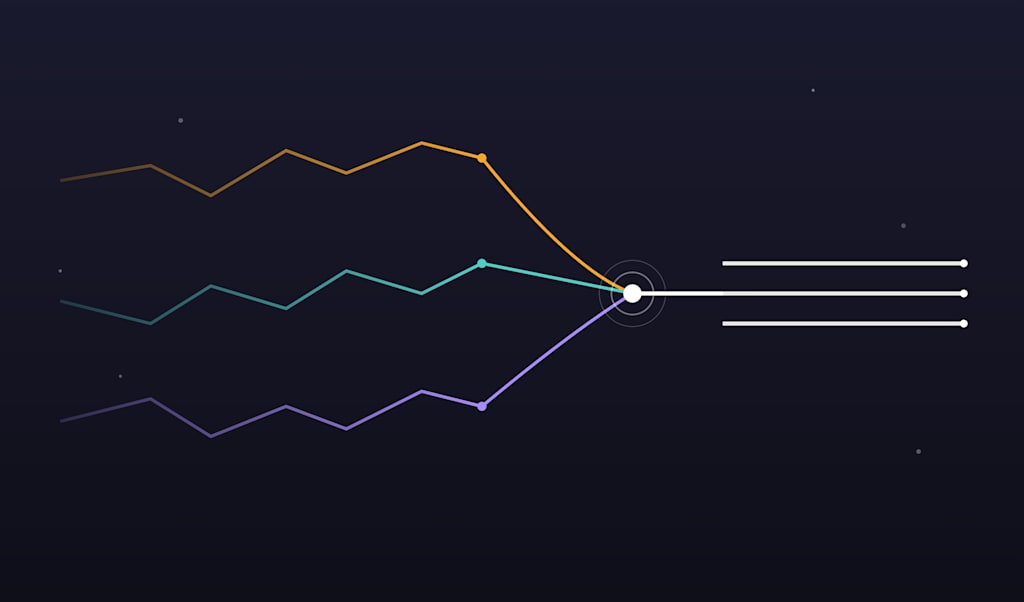
This is the part of building financial software that almost nobody talks about. The actual product — the charts, the dashboard, the alerts — is the easy part. The hard part is the plumbing underneath it: reconciling five inconsistent data sources into something a single application can reason about.
It's a problem that scales badly, too. Every time you want to add a new asset class — say, decentralized exchange data, or commodities, or a new regional stock exchange — you don't just add a feature. You add an entire new integration, with its own failure modes, its own documentation to read, its own edge cases to discover the hard way at 2am when something breaks in production.
I started paying attention to this problem because I kept hearing the same complaint from different people building unrelated things — a quant researcher backtesting strategies across asset classes, a fintech founder building a robo-advisor, a hobbyist building exactly the kind of dashboard my friend was working on. They were all independently solving the same plumbing problem, often badly, often more than once.
What's interesting is that a few companies have started treating this fragmentation as the actual product to build, rather than a problem every team has to solve from scratch. SiftingIO is one example — instead of separate integrations for crypto, forex, equities, and on-chain data, it normalizes all of it into one schema behind a single credential. Whether you're asking for the price of Bitcoin or Apple stock, the shape of the response is the same.
That doesn't make building a trading dashboard trivial. There's still a lot of product work, design work, and decision-making about what to actually show people and how. But it does remove an entire category of plumbing that used to eat months of engineering time before a single feature ships.
My friend eventually finished his dashboard. It took him eight months, most of which — by his own estimate — went into data integration rather than the actual product. When I asked him what he'd do differently if he started over, he didn't say "use a different framework" or "design the UI first." He said he'd spend the first week researching whether someone had already solved the data fragmentation problem, instead of assuming he had to solve it himself.
It's a small lesson, but a useful one for anyone building something similar: before you write the tenth API integration, it's worth asking whether the unglamorous infrastructure problem you're solving has already been solved by someone whose whole job is solving exactly that.
About the Creator
Enjoyed the story? Support the Creator.
Subscribe for free to receive all their stories in your feed.
Comments
There are no comments for this story
Be the first to respond and start the conversation.