
Weather Forecasting Services Market: Predictive Modeling, Automation & Market Potential
Growing reliance on weather intelligence, advanced predictive models, and cloud-based platforms is enhancing operational efficiency and shaping strategic planning across multiple end-use industries worldwide

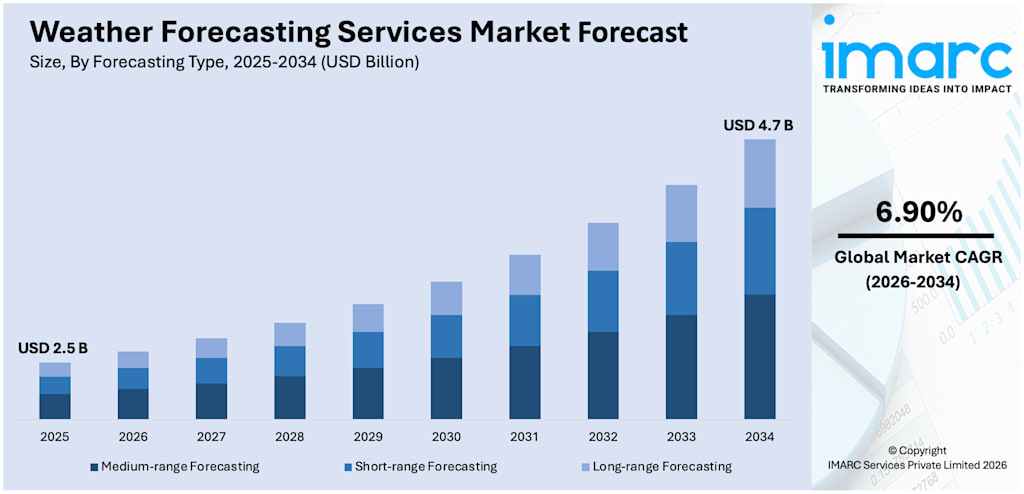
The global demand for high-precision meteorological insights is surging as climate volatility and extreme weather events become more frequent. Modern weather forecasting services have moved beyond simple rain-or-shine predictions, evolving into critical decision-support tools for global industries like aviation, energy, and agriculture. According to IMARC Group’s latest data, The global weather forecasting services market size was valued at USD 2.5 Billion in 2025. Looking forward, IMARC Group estimates the market to reach USD 4.7 Billion by 2034, exhibiting a CAGR of 7.17% from 2026-2034.
Weather forecasting services now operate as a backbone for industrial risk management, with the market successfully crossing the multi-billion-dollar threshold. This expansion is primarily fueled by the integration of artificial intelligence and high-performance computing, which allow for hyper-local accuracy. Businesses are increasingly adopting these services to mitigate the financial impact of hurricanes, droughts, and floods, which collectively caused over USD 165 billion in losses in recent years in the U.S. alone.
Download Your Complimentary "Weather Forecasting Services Market" Insights PDF
Weather Forecasting Services Market Growth Drivers:
- Increasing Frequency of Extreme Weather Events
The intensifying severity of climate-related disasters, such as hurricanes, wildfires, and flash floods, is a primary driver for professional forecasting adoption. In 2024, record-breaking heatwaves and storms impacted over 90% of certain regions, forcing governments and private enterprises to seek advanced early warning systems. These services provide the 24-hour notice periods necessary to reduce disaster-related damages by an estimated 30%. With global climate risks rising, the market currently valued at USD 2.5 billion is seeing massive investment from the insurance and public safety sectors to protect infrastructure and human life.
- Technological Integration of AI and Machine Learning
The shift toward automated, data-driven meteorology is revolutionizing how atmospheric data is processed. Approximately 40% of global forecasts are now refined using AI algorithms, which can analyze quintillions of bytes of data from satellites and IoT sensors in real time. This technological leap eliminates manual errors and provides hyper-localized insights that were previously impossible. Large enterprises, which command over 70% of the market share, utilize these high-precision models to manage complex global supply chains, ensuring that local weather disruptions do not lead to massive logistical bottlenecks or operational downtime.
- Expansion of the Renewable Energy Sector
As the global energy transition accelerates, the dependence on wind, solar, and hydroelectric power has made precise weather data a non-negotiable asset. Solar energy operators now utilize site-specific alerts to protect panels from hail, while wind farms rely on short-range forecasts to balance grid stability and predict power output. Given that renewable energy efficiency is directly tied to atmospheric conditions, utilities are increasingly integrating weather-as-a-service models into their daily operations.
Weather Forecasting Services Market Trends:
- Shift Toward Hyper-Local and Nowcasting Solutions
A major trend in the industry is the move away from regional outlooks toward "nowcasting," which provides high-accuracy weather updates for specific zip codes or even individual assets. Cities and logistics companies are using these tools to manage urban flash flooding and delivery schedules with minute-by-minute precision. This trend is supported by the deployment of dense IoT sensor networks that feed real-time environmental data into cloud platforms. Market data indicates that medium-range and short-range forecasting currently account for nearly 30% of the market share, as users demand immediate, actionable insights for tactical planning.
- Strategic Partnerships Between Tech Giants and Agencies
The industry is witnessing a wave of collaborations between private technology firms and national meteorological agencies to share proprietary data and research. For example, recent partnerships involve the integration of hyper-local weather APIs into digital applications for logistics and transportation, allowing for seamless risk assessment. These collaborations foster innovation by combining massive historical datasets with modern predictive analytics.
- Premiumization and Advanced Risk Analytics
Weather services are evolving into comprehensive risk management platforms that offer more than just temperature and precipitation data. Modern providers are branding "climatology-as-a-service," offering sophisticated dashboards that translate weather patterns into financial risk scores for the BFSI and agriculture sectors. For instance, new index-based tools now quantify the severity of heatwaves to help public safety officials prepare for health-related emergencies. This shift toward high-value, specialized analytics is a key trend in North America and Europe, where affluent enterprise clients are willing to pay a premium for source-verified, artesian-quality data that ensures business continuity.
Recent News and Developments in Weather Forecasting Services Market:
- January 2026: DTN LLC launched the "DTN Weather Hub," a next-generation intelligence platform designed to help organizations translate raw atmospheric data into operational risk insights across the aviation and utility sectors.
- September 2025: AccuWeather Inc. introduced a new developer portal powered by Zuplo, providing streamlined access to hundreds of weather data APIs for enterprises to integrate real-time alerts into their logistics and energy applications.
- September 2025: Vaisala Oyj rolled out advanced hail forecast alerts within its Xweather Protect platform, allowing solar energy operators to receive site-specific severe weather warnings up to 60 minutes before a storm hits.
Note: If you require specific details, data, or insights that are not currently included in the scope of this report, we are happy to accommodate your request. As part of our customization service, we will gather and provide the additional information you need, tailored to your specific requirements. Please let us know your exact needs, and we will ensure the report is updated accordingly to meet your expectations.
About the Creator
Andrew Sullivan
Hello, I’m Andrew Sullivan. I have over 9+ years of experience as a market research specialist.
Enjoyed the story? Support the Creator.
Subscribe for free to receive all their stories in your feed.
Comments
There are no comments for this story
Be the first to respond and start the conversation.