
Water Pipeline Leak Detection System Market: Smart Monitoring, AI Integration & Infrastructure Security in Saudi Arabia
How real-time monitoring technologies, IoT-enabled sensors, and predictive analytics are enhancing leak detection accuracy, minimizing water loss, and improving operational efficiency across modern water pipeline infrastructure systems worldwide.

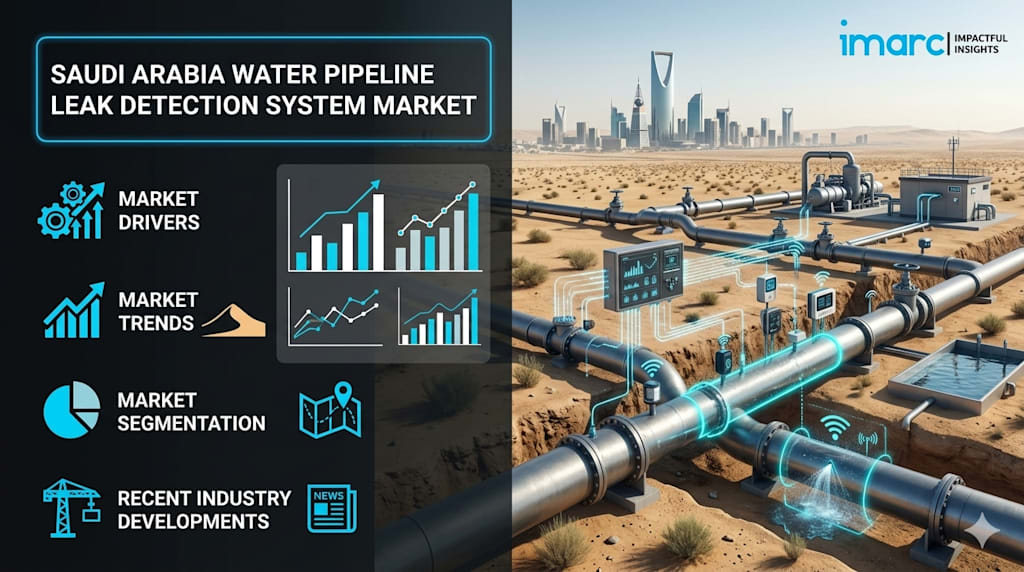
Rising water scarcity concerns, large-scale government-backed infrastructure programs, and rapid adoption of smart monitoring technologies are reshaping how Saudi Arabia manages its critical water pipeline networks. The Saudi Arabia water pipeline leak detection system market size reached USD 25.5 Million in 2025. Looking forward, IMARC Group expects the market to reach USD 40.3 Million by 2034, exhibiting a growth rate (CAGR) of 5.23% during 2026-2034, reflecting robust demand dynamics driven by national policy priorities, environmental urgency, and breakthrough detection innovations.
The market is driven by the growing government investments in water infrastructure under its Vision 2030 plan, increasing concerns about water resource depletion, and technological advancements in leak detection technology like acoustic sensors, fiber-optic cables, and intelligent monitoring systems.
Saudi Arabia Water Pipeline Leak Detection System Market Growth Drivers:
- Growing Government Investments in Water Infrastructure
Saudi Arabia's Vision 2030 plan places water resource efficiency at the center of its national development agenda, triggering large-scale investments across pipeline construction, monitoring, and maintenance. The Saudi Water Partnership Company (SWPC) announced eight new water infrastructure projects worth USD 8 billion in October 2024, with all contracts earmarked for award within 12 months. This consistent project pipeline is designed to stimulate private sector competition and long-term investment. As networks expand in scale and geographic reach, the demand for advanced leak detection systems grows proportionally, making government policy one of the strongest catalysts for market expansion.
- Acute Water Scarcity and Rising Resource Depletion Concerns
Saudi Arabia is among the most water-stressed nations globally, with no perennial rivers and limited rainfall. The country depends heavily on desalinated water and an extensive network of underground and overground pipelines to meet municipal, industrial, and agricultural needs. Any undetected leak carries significant economic consequences, particularly because desalinated water is among the most expensive to produce. These conditions make leak detection systems a non-negotiable investment rather than a discretionary upgrade. The IMARC Group notes that the Saudi Arabia smart water management market is projected to reach USD 0.42 Billion, signaling how central intelligent water systems have become to national planning.
- Rapid Adoption of IoT and AI-Powered Detection Technologies
Technological advancements are fundamentally changing the speed, accuracy, and cost-effectiveness of pipeline monitoring. Acoustic sensors detect pressure variations and vibrations caused by leaks in real time. Fiber-optic cables provide distributed sensing along pipeline routes, enabling pinpoint fault identification. Smart Ball technology uses sensor-equipped spheres to travel through pipelines and map internal conditions. Magnetic Flux Leakage systems identify corrosion and structural weakness in metallic pipes before they escalate into major failures. The convergence of Internet of Things connectivity and Artificial Intelligence is enabling predictive maintenance at scale, allowing operators to anticipate failure points rather than simply respond to them. The Saudi Arabia AI market alone is projected to reach USD 4,018 Million, underscoring the scale of digital investment supporting this sector.
Saudi Arabia Water Pipeline Leak Detection System Market Trends:
- Shift Toward Integrated Smart Water Management Platforms
Leak detection is increasingly deployed as part of broader smart water management ecosystems rather than as a standalone solution. Operators integrate acoustic and non-acoustic detection equipment with centralized control dashboards, enabling real-time monitoring of pipeline health across thousands of kilometers simultaneously. Municipal networks in major cities such as Riyadh, Jeddah, and Dammam are leading adoption of these integrated platforms, driven by the need to manage non-revenue water loss and meet service-level targets set by national regulators. This systems-level thinking is pushing procurement decisions beyond individual sensors toward comprehensive monitoring infrastructure contracts.
- Growing Demand Across Industrial and Municipal End-Use Segments
The industrial sector, particularly petrochemical clusters and manufacturing zones in the Eastern Region, represents a high-growth application area for pipeline leak detection. Water is both a critical process input and a regulated resource in these zones, making continuous monitoring essential for operational continuity and regulatory compliance. Simultaneously, municipal end-use remains the largest demand segment, as city-scale distribution networks across Saudi Arabia require persistent surveillance. Commercial and residential applications are also expanding in line with urban development programs connected to Vision 2030 megaprojects such as NEOM and the Red Sea Project.
- Rise of Predictive Maintenance as an Industry Standard
The market is witnessing steady expansion in demand for predictive rather than reactive maintenance models. Ultrasonic and fiber-optic technologies now allow operators to monitor flow rate discrepancies, vibration signatures, and structural anomalies on a continuous basis, generating data that feeds into AI models capable of forecasting failure risks. This shift is particularly relevant for aging pipeline infrastructure in older urban districts, where physical inspection is both costly and disruptive. Predictive maintenance reduces unplanned downtime, lowers repair costs, and minimizes water loss, creating a strong business case for technology investment independent of regulatory mandates.
Recent News and Developments in the Saudi Arabia Water Pipeline Leak Detection System Market:
- April 2026: SWA and Yokogawa advance AI-powered leak detection collaboration launched at IDWS, integrating intelligent monitoring for real-time pipeline management and reduced water losses across the Kingdom.
- March 2026: AP Sensing deploys Distributed Acoustic Sensing (DAS) systems on major water transmission pipelines, enabling simultaneous leak location and third-party intrusion detection along extended networks.
- February 2026: NWC rolls out smart sensor networks in Qassim distribution projects, targeting significant NRW cuts through advanced IoT-based pressure and flow monitoring technologies.
- January 2026: Satellite radar-multispectral fusion with machine learning achieves 0.82 accuracy in detecting underground pipeline leaks under paved urban surfaces in arid conditions.
- December 2025: Buraydah pilot using Sonic GL-F AI correlators identifies 9 leaks from 203 recordings on 210km transmission lines, training local teams for independent monitoring and NRW reduction.
Note: If you require specific details, data, or insights that are not currently included in the scope of this report, we are happy to accommodate your request. As part of our customization service, we will gather and provide the additional information you need, tailored to your specific requirements. Please let us know your exact needs, and we will ensure the report is updated accordingly to meet your expectations.
About the Creator
Kishan Kumar
My name is Kishan Roy and I am a market analyst having 5 years of experience and a skilled researcher with a keen eye for consumer trends and data-driven insights.
Enjoyed the story? Support the Creator.
Subscribe for free to receive all their stories in your feed.
Comments
There are no comments for this story
Be the first to respond and start the conversation.