
Walter Pitts: The Young Man Who Imagined a Thinking Network
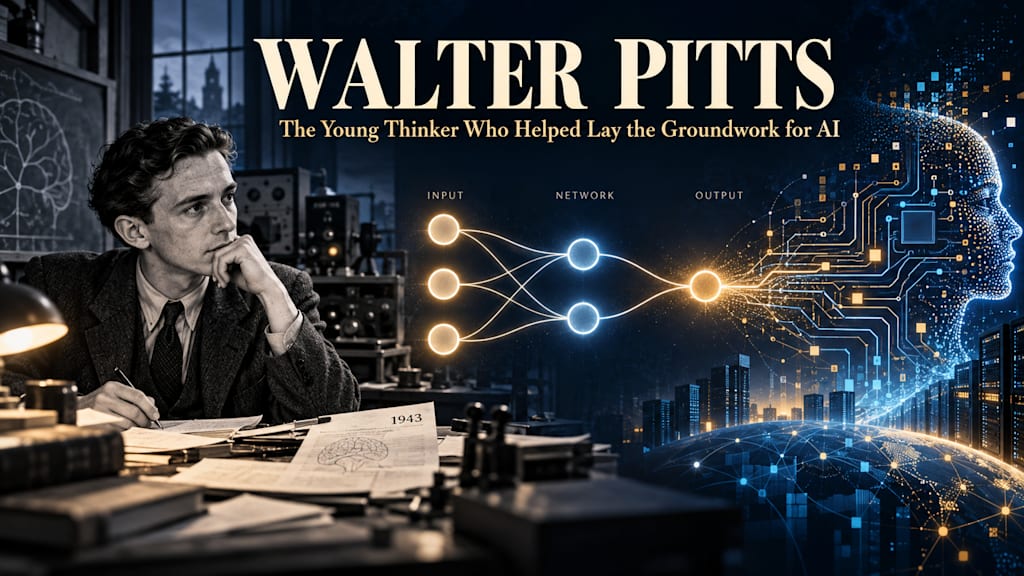
Decades before modern artificial intelligence, Pitts and Warren McCulloch showed how networks of simple artificial neurons might perform logical tasks.
Introduction
Today, artificial intelligence can recognise speech, identify objects in photographs and produce convincing passages of writing. The machinery behind these achievements is enormously complex, but one of its early ideas was surprisingly simple. What if a brain could be studied as a network of small units, each responding to signals from other units?
In 1943, Walter Pitts and Warren McCulloch published a paper exploring that question. They did not build a modern AI system, and their model could not learn as today’s neural networks do. They established something more fundamental: a network of simplified artificial neurons could be described mathematically and used to carry out logical operations. Their paper became part of the groundwork on which later neural-network research was built.
An Unusual Young Thinker
Walter Pitts was born in Detroit in 1923. He was largely self-taught in the mathematics and logic that would shape his career. Accounts of his childhood describe a young man drawn to difficult books and determined to understand the rules beneath thought itself.
One often-repeated story says that, at twelve, he spent days reading Principia Mathematica, the formidable work of Bertrand Russell and Alfred North Whitehead. Stories about precocious thinkers can become embellished over time, so the precise details deserve caution. What is clear is that Pitts developed an exceptional command of logic while still young and pursued ideas well beyond an ordinary school curriculum.
He eventually joined a circle of researchers interested in the relationship between the brain, mathematics and machines. Among them was Warren McCulloch, a scientist who studied the nervous system. Their partnership brought together a question about living brains and a way of expressing that question in logic.
Can a Neuron Make a Decision?
A real neuron is a living cell with complicated behaviour. McCulloch and Pitts deliberately stripped away most of that complexity. In their model, an artificial neuron received signals and either produced an output or did not. Its response depended on the inputs it received, including signals that could prevent it from firing.
Imagine a lamp that lights only when two switches are on. That arrangement performs the logical task we call AND. Another arrangement might light when either switch is on, performing OR. A carefully connected collection of artificial neurons could represent more complicated combinations of such decisions.
The achievement was not the discovery that the brain literally consists of little switches. It was showing how logical processes might emerge from a network of simple connected elements. Instead of placing an entire thought inside one special unit, the model made the pattern of connections important.
That idea helped researchers ask a new kind of question. If we specify what each unit does and how the units connect, what can the whole network accomplish? The 1943 paper gave them a formal way to investigate it.
Why This Mattered for Artificial Intelligence
The term artificial intelligence had not yet become the name of a research field when McCulloch and Pitts published their paper. Their immediate concern was the nervous system and the logic of its activity. Nevertheless, the possibility of performing complex tasks with networks of simple units would become highly influential in computing and AI.
Their artificial neuron was an early ancestor of the units used in later neural-network models. Researchers subsequently developed methods for changing connections and improving a system’s performance through training. Modern networks can contain immense numbers of adjustable values and require vast amounts of data and computing power. The McCulloch–Pitts model had none of that machinery.
That distinction matters. It would be misleading to say that Pitts invented the technology behind today’s chatbots in one step. His contribution was to help establish a way of thinking: networks of relatively simple units could process information, and mathematics could reveal what those networks were capable of doing. Later generations built and rebuilt upon that foundation.
The Frog’s Eye
Pitts’s interests extended beyond his early theoretical model. In 1959, he was among the authors of another influential paper, What the Frog’s Eye Tells the Frog’s Brain. The researchers examined signals travelling from a frog’s eye and found that different pathways responded to particular features of what the frog saw. The eye was doing more than simply passing along an untouched picture.
That discovery adds an interesting turn to Pitts’s story. The living nervous system proved more intricate than a simple chain of on-or-off decisions. Some processing happened before visual information reached the brain, with different cells responding to aspects such as movement and contrast. The work influenced thinking about perception while reminding researchers that a useful mathematical model is still a simplification of biology.
There is no contradiction in valuing both papers. The 1943 model helped make neural computation a subject that could be studied rigorously. The later experiment helped reveal how much more there was to understand about actual neurons and sensory systems.
A Life Beyond the Famous Paper
Pitts worked with researchers who helped shape early studies of brains and computation, including McCulloch and Jerome Lettvin. Yet his personal story was difficult, and his name never became as familiar to the public as those of some later AI pioneers. He died in 1969, only forty-six years old.
His death came long before neural networks became part of everyday technology. He never saw a phone recognise its owner’s face or a computer respond to a spoken question. We cannot know what he would have thought of those systems, and we should not pretend that he foresaw every development that followed his work.
What we can say is that the question he helped formulate has endured. How much complex behaviour can arise when simple processing units are joined together? It is still a question for AI researchers, neuroscientists and philosophers, even though they approach it with tools Pitts could scarcely have imagined.
Conclusion
Walter Pitts was neither the sole inventor of artificial intelligence nor a footnote to someone else’s achievement. With Warren McCulloch, he produced a landmark model that connected neurons, logic and computation. His later work on the frog’s visual system showed his continuing interest in how living creatures process information.
Modern AI has travelled a long way from the artificial neurons of 1943. Its systems learn in ways that Pitts’s original model did not, and biological brains remain far more complicated than any simple diagram. Yet his central question still feels remarkably current: what happens when many modest units are connected in the right way?
About the Creator
Alan Spencer
Have been an author and writer for over 20 years. Have been a journalist, editor, proofreader, and a designer and presenter of training courses. Have written over 100 articles, two books, and around 20 training courses.
Enjoyed the story? Support the Creator.
Subscribe for free to receive all their stories in your feed. You could also become a paid subscriber, letting them know you appreciate their work.
Comments
There are no comments for this story
Be the first to respond and start the conversation.