
Video Conferencing Market Gains Momentum with AI Integration
How AI integration, hybrid work trends, and cloud collaboration tools are transforming communication efficiency and enterprise connectivity in the video conferencing market

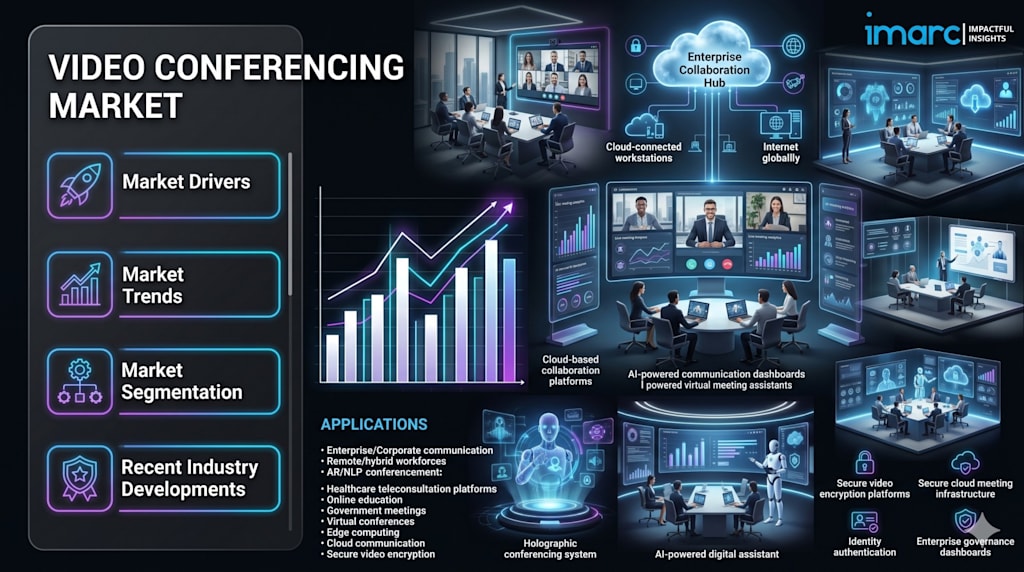
According to IMARC Group's latest research publication, The global video conferencing market size was valued at USD 13.8 Billion in 2025. Looking forward, IMARC Group estimates the market to reach USD 31.4 Billion by 2034, exhibiting a CAGR of 9.60% from 2026-2034.
How Video Conferencing is Reshaping the Future of Global Communication
- AI-Enabled Intelligence Transforming Virtual Meetings: Artificial intelligence has fundamentally changed what video conferencing platforms can deliver, moving well beyond simple audio-visual transmission toward adaptive, intelligent communication environments. Modern platforms now incorporate AI-driven noise suppression, real-time transcription, automated meeting summaries, live translation, and smart speaker framing that keeps participants centered on screen without manual camera adjustment.
- Machine learning algorithms continuously analyze participant behavior, bandwidth conditions, and environmental variables to optimize video quality and audio clarity in real time, ensuring consistent meeting experiences even under constrained network conditions.
- AI-powered sentiment analysis tools embedded within enterprise video conferencing platforms are beginning to surface insights from meeting dynamics, flagging engagement drops and attention patterns to help team leaders run more productive sessions.
- In March 2024, Zoom and Avaya announced a strategic alliance merging Zoom's AI-oriented collaborative platform "Zoom Workplace" with Avaya's "Communication and Collaboration Suite," creating an integrated ecosystem that streamlines communication and workflow management for enterprise customers at scale.
- Remote and Hybrid Work Culture Driving Structural Demand: The normalization of flexible work arrangements has permanently elevated video conferencing from a convenience tool to a mission-critical enterprise infrastructure component. In the United States, approximately 12.2% of workers operate fully remotely, while 28.5% of employees work from home on a hybrid basis, generating sustained daily demand for high-performance virtual meeting platforms across every industry vertical.
Video Conferencing Industry Overview
The video conferencing sector occupies a strategically central position within the broader enterprise technology landscape, functioning as the connective tissue linking distributed workforces, remote education systems, telehealth networks, and government digital services. The market is experiencing strong growth momentum as investments in digital infrastructure converge with permanent shifts in how organizations, institutions, and individuals structure communication across geographic boundaries.
North America commands the dominant regional position, holding 39.8% of the global market share, underpinned by mature digital infrastructure, high enterprise technology adoption rates, and a highly competitive vendor ecosystem that continuously drives product innovation. The region benefits from 96% adult internet usage in the United States, according to Pew Research Centre data, providing an exceptionally broad addressable population for video communication platforms operating across professional, educational, and healthcare segments.
Video Conferencing Market Trends and Drivers
The integration of video conferencing tools with broader enterprise productivity ecosystems is a defining trend shaping procurement decisions across large organizations. Platforms that function as standalone communication tools are losing competitive ground to integrated suites that connect seamlessly with project management software, document collaboration tools, customer relationship management systems, and enterprise resource planning platforms, creating unified digital workspaces that remove friction from daily collaboration workflows.
Security and compliance architecture has emerged as a primary selection criterion, particularly in regulated industries including finance, healthcare, and government. Organizations managing sensitive data and privileged communications are prioritizing on-premises deployment models, which currently hold 58.7% of the market by deployment mode, precisely because they offer complete control over data sovereignty and infrastructure customization without dependency on third-party cloud environments.
The telepresence segment continues to lead by conference type, driven by demand from large enterprises conducting high-stakes executive meetings, cross-border board sessions, and complex multi-party negotiations where the quality of communication directly influences decision outcomes. These systems replicate in-person presence through high-definition video, spatial audio, and life-size display configurations that meaningfully reduce the cognitive and emotional gap between virtual and physical interaction.
Corporate communications holds the largest share by application, reflecting how fundamentally video conferencing has become embedded in the operational fabric of modern business. Whether for daily team stand-ups, quarterly business reviews, client presentations, or cross-departmental strategy sessions, video conferencing now serves as the default communication medium for organizations managing geographically distributed teams across time zones and borders.
Leading Companies Operating in the Global Video Conferencing Industry
- Adobe Inc.
- Amazon Web Services Inc.
- Avaya Inc.
- Cisco Systems Inc.
- Goto Group Inc.
- HP Inc.
- Huawei Technologies Co. Ltd.
- Logitech International S.A.
- Microsoft Corporation
- Vidyo Inc.
- Zoom Video Communications Inc.
Video Conferencing Market Report Segmentation
By Component:
- Hardware (Camera, Microphone/Headphone, Others)
- Software
- Service (Professional Services, Managed Services)
Hardware represents the largest segment, holding 49.8% of market share, driven by organizational investment in high-quality cameras, noise-canceling microphones, and room-based conferencing systems that deliver professional-grade audio-visual experiences across enterprise and institutional environments.
By Conference Type:
- Telepresence System
- Integrated System
- Desktop System
- Service-Based System
Telepresence systems lead this segment, favored by large enterprises for their ability to deliver immersive, high-fidelity virtual presence experiences that closely replicate the communicative quality of in-person meetings for executive and high-stakes business discussions.
By Deployment Mode:
- On-Premises
- Cloud-Based
On-premises deployments dominate with 58.7% of market share, reflecting the priority placed by enterprises in regulated industries on data security, infrastructure control, and customization flexibility that cloud-based alternatives cannot fully replicate.
By Enterprise Size:
- Large Enterprises
- SME (Small and Medium-sized Enterprises)
Large enterprises hold 55.9% of market share, driven by their complex, multinational communication requirements, higher security standards, and larger technology budgets that support investment in advanced, scalable video conferencing systems.
By Application:
- Corporate Communications
- Training and Development
- Marketing and Client Engagement
Corporate communications is the leading application segment, as organizations depend on video conferencing for the full spectrum of internal and external business communication, from daily team coordination to executive leadership sessions and client engagement.
By End Use:
- Corporate
- Education
- Healthcare
- Government and Defense
- BFSI
- Media and Entertainment
- Others
Corporate end users lead with 37.6% of market share, with education and healthcare emerging as the fastest-growing verticals as both sectors institutionalize hybrid delivery models and digital-first service engagement strategies.
Regional Insights:
- North America (United States, Canada)
- Asia Pacific (China, Japan, India, South Korea, Australia, Indonesia, Others)
- Europe (Germany, France, United Kingdom, Italy, Spain, Others)
- Latin America (Brazil, Mexico, Others)
- Middle East and Africa
North America leads globally with 39.8% of market share, supported by advanced digital infrastructure, high enterprise adoption rates, and a mature competitive vendor ecosystem that continuously drives feature innovation and platform integration capabilities.
Recent News and Developments in the Video Conferencing Market
- October 2024: Adobe Inc. announced at Adobe MAX that the Firefly family of generative AI models now includes video capabilities, available in limited beta. The Firefly video model is positioned as the first commercially safe AI video solution, building on a foundation that has generated over 13 billion images since its launch, expanding Adobe's role in AI-powered creative and communication workflows.
- September 2024: GoTo launched GoTo Connect CX, an AI-enabled multichannel customer experience solution designed for small and medium-sized businesses. The platform integrates the GoTo Connect suite with AI enhancements to enable more efficient and engaging customer communication across multiple channels simultaneously.
- September 2024: HP Inc. declared at HP Imagine a new generation of AI-enabled video conferencing solutions alongside next-generation AI personal computers and scalable GPU performance tools. The announcements are designed to redefine professional work dynamics through enhanced audio, video, and AI platforms that support both individual and enterprise productivity.
Note: If you require specific details, data, or insights that are not currently included in the scope of this report, we are happy to accommodate your request. As part of our customization service, we will gather and provide the additional information you need, tailored to your specific requirements. Please let us know your exact needs, and we will ensure the report is updated accordingly to meet your expectations.
About the Creator
Abhay Rajput
I am working in market research company that provides market and business research intelligence across the globe.
Enjoyed the story? Support the Creator.
Subscribe for free to receive all their stories in your feed.
Comments
There are no comments for this story
Be the first to respond and start the conversation.