
Vegetable Seed Market Trends: Precision Breeding, Sustainable Agriculture & Industry Forecast to 2034
How precision breeding and biotechnology innovations are improving yield potential, disease resistance, and adaptability to changing environmental conditions in vegetable seed production

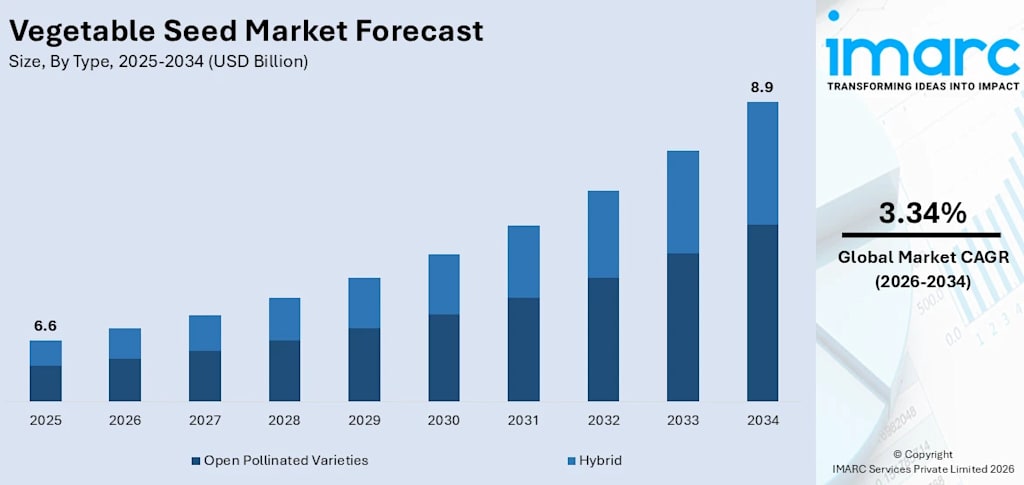
Rising global populations, the modernization of agriculture, and a growing consumer shift toward nutrient-dense diets are fueling the demand for high-quality vegetable seeds. These seeds are the foundation of food security, enabling farmers to enhance yields on limited arable land while meeting the needs of a health-conscious public. According to IMARC Group’s latest data, the global vegetable seed market size was valued at USD 6.6 Billion in 2025. Looking forward, IMARC Group estimates the market to reach USD 8.9 Billion by 2034, exhibiting a CAGR of 3.34% from 2026-2034.
Vegetable seeds have evolved into a sophisticated global industry essential for both commercial large-scale farming and the burgeoning home-gardening sector. Market expansion is driven by the rapid adoption of hybrid varieties that offer superior disease resistance and uniformity, as well as a significant push for organic and non-GMO options in developed regions. Retail innovation through specialized e-commerce platforms and the expansion of protected cultivation such as greenhouses and hydroponics are further accelerating market reach. Key segments include Solanaceae, Root & Bulb, and Brassica, with growers increasingly prioritizing climate-resilient traits, enhanced nutritional profiles, and high germination rates to ensure profitable and sustainable harvests.
Get Your Free "Vegetable Seed Market" Forecast & Insights Sample
Vegetable Seed Market Growth Drivers:
- Global Food Security and Population Pressures
As the global population heads toward a projected 9.7 billion by 2050, the agricultural sector faces the massive task of increasing food production by nearly 60%. Vegetable seeds are at the heart of this challenge, providing the genetic foundation for high-yielding crops. In regions like Asia-Pacific, where arable land is increasingly limited, there is a surge in demand for short-duration and high-performance seeds. Farmers are moving away from traditional saved seeds toward certified, high-quality varieties that guarantee better caloric output and consistent supply for urban centers.
- Surge in Health and Wellness Consciousness
Modern consumers are increasingly replacing processed carbohydrates with fresh, nutrient-dense vegetables to combat lifestyle diseases like obesity and diabetes. This dietary shift has created a lucrative market for "functional" vegetables varieties bred specifically for higher vitamin, mineral, or antioxidant content. For instance, the organic vegetable sector in the U.S. alone reached a valuation of approximately USD 3.5 billion recently. This demand forces seed producers to innovate, developing varieties that not only grow efficiently but also meet the flavor and nutritional expectations of a health-focused demographic.
- Technological Advancements in Seed Breeding
The industry is witnessing a transition from conventional breeding to advanced biotechnological methods like gene editing and molecular markers. These tools allow for the development of "climate-smart" seeds that can thrive in saline soils or survive extreme heat and drought. Hybrid seeds are particularly favored in commercial farming because they can deliver yield gains of up to 20% compared to older open-pollinated types. With over 90% of certain major crops in North America already utilizing advanced seed traits, the move toward tech-heavy, resilient vegetable seeds is becoming the global standard.
Vegetable Seed Market Trends:
- Expansion of Protected and Urban Cultivation
Changing weather patterns and the need for year-round production have led to a boom in greenhouse and vertical farming. These controlled environments require specialized seeds designed for high-density planting and lower light conditions. Currently, protected cultivation accounts for a massive share of high-value vegetable production globally. Urban farming initiatives in "smart cities" are also driving the demand for dwarf or container-friendly vegetable varieties. This trend allows for local, "farm-to-table" supply chains, reducing the carbon footprint of logistics while ensuring urban dwellers have access to fresh produce.
- Shift Toward Sustainability and Organic Sourcing
There is a growing institutional and consumer push for "green seeds"—those produced without synthetic chemicals and treated with biological rather than chemical coatings. Europe, for example, is targeting a six-fold increase in organic seed production over the next decade to meet its sustainability goals. Brands are responding by launching non-GMO and certified organic seed lines to appeal to eco-conscious hobbyists and commercial organic farmers. This trend is supported by new regulatory frameworks that favor biodiversity and the reduction of chemical runoff in agricultural heartlands.
- Digitalization of Seed Distribution and Precision Farming
The way seeds reach the soil is being transformed by e-commerce and precision agriculture. Online marketplaces for seeds are growing at a double-digit pace, offering farmers and gardeners access to niche, heirloom, and high-tech varieties that were previously hard to source. On the commercial side, "variable-rate seeding" uses data analytics to determine the exact number of seeds needed per acre based on soil health. This precision reduces waste and ensures that every seed has the optimal environment to reach its full genetic potential, maximizing the return on investment for growers.
Recent News and Developments in Vegetable Seed Market:
- September 2025: The Chinese Ministry of Agriculture (MARA) released an updated report confirming that domestic seed supply for the 2025/26 season is sufficient to meet record-high demand, following a 17% increase in the acreage dedicated to high-performance hybrid production.
- May 2025: Sakata Seed Corporation officially opened a new 2.5-hectare R&D station in Turkey. The facility is dedicated to breeding resilient cucumber, tomato, and pepper varieties specifically tailored for the challenging climates of the Middle East and Central Asia.
- March 2025: Ferry-Morse expanded its retail footprint by launching 50 new non-GMO and organic vegetable seed varieties, targeting the growing wave of American "hobbyist" gardeners looking for regional and aesthetic diversity in their home patches.
Note: If you require specific details, data, or insights that are not currently included in the scope of this report, we are happy to accommodate your request. As part of our customization service, we will gather and provide the additional information you need, tailored to your specific requirements. Please let us know your exact needs, and we will ensure the report is updated accordingly to meet your expectations.
About the Creator
Andrew Sullivan
Hello, I’m Andrew Sullivan. I have over 9+ years of experience as a market research specialist.
Enjoyed the story? Support the Creator.
Subscribe for free to receive all their stories in your feed.
Comments
There are no comments for this story
Be the first to respond and start the conversation.