
Usage-based Insurance Market Gains Momentum Through AI Adoption
The usage-based insurance market is growing due to rising demand for personalized and cost-effective insurance solutions worldwide.

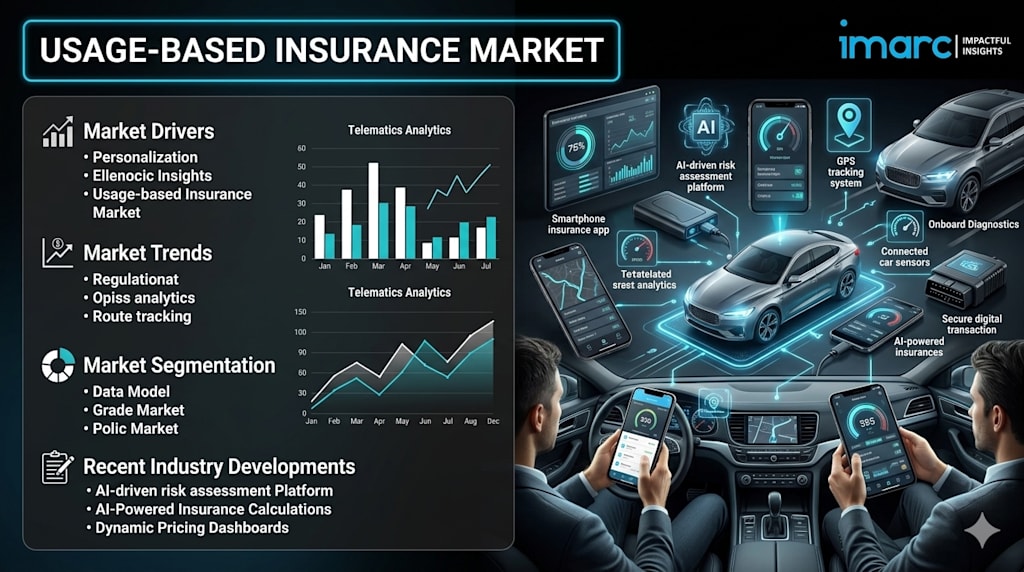
According to IMARC Group's latest research publication, the global usage-based insurance market reached USD 62.35 Billion in 2024. Looking ahead, IMARC Group projects the market will expand significantly through 2033, with advanced telematics technologies and smartphone-based solutions becoming standard across the insurance industry.
How AI is Reshaping the Future of Usage-Based Insurance Market
- Behavioral Risk Prediction and Personalized Pricing Models: AI algorithms analyze driving patterns—acceleration, braking, speed variations—to assign risk scores instantly. Insurers now calculate premiums reflecting actual driving behavior rather than demographic assumptions, enabling safe drivers to save substantially on coverage costs.
- Real-Time Telematics Data Processing and Fleet Optimization: Machine learning processes millions of data points from connected vehicles daily, identifying high-risk driving behaviors and intervention opportunities. Companies implementing these solutions achieve faster claims processing and improved loss prevention outcomes across their customer portfolios.
- Predictive Maintenance and Vehicle Health Monitoring: AI-powered diagnostic systems monitor vehicle sensor data to predict equipment failures and maintenance needs before breakdowns occur. This proactive approach reduces accident risks while helping drivers maintain vehicles in optimal condition, directly supporting safer roads.
Usage-Based Insurance Industry Overview
The usage-based insurance sector is experiencing fundamental transformation driven by telematics adoption and consumer demand for fair, transparent pricing. Insurers across North America, Europe, and Asia Pacific are embedding connected car technologies into their core business models, moving away from traditional demographic-based underwriting toward behavior-driven models that reward safe driving. Car manufacturers including Stellantis, Kia, and Ford are pre-installing telematics capabilities in new vehicles, enabling seamless data collection without aftermarket devices.
Usage-Based Insurance Market Trends & Drivers
Telematics technology enables insurers to collect real-time driving data—acceleration patterns, speed variations, braking behavior—remotely from vehicles, creating unprecedented transparency in risk assessment. About 20 million of the 875 million motor insurance plans globally now incorporate usage-based elements, reflecting growing consumer acceptance. Insurers benefit from accurate, behavior-based premium calculations while drivers appreciate direct control over their costs through demonstrable safe driving.
Global road traffic incidents claim 1.3 million lives annually and injure 20 to 50 million people, according to WHO data, creating urgent demand for behavior-change solutions. Governments worldwide are implementing comprehensive road safety initiatives—NSW's 2026 Road Safety Action Plan and the US federal "Road to the Zero" project targeting highway fatality elimination by 2050—that align perfectly with usage-based insurance incentives.
Connected and autonomous vehicles generate vast volumes of driving data, enabling sophisticated risk assessment and personalized insurance offerings previously impossible. New vehicle penetration in usage-based programs reached 60.6% market share, as factory-installed telematics, onboard diagnostics, and IoT technologies eliminate aftermarket installation complexity.
Leading Companies Operating in the Global Usage-Based Insurance Market
- Aioi Nissay Dowa Insurance UK Ltd
- Allianz SE
- Allstate Insurance Company
- American International Group Inc.
- Assicurazioni Generali S.p.A.
- AXA
- Liberty Mutual Insurance Company
- Mapfre S.A.
- Progressive Casualty Insurance Company
- State Farm Automobile Mutual Insurance Company
- TomTom International BV
- UnipolSai Assicurazioni S.p.A. (Unipol Gruppo S.p.A)
Usage-Based Insurance Market Segmentation
By Type
- Pay-As-You-Drive (PAYD) – 55.2% market share
- Pay-How-You-Drive (PHYD)
- Manage-How-You-Drive (MHYD)
- Others
Pay-as-you-drive represents the dominant segment, allowing policyholders to pay premiums based solely on distance driven.
By Technology
- OBD II
- Black Box – 40.3% market share
- Smartphones
- Others
Black box technology leads the market, providing in-car devices that track comprehensive driving metrics including speed, braking patterns, acceleration, and cornering behavior.
By Vehicle Type
- Light-duty Vehicle (LDV) – 85.8% market share
- Heavy-duty Vehicle (HDV)
Light-duty vehicles dominate usage-based insurance adoption.
By Vehicle Age
- New Vehicles – 60.6% market share
- Used Vehicles
New vehicles command dominant market share due to factory-installed telematics, onboard diagnostics.
Regional Insights
- North America
- Europe
- Asia Pacific
- Latin America
- Middle East and Africa
Recent News and Developments in Usage-Based Insurance Market
- June 2025: Zuno General Insurance launched India's first crash detection-enabled car insurance through its Zuno Smart Drive app.
- May 2025: If P&C Insurance launched an embedded car-sharing insurance product on Socotra's cloud-native platform.
Note: If you require specific details, data, or insights not currently included in this report, we are happy to accommodate your request. As part of our customization service, we will gather and provide additional information tailored to your specific requirements. Please let us know your exact needs, and we will ensure the report is updated accordingly to meet your expectations.
About the Creator
sujeet. imarcgroup
With 2 years of hands-on experience at IMARC Group, I have conducted in-depth market research and analysis across diverse industries including technology, healthcare, agriculture, and consumer goods.
Enjoyed the story? Support the Creator.
Subscribe for free to receive all their stories in your feed.
Comments
There are no comments for this story
Be the first to respond and start the conversation.