
US Small Satellite Market: Fastest-growing Segment of the US Commercial Aerospace Market supported by Defense-led Applications‚ Commercial Space‚ and Earth Intelligence
The United States small satellite market size was valued at USD 167.6 Million in 2025. The market is projected to reach USD 533.4 Million by 2034, exhibiting a CAGR of 13.59% from 2026-2034

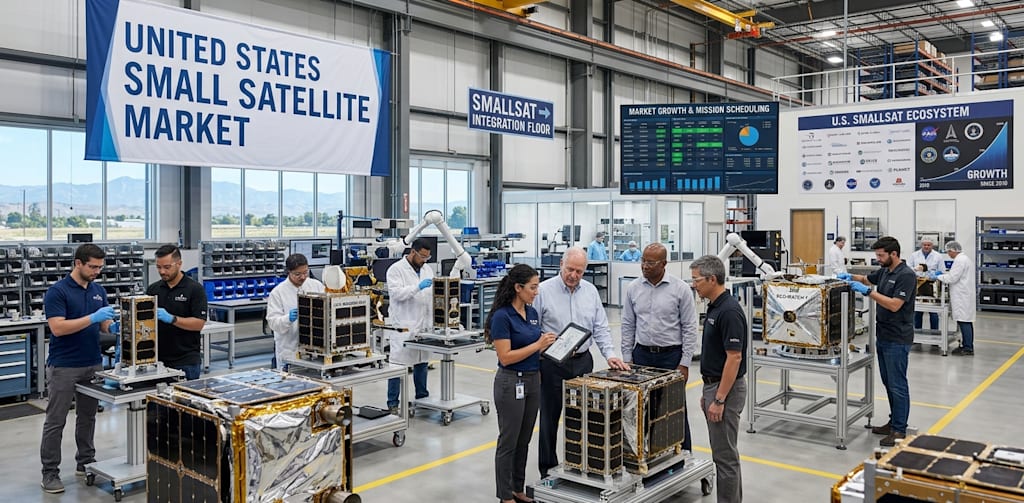
The United States small satellite industry has continued to grow․ A wider set of satellite technologies has become more affordable․ Satellite missions that were once dominated by large government-led missions can now be accomplished with small satellites‚ enabling a wider range of applications and increased participation by universities and the private sector․
According to IMARC Group‚ the US small satellite market was valued at USD 167․6 million in 2025 and is expected to reach USD 533․4 million by 2034‚ growing at a CAGR of 13․59% from 2026 to 2034․ This is driven by the demand for real-time data‚ national security use cases‚ and satellite-based solutions across commercial and government sectors․
Progressing toward more agile and cost-effective space systems
The small satellite market in the United States is part of a historic shift in the global space economy․ Costly and years-in-the-making‚ large satellites are increasingly being augmented and sometimes replaced by small modular space systems that can be deployed in months and for a fraction of the cost․
This has enabled a new set of players‚ such as startup companies‚ academic institutions and defense agencies‚ to enter space‚ and the economics of deploying constellations of satellites‚ rather than a smaller number of bigger satellites‚ has also fundamentally changed how data is collected‚ processed and used․
Defense and government applications drive core demand․
Close relationships between defense and government agencies are a key factor in the success of the US small satellite marketplace․ Small satellites are increasingly being used for:
Surveillance and intelligence gathering
- Secure communication systems
- Missile tracking and early warning systems
- Battlefield situational awareness
- Disaster monitoring and disaster response coordination
Their low cost and ease of deployment make them attractive options for a military's modernization program‚ and their ability to operate in a low Earth orbit (LEO) allows for low latency monitoring and data transmission․
Expanding Role in Commercial and Civil Applications
There is also a growing commercial market for small satellites‚ with many industries in the public and private sectors using satellite data to improve decision making․
Key commercial applications include:
- Precision agriculture and crop monitoring
- Logistics and fleet tracking
- Urban planning and infrastructure management
- Weather forecasting and climate assessment
- Telecommunications and broadband connectivity
With the rise of such data-driven industries‚ demand for near real-time geospatial intelligence is likely to expand‚ which small satellites are well-placed to deliver with their frequent and high-resolution Earth observation capabilities․
Environmental Monitoring and Climate Intelligence
Another major area of growth is environmental applications․ Small satellites are widely used for environmental monitoring:
- Climate change indicators
- Ocean temperature and currents
- Deforestation and other land use changes
- Natural disasters include hurricanes and wildfires․
Their ability to repeatedly image the same area makes satellites important for science and environmental policy․ With the growing concern about global warming‚ the demand for satellite based data for global warming may be expected to grow․
Technological developments are transforming the sector․
The United States has continued to be a leader in satellite technology‚ with advances in miniaturization of components‚ propulsion‚ and onboard computer technology that have allowed satellites to become smaller and more powerful․
Prominent innovations include:
- Miniaturized sensors and payload systems
- Software-defined satellites with reprogrammable functionality
- Analytics and data processing powered by artificial intelligence
- Lowering deployment costs for rideshare systems
- Improved access to orbit with reusable launches
Instead‚ these developments allow for continual updates and improvements to be made without replacement of earlier satellites․
Competitive landscape and industry dynamics
The US small satellite market is competitive and consists of incumbent space companies‚ defense contractors and newer space startups‚ with a specific feature being the partnerships between private companies and government agencies in the ecosystem․
Some trends in the competitive landscape include:
- Increased public-private partnerships
- Concentrate on vertically integrated satellite solutions
- The expansion of satellite constellations for global communications
- Investing in faster manufacturing and launches
Companies prefer to control the entire value chain from design to manufacturing‚ from product launch to data services‚ to optimize their costs and provide better services․
Market Outlook
The United States small satellite industry will continue to grow through 2034 as the demand for small satellite applications‚ the modernization of defense programs‚ and the reliance on the real-time Earth intelligence will continue to drive the demand for small satellites․
As technology improves‚ small satellites are expected to continue playing an important role in communication networks‚ environmental monitoring‚ and global data infrastructure․ Their flexible‚ cheaper nature makes them a key technology in the coming space economy․
About the Creator
michael matthew
I’m a market researcher passionate about understanding people, markets, and motivations. My work blends data analysis, consumer psychology, and strategic insight to help brands and businesses make informed, human-centered decisions.
Enjoyed the story? Support the Creator.
Subscribe for free to receive all their stories in your feed.
Comments
There are no comments for this story
Be the first to respond and start the conversation.