
United States Smart Thermostat Market: Growth Driven by Smart Homes and Energy Efficiency
The United States smart thermostat market is expanding rapidly as consumers adopt AI-powered smart home technologies to improve comfort, reduce energy costs, and enhance sustainability.

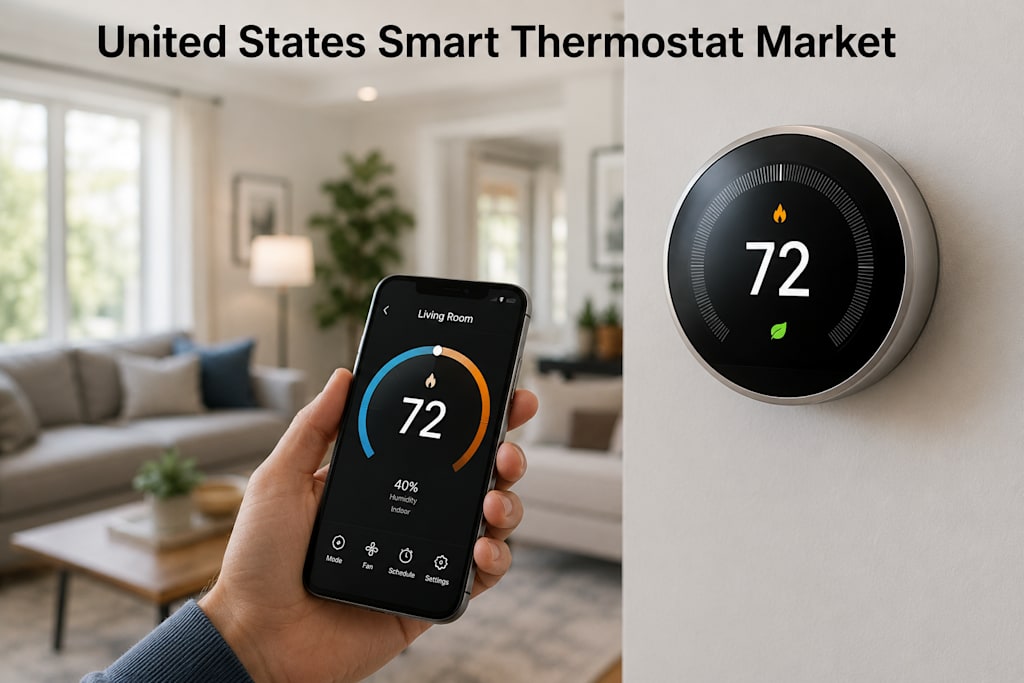
Smart thermostats are becoming increasingly integrated into the United States smart home market, a sector which is growing at a phenomenal rate. This trend is fueled by consumer demand for automated homes that conserve energy and cost while integrating seamlessly with other networked devices and applications. As such, smart thermostats are rapidly gaining traction in the U.S. And are poised to become a central element of the nation's expanding smart home and energy control landscape. The United States smart thermostat market was valued at $1,208.8 million in 2025, but projections by IMARC Group estimate it to grow to $4,518.9 million by 2034 at a compound annual growth rate (CAGR) of 15.31% for the 2026-2034 period.
The increasing demand for energy efficiency and savings has been one of the main factors driving market expansion. Given that HVAC is the largest contributor to household energy consumption, smart thermostats that automatically regulate temperature based on occupancy, schedules, and real-time weather conditions help homeowners and business operators reduce energy wastage while optimizing comfort. The rise in the popularity of smart home devices is another contributing factor to market growth. Consumers are increasingly drawn to connected technology that allows for convenient remote control via smartphone applications or voice assistants like Amazon Alexa, Google Assistant, and Apple HomeKit, enabling users to monitor and manage energy usage from anywhere.
Rapid technological advancements are at the forefront of market growth. The integration of AI and machine learning capabilities into smart thermostats allows them to learn user preferences, adapt to changing needs, and optimize temperature settings more effectively, enhancing user convenience and energy efficiency. Features like geofencing and occupancy detection offer enhanced convenience, while adaptive scheduling and real-time energy monitoring capabilities enable proactive energy management. One of the most popular trends in the market is the growth in the demand for learning smart thermostats, which are designed to create fully automated climate control schedules by analyzing user behavior patterns and environmental conditions to maximize both comfort and energy savings. The widespread adoption of AI-driven home automation solutions is expected to boost demand for these devices further.
Government incentives and policies are also encouraging the adoption of smart thermostats. Various federal and state programs that promote energy-efficient appliances and smart home technologies offer homeowners rebates, tax credits, and utility incentives for investing in devices like smart thermostats. ENERGY STAR certified devices, for example, are particularly favored and receive significant policy support in an effort to reduce overall energy consumption and greenhouse gas emissions. Another developing trend in the smart thermostat market is increased integration of these devices into comprehensive IoT ecosystems, including smart lighting systems, smart locks, security systems, solar energy systems, and EV charging solutions, thus creating fully interconnected smart homes and maximizing convenience and efficiency.
Smart thermostats are classified into three categories based on functionality: standalone smart thermostats, connected smart thermostats, and learning smart thermostats.Wireless smart thermostats are most popular, due to ease of installation and compatibility with existing networks.Smart thermostat applications include residential, commercial, and industrial sectors, with residential use currently dominating the market share.The home market is robust as homeowners seek energy-efficient and smart home comfort and utility.Commercial smart thermostat use is on the rise as businesses, hotels, office buildings, educational facilities and retail spaces adopt energy-saving smart thermostats. By region, adoption is growing across Northeast, Midwest, South, and West states, driven by increased smart home penetration, utility modernization initiatives, and increasing awareness of sustainable living. The market is noteworthy because it addresses two significant societal and business trends: sustainability and digital transformation. Combining automation and energy savings, the smart thermostat serves an attractive solution to both eco-conscious consumers and high-tech homeowners alike. Future growth will likely be fueled by continued innovations in AI, IoT and smart home integration as consumers' demand for more convenience and energy management in their lives continue to drive innovation in smart thermostats.
About the Creator
michael matthew
I’m a market researcher passionate about understanding people, markets, and motivations. My work blends data analysis, consumer psychology, and strategic insight to help brands and businesses make informed, human-centered decisions.
Enjoyed the story? Support the Creator.
Subscribe for free to receive all their stories in your feed.
Comments
There are no comments for this story
Be the first to respond and start the conversation.