
United States Process Instrumentation Market Set for Steady Growth Through 2034
Automation, Smart Manufacturing, and Infrastructure Modernization Drive Demand Across American Industries

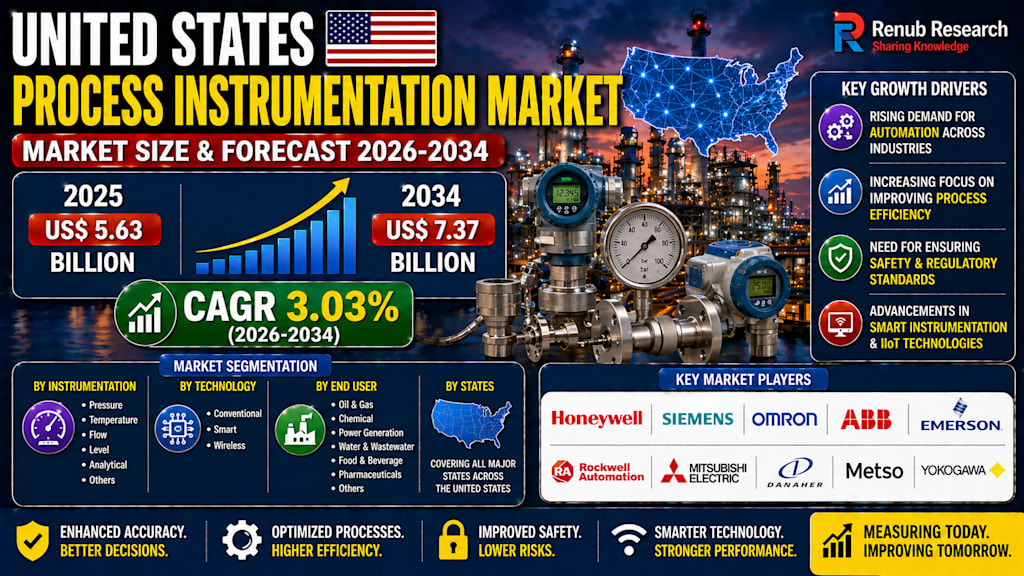
The United States Process Instrumentation Market is entering a phase of consistent and sustainable expansion as industries across the nation continue modernizing their operations. According to Renub Research, the market is projected to grow from US$ 5.63 Billion in 2025 to US$ 7.37 Billion by 2034, registering a CAGR of 3.03% during 2026–2034. This steady rise reflects the growing need for automation, process efficiency, safety compliance, and real-time monitoring across multiple industrial sectors.
Process instrumentation refers to the systems and devices used to measure, monitor, and control industrial processes. These include sensors, analyzers, flow meters, pressure gauges, control valves, transmitters, and temperature controllers. They play a critical role in ensuring precision, productivity, and safety in industries such as oil and gas, chemicals, pharmaceuticals, food processing, utilities, and power generation.
As the United States strengthens its industrial base and invests in smart factories, digital transformation, and infrastructure upgrades, process instrumentation is becoming more important than ever before.
Why Process Instrumentation Matters Today
Modern industrial operations depend on data. Manufacturers and utility providers need constant information about pressure, temperature, fluid flow, levels, emissions, and system performance. Process instrumentation enables this by delivering real-time operational visibility.
Without accurate instrumentation, factories face higher risks of downtime, safety incidents, energy waste, and product inconsistency. With advanced instrumentation systems, companies can optimize production lines, improve maintenance planning, reduce waste, and remain compliant with regulations.
This growing dependence on measurement and control technologies is pushing demand higher throughout the United States.

Industrial Automation Is Accelerating Growth
One of the biggest growth drivers for the U.S. process instrumentation market is the rapid adoption of industrial automation.
Manufacturers are embracing automated systems to improve speed, accuracy, and efficiency while reducing reliance on manual labor. Industries such as chemicals, food and beverage, metals, pharmaceuticals, and electronics are increasingly implementing automated production lines that require sophisticated instrumentation.
Sensors, control systems, and digital instruments help factories maintain product quality while reducing errors and minimizing waste. These systems also allow predictive maintenance, helping companies identify equipment issues before failures occur.
As labor shortages and rising operating costs continue, automation is no longer optional—it is becoming essential.
Industry 4.0 and Smart Factories Create New Opportunities
The move toward Industry 4.0 is transforming American manufacturing. Smart factories connect machines, sensors, software platforms, and analytics tools into a single intelligent ecosystem.
Process instrumentation is the foundation of this transformation. Without reliable measurement devices, connected factories cannot gather the data needed for automation and decision-making.
Wireless sensors, cloud-connected devices, remote diagnostics, and AI-based analytics are creating new revenue opportunities for instrumentation suppliers. Companies that provide digital-ready products are expected to benefit significantly over the next decade.
Energy and Utilities Sector Fueling Demand
The energy and utilities sector is another major contributor to market growth.
Power plants, renewable energy facilities, water treatment plants, and pipeline networks depend on precise instrumentation for safe and efficient operation. Pressure monitoring, flow control, and temperature measurement are critical in these environments.
The United States is also investing heavily in upgrading aging infrastructure. Many power and water systems still rely on outdated control technologies, creating a strong replacement market for next-generation instruments.
As clean energy adoption rises, solar plants, wind farms, gas facilities, and battery storage systems are increasing demand for intelligent monitoring systems and automation solutions.
Safety Regulations and Compliance Remain Essential
Strict environmental, worker safety, and product quality regulations continue to support demand for process instrumentation.
Industries such as oil and gas, chemicals, and pharmaceuticals must continuously monitor operating conditions and maintain detailed records. Failure to comply can result in penalties, shutdowns, or reputational damage.
Modern instrumentation solutions help businesses stay compliant through:
- Continuous emissions monitoring
- Hazard detection systems
- Automatic shutdown mechanisms
- Accurate batch recording
- Product quality verification
- Remote monitoring in dangerous environments
As regulations tighten, investment in high-accuracy and traceable instrumentation systems is expected to rise further.
Key Market Challenges
Despite promising growth, the market faces certain obstacles.
High Initial Investment Costs
Advanced instrumentation systems can be expensive, especially for small and medium-sized manufacturers. Hardware, software integration, installation, engineering services, and employee training all add to upfront costs.
Many older facilities also require redesigns to integrate new digital systems.
Skilled Workforce Shortage
There is increasing demand for technicians and engineers who can install, calibrate, maintain, and troubleshoot complex instrumentation networks.
However, the U.S. manufacturing workforce is aging, and many industries face a shortage of skilled technical talent. This can slow modernization projects and increase maintenance risks.
Strong Demand by Product Category
Pressure Instruments
Pressure measurement devices remain one of the largest market segments. They are widely used in oil and gas, chemical plants, power generation, and manufacturing. Demand is rising for smart pressure transmitters with self-diagnostics and remote connectivity.
Temperature Instruments
Temperature monitoring is essential in pharmaceuticals, food processing, chemicals, and energy systems. Thermocouples, RTDs, and infrared sensors are seeing increased adoption due to their role in quality control and energy efficiency.
Flow Instruments
Flow meters are increasingly used in water systems, pipelines, beverage production, and industrial processing where accurate fluid movement data is critical.
Analytical Instruments
Gas analyzers, pH meters, and composition sensors are becoming more valuable as environmental regulations tighten and product precision requirements increase.
Technology Segments Driving Market Expansion
Programmable Logic Controllers (PLCs)
PLCs remain a core component of industrial automation in the United States. They control machinery, coordinate workflows, and integrate data from multiple instruments.
Modern PLCs now include advanced networking, remote access, and analytics capabilities.
Distributed Control Systems (DCS)
DCS platforms are essential in large continuous-process industries such as refining, chemicals, and power generation. Their ability to handle complex processes with redundancy and reliability supports long-term demand.
SCADA and MES Systems
Supervisory Control and Data Acquisition (SCADA) and Manufacturing Execution Systems (MES) are helping industries improve visibility, planning, and process control in real time.
Regional Highlights Across the United States
California
California’s leadership in semiconductors, renewable energy, pharmaceuticals, EV manufacturing, and food processing makes it a strong market for process instrumentation. Sustainability goals are further accelerating adoption.
New York
New York’s pharmaceutical, chemical, water treatment, and power sectors are creating strong demand for measurement and control systems, particularly as aging infrastructure is modernized.
Washington
Washington benefits from aerospace manufacturing, hydropower, food processing, and clean energy development. These sectors require highly reliable instrumentation technologies.
New Jersey
With its large pharmaceutical and chemical manufacturing presence, New Jersey remains one of the most important state-level markets for precision instrumentation systems.
Competitive Landscape
The United States Process Instrumentation Market features several global leaders competing through innovation, acquisitions, product launches, and digital integration strategies.
Major companies include:
- Honeywell International Inc.
- Siemens AG
- ABB Ltd.
- Emerson Electric Company
- Rockwell Automation Inc.
- Omron Corporation
- Yokogawa Electric Corporation
These companies are focusing heavily on IIoT-ready devices, cybersecurity, predictive maintenance, and cloud-connected systems.
Final Thoughts
The United States Process Instrumentation Market may not be the fastest-growing industrial segment, but it is one of the most essential. Every modern plant, utility system, refinery, and manufacturing facility depends on accurate measurement and intelligent control.
With Renub Research forecasting the market to reach US$ 7.37 Billion by 2034, the industry is positioned for dependable long-term expansion. Automation, energy modernization, regulatory compliance, and smart manufacturing will continue shaping the future of this market.
About the Creator
Enjoyed the story? Support the Creator.
Subscribe for free to receive all their stories in your feed.
Comments
There are no comments for this story
Be the first to respond and start the conversation.