
United States Photonics Market Set to Reach US$ 221.33 Billion by 2033 as Optical Technologies Transform Communications, Healthcare, and Manufacturing
From fiber-optic networks and advanced medical imaging to defense systems and consumer electronics, photonics is becoming one of the most influential technologies shaping America's innovation economy.

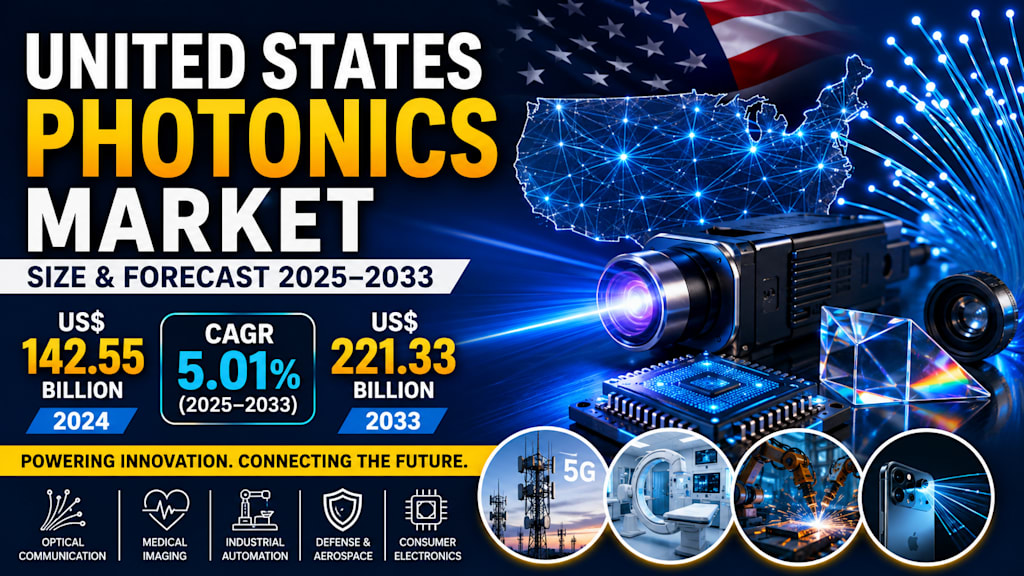
United States Photonics Market Size & Forecast 2025–2033
The United States photonics market is entering a new phase of expansion as industries increasingly rely on light-based technologies to improve efficiency, communication, precision, and performance. According to Renub Research, the U.S. Photonics Market is expected to grow from US$ 142.55 billion in 2024 to US$ 221.33 billion by 2033, registering a CAGR of 5.01% during the forecast period from 2025 to 2033.
Photonics, often described as the science and technology of generating, controlling, and detecting light, has become the foundation for numerous advanced applications. From fiber-optic internet and laser manufacturing systems to healthcare diagnostics and next-generation defense solutions, photonics is helping redefine how industries operate in an increasingly digital world.
As the United States continues investing in advanced manufacturing, artificial intelligence infrastructure, telecommunications, and healthcare innovation, photonics is emerging as a strategic technology sector with substantial long-term growth potential.
Why Photonics Matters More Than Ever
Modern economies depend heavily on fast data transmission, precise sensing, and high-performance imaging systems. Photonics enables all three.
Unlike conventional electronic systems that use electrons to transfer information, photonic technologies use photons, allowing significantly faster communication with reduced energy consumption. This advantage has made photonics indispensable in data centers, telecommunications networks, and emerging computing architectures.
The United States remains one of the world's leading photonics innovation hubs thanks to its strong research ecosystem, government support programs, world-class universities, and concentration of technology companies. The growing importance of optical technologies in quantum computing, autonomous vehicles, aerospace systems, and healthcare diagnostics continues to strengthen the country's position in the global market.
High-Speed Communication Networks Are Driving Market Growth
One of the most significant factors supporting photonics adoption is the increasing demand for faster and more reliable communication infrastructure.
The rapid expansion of cloud computing, video streaming, artificial intelligence applications, and connected devices has dramatically increased global data traffic. Traditional communication technologies struggle to meet these requirements efficiently, creating greater demand for photonics-based solutions such as optical fibers, photonic integrated circuits, and advanced transceivers.
The deployment of 5G networks across the United States has further accelerated investments in optical communication technologies. Telecommunications providers are expanding fiber-optic infrastructure to support growing bandwidth requirements and improve network reliability.
Industry reports indicate that fiber-optic installations increased significantly between 2020 and 2023, enabling broadband access to millions of additional households. At the same time, data center operators are investing heavily in photonic technologies to manage the growing computational demands generated by AI workloads and cloud services.
As next-generation communication systems continue evolving, photonics will remain essential for delivering the speed and scalability required by modern digital infrastructure.
Healthcare Applications Continue Expanding
Healthcare has become one of the most exciting growth areas for photonics technology.
Medical professionals increasingly depend on photonic systems for diagnostic imaging, minimally invasive procedures, and precision treatments. Technologies such as optical coherence tomography, laser surgery systems, fluorescence imaging, and biosensors have improved clinical outcomes while reducing patient recovery times.
The United States healthcare sector is particularly well positioned to benefit from these innovations due to its strong investment in medical research and advanced healthcare infrastructure.
Growing rates of chronic diseases, combined with an aging population, are encouraging healthcare providers to adopt technologies capable of improving early disease detection and patient monitoring. Photonic devices offer non-invasive, highly accurate diagnostic capabilities that support these objectives.
Recent increases in federal biophotonics research funding and growing numbers of photonics-based medical device approvals further demonstrate the technology's importance in modern healthcare. Hospitals, diagnostic laboratories, and research institutions are increasingly incorporating optical technologies into their operations to improve efficiency and accuracy.
As precision medicine gains momentum, photonics will continue playing a critical role in delivering personalized healthcare solutions.
Federal Support Strengthens Industry Development
Government investment remains one of the strongest pillars supporting the U.S. photonics industry.
Programs such as the National Photonics Initiative, Department of Defense research projects, National Science Foundation grants, and DARPA-funded innovation programs have significantly accelerated technological advancement.
These initiatives support research in areas including integrated photonics, quantum technologies, advanced manufacturing, optical sensing, and next-generation communication systems.
Federal agencies allocated substantial funding toward photonics-related research and development activities in recent years, reflecting the strategic importance of the sector.
In addition to direct funding, innovation clusters located in states such as California and New York have created collaborative environments where universities, startups, and established corporations work together to commercialize emerging technologies.
These innovation ecosystems help transform laboratory breakthroughs into commercially viable products, strengthening America's competitive position in global technology markets.
Market Challenges Remain
Despite strong growth prospects, the photonics industry faces several challenges.
High Production Costs
Many advanced photonic components require specialized materials, sophisticated manufacturing processes, and highly controlled production environments.
Lasers, photonic integrated circuits, advanced sensors, and imaging systems often involve complex fabrication techniques that increase manufacturing costs. These expenses can limit adoption among cost-sensitive industries and smaller organizations.
Although ongoing technological advancements may eventually reduce production costs, affordability remains a challenge for broader market penetration.
Workforce Shortages
The growing photonics industry also faces a shortage of skilled professionals.
Demand for engineers, technicians, optical scientists, and photonics specialists continues rising faster than educational institutions can produce qualified graduates. Many companies report difficulties recruiting personnel with expertise in optics, laser systems, semiconductor fabrication, and integrated photonics.
Without sufficient workforce development programs, talent shortages could slow innovation and limit the industry's growth potential.
Strengthening partnerships between universities, technical colleges, and industry organizations will be critical to addressing this challenge over the coming years.
LED Photonics Segment Shows Strong Momentum
LED-based photonics technologies continue experiencing substantial growth across multiple sectors.
Energy efficiency regulations, sustainability goals, and technological advancements have increased demand for LED lighting systems in residential, commercial, industrial, and automotive applications.
Emerging technologies such as OLED and MicroLED displays are creating additional opportunities within consumer electronics markets. Smart lighting systems, adaptive automotive headlamps, and horticultural lighting applications are also contributing to market expansion.
Major industry acquisitions and significant investments in photonic device development highlight growing confidence in the long-term prospects of LED photonics technologies.
Surveying and Detection Applications Gain Importance
Photonics plays an increasingly important role in surveying, mapping, and detection systems.
Technologies such as LiDAR, optical sensors, laser scanning systems, and advanced imaging platforms enable highly accurate measurements across various industries.
Demand is particularly strong in autonomous transportation, infrastructure development, environmental monitoring, and smart city projects.
As governments and private organizations invest in modernizing transportation networks and urban infrastructure, photonics-based surveying solutions are expected to see continued adoption.
Their ability to deliver precise data under challenging environmental conditions makes them valuable tools for engineering, defense, and geospatial applications.
Medical Technology Segment Remains a Key Growth Engine
Medical technology represents one of the fastest-growing applications for photonics.
Advanced imaging techniques, laser therapies, optical biosensors, and diagnostic tools are becoming standard components of modern healthcare delivery.
Technologies such as Raman spectroscopy and optical coherence tomography provide healthcare professionals with highly detailed information that supports faster and more accurate diagnoses.
The integration of artificial intelligence with photonic imaging systems is further enhancing diagnostic capabilities. AI-powered analysis can improve image interpretation, support clinical decision-making, and reduce diagnostic errors.
As healthcare providers seek more effective and less invasive treatment approaches, photonics-based medical technologies are expected to experience sustained growth.
Consumer Electronics Continue Driving Demand
Consumer electronics manufacturers remain among the largest users of photonic technologies.
Modern smartphones, wearable devices, augmented reality headsets, and smart home products increasingly rely on optical components to deliver advanced functionality.
Facial recognition systems, LiDAR sensors, high-resolution cameras, gesture recognition technologies, and display systems all depend on sophisticated photonic solutions.
The growing popularity of augmented reality and virtual reality devices is creating new opportunities for photonics manufacturers. These immersive technologies require advanced optical systems capable of delivering realistic user experiences.
As consumers continue demanding smarter and more feature-rich devices, photonics will remain central to innovation in the electronics industry.
Industrial Photonics Accelerates Smart Manufacturing
Manufacturing companies across the United States are increasingly embracing photonics to improve productivity and quality.
Laser cutting systems, machine vision technologies, optical inspection equipment, and process monitoring solutions are helping manufacturers achieve higher levels of automation and precision.
The rise of Industry 4.0 initiatives has further increased demand for photonic technologies capable of supporting real-time monitoring and intelligent production systems.
Industries including automotive, aerospace, semiconductor manufacturing, and electronics assembly are among the largest adopters of industrial photonics solutions.
These technologies enable manufacturers to reduce waste, improve quality control, and enhance operational efficiency in highly competitive markets.
Regional Analysis: Leading State Markets
California
California remains the undisputed leader of the U.S. photonics industry. Silicon Valley's technology ecosystem, world-renowned universities, venture capital network, and strong defense sector create ideal conditions for photonics innovation.
Applications range from semiconductor manufacturing and AI hardware to aerospace systems and advanced communications infrastructure.
New York
New York has established itself as a major photonics hub through initiatives such as AIM Photonics and significant investments in integrated photonics manufacturing.
Regions including Rochester and Albany continue attracting startups, researchers, and global technology companies focused on photonics innovation.
New Jersey
New Jersey benefits from strong healthcare, pharmaceutical, and telecommunications industries that actively utilize photonic technologies.
The state's research institutions and innovation centers support continued advancements in medical imaging, diagnostics, and optical communications.
Competitive Landscape
The U.S. photonics market remains highly competitive, with established multinational corporations and innovative technology companies investing heavily in research and development.
Leading players focus on product innovation, strategic acquisitions, partnerships, and manufacturing expansion to strengthen their market positions.
Major companies operating in the market include Intel Corporation, NeoPhotonics Corporation, Infinera Corporation, Molex Inc., Hamamatsu Photonics KK, IPG Photonics, Vescent Photonics LLC, Photonic Systems Inc., Thorlabs Inc., and NEC Corporation.
10 Recent Company Developments Shaping the U.S. Photonics Industry
Intel expanded investments in silicon photonics technologies to improve AI data center performance and next-generation networking capabilities.
Lumentum strengthened its optical networking portfolio following continued integration and expansion of NeoPhotonics technologies.
Infinera advanced coherent optical networking solutions designed for high-capacity cloud and telecom infrastructure.
IPG Photonics introduced new high-power fiber laser systems aimed at industrial manufacturing applications.
Hamamatsu Photonics expanded research efforts focused on advanced imaging and photodetector technologies.
Thorlabs broadened its portfolio of photonics instruments supporting life sciences and research laboratories.
NEC continued developing optical communication technologies to support future 5G and 6G network architectures.
Molex expanded high-speed optical interconnect solutions targeting hyperscale data centers.
Vescent Photonics accelerated innovation in quantum sensing and precision laser technologies.
Excelitas Technologies strengthened its LED photonics capabilities through the acquisition and integration of Phoseon Technology.
Final Thoughts
Photonics has evolved from a specialized scientific discipline into a foundational technology powering modern economies. Whether enabling ultra-fast communications, advanced healthcare diagnostics, intelligent manufacturing systems, or next-generation consumer devices, photonics continues to expand its influence across virtually every major industry.
With the U.S. Photonics Market projected to grow from US$ 142.55 billion in 2024 to US$ 221.33 billion by 2033, the sector is poised for steady expansion. Strong federal support, world-class research institutions, increasing digitalization, and rising demand across healthcare, telecommunications, defense, and industrial applications position the United States as a global leader in photonics innovation for years to come.
About the Creator
Enjoyed the story? Support the Creator.
Subscribe for free to receive all their stories in your feed.
Comments
There are no comments for this story
Be the first to respond and start the conversation.