
United States Photonics Market: How Light-Based Technologies Are Powering the Next Industrial Revolution in 2026
The U.S. photonics market is expanding rapidly as demand for high-speed communication, advanced imaging, and optical technologies accelerates across industries.

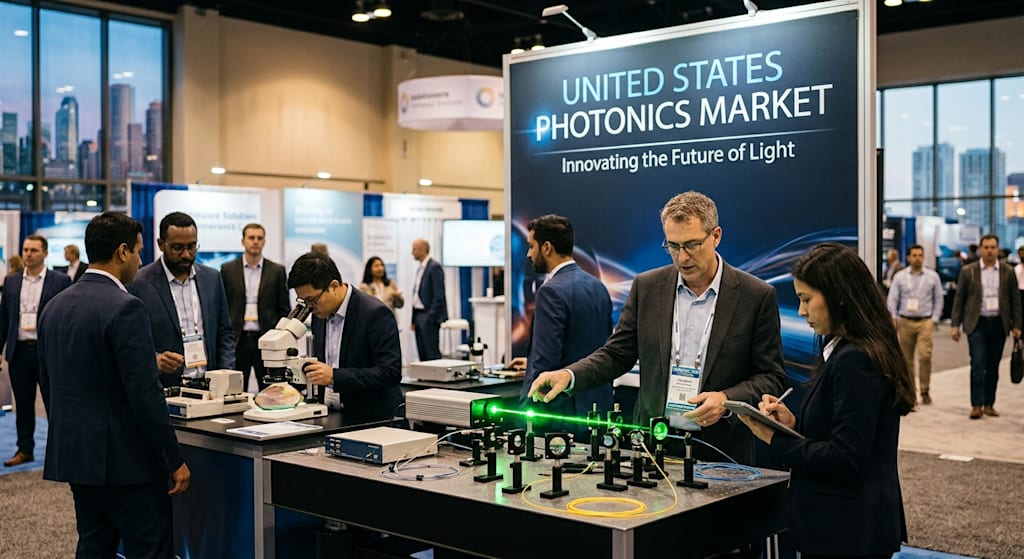
The United States is on the cusp of a technological revolution, where light rather than electricity is becoming a fundamental building block for innovation. At the heart of this revolution is the photonics industry, a discipline concerned with the manipulation of photons (particles of light) to create speed, clarity, accuracy, and computing power.
From fiber-optic communications to medical imaging, lasers, sensors and computing, photonics technology is behind the systems that are defining our daily lives. By 2026, the industry's influence is only set to expand as its capabilities are increasingly called upon by sectors demanding ever faster data rates, smarter products and energy-efficient technology.
In the United States the photonics market was worth $224.1 billion in 2025 and is predicted to reach $406.4 billion by 2034, representing an impressive 6.84% compound annual growth rate over the 2026-2034 period (IMARC Group).
Why is the market set to grow so significantly in 2026?
High-speed data communications is one of the strongest drivers of growth. The continuous rise of cloud computing, streaming services and artificial intelligence (AI) driven applications has increased the demand for ever faster and more reliable data transmission. Photonics allows light signals to be sent over optical fiber, at considerably faster rates than is possible using electronic transmission.
The growth of data centers and digital infrastructure is another significant factor. AI workloads and big data analyses require a higher computational power and greater energy efficiency from modern data centers, and with data centers at the forefront of innovation, it's not difficult to see how the photonics industry will benefit.
Healthcare and medical advancement is further increasing demand. Photonics is one of the key enablers of healthcare technology and with the advancement of medical imaging, laser surgery, optical diagnostic scanning and biosensing the number of uses for this industry continues to grow. These systems help doctors detect diseases earlier, perform operations with less invasive surgery and a higher degree of precision. This need for advanced diagnostics and personalized treatment within the U.S. Healthcare system will continue to fuel this industry throughout 2026.
The integration of industrial automation and manufacturing applications. Photonics allows for a higher degree of precision, reduced waste and improved efficiency within industries where lasers and optical systems are becoming essential for cutting, welding and general material processing. With the increase in smart production systems in the U.S. Manufacturing sector, photonics is once again becoming central to technological advancement.
The demand from consumer electronics and everyday devices. From our smartphone displays to the sensors in our cameras, our everyday technology is becoming increasingly integrated with the optical components and photonics industry. Modern smart technology utilizes advanced optical sensors and camera systems to enhance the user experience. As virtual reality (VR) and augmented reality (AR) continue to be developed the role of photonics in bringing them to fruition is becoming ever more important for real-time processing.
Photonics within defense, aerospace and security sectors. These traditional sectors continue to be one of the strongest drivers of photonics development, with applications including laser aiming systems, high resolution night vision and secure communication systems all contributing to growth. Space technology such as satellite communications also rely heavily on the capabilities of this industry.
A key growing trend within the market is silicon photonics and PICs. This integration of multiple optical components into a single chip is leading to increased processing speed and reduced power consumption. With demands growing from AI data centers this type of photonics integration will become critically important by 2026 and beyond.
Market segmentation overview.
The U.S. Photonics market can be broken down into:
- LEDs, Lasers, detectors, sensors, optical communication systems
- Data communication, medical technology, imaging, production technology, lighting
- Consumer electronics, healthcare, industrial, defense, telecommunications, construction.
Within this, data communications and optical systems are the most important and rapidly growing sector, mainly due to the increasing reliance on digital infrastructure and the continued demand for better data transfer.
Why is the industry so important?
Photonics isn't just another sector within technology it's a foundational enabler of numerous other high-growth sectors. With applications from AI and cloud computing through to healthcare, defense and manufacturing, photonics is integral to almost every aspect of modern economies. Its importance is only set to grow as the industry continues to solve the issue of how we can achieve greater data speed using light instead of electricity.
What's next?
The future growth of the U.S. Photonics market will be heavily influenced by the continued development of high-speed data communications systems, the growth of AI infrastructure and a persistent demand for energy-efficient solutions. As industries across the board continue to push the boundaries of speed, accuracy and connectivity the photonics industry will always play a pivotal role in enabling this advancement. In many ways, 2026 represents the point where light-based technologies evolve from niche components to essential components within the digital economy.
About the Creator
michael matthew
I’m a market researcher passionate about understanding people, markets, and motivations. My work blends data analysis, consumer psychology, and strategic insight to help brands and businesses make informed, human-centered decisions.
Enjoyed the story? Support the Creator.
Subscribe for free to receive all their stories in your feed.
Comments
There are no comments for this story
Be the first to respond and start the conversation.