
United States Online Food Delivery Market Expected to Reach US$67.85 Billion by 2034 as Convenience Culture Drives Digital Dining
Rising smartphone usage, demand for instant meal delivery, and rapid expansion of food delivery applications are transforming America’s dining habits

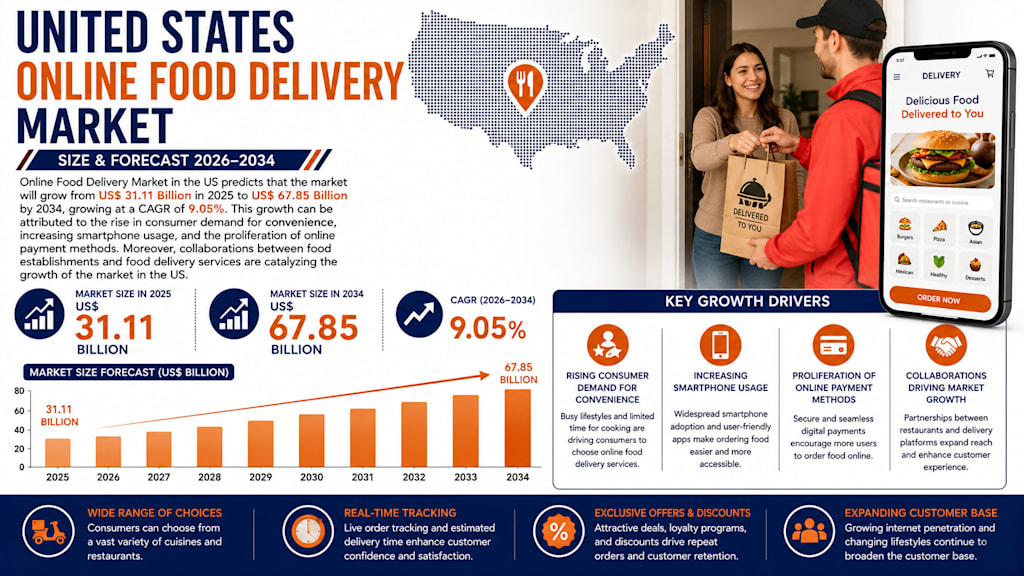
The United States online food delivery market is experiencing rapid expansion as changing consumer lifestyles, digital technology adoption, and growing demand for convenience continue reshaping the country’s food service industry. What was once considered an occasional convenience has now become an essential part of everyday life for millions of Americans.
According to Renub Research, the United States online food delivery market is projected to grow from US$31.11 billion in 2025 to approximately US$67.85 billion by 2034, expanding at a compound annual growth rate (CAGR) of 9.05% between 2026 and 2034.
The market’s strong growth is being fueled by rising smartphone usage, increasing consumer preference for convenience, expansion of digital payment systems, and growing collaborations between restaurants and food delivery platforms.
As digital lifestyles continue evolving and consumers increasingly seek instant access to meals and restaurant services, online food delivery is becoming one of the fastest-growing segments within the broader digital commerce industry.
Online Food Delivery Has Become a Mainstream Consumer Habit
Online food delivery involves the use of digital platforms and mobile applications to order meals from restaurants and have them delivered directly to customers’ homes or workplaces.
Consumers can:
Browse menus, customize orders, make payments, and track deliveries in real time using websites or mobile applications.
The popularity of online food delivery in the United States has increased dramatically because of changing lifestyles and the growing importance of convenience.
Consumers increasingly rely on delivery services because of:
Busy work schedules, urban lifestyles, limited cooking time, and preference for fast meal access.
The COVID-19 pandemic also accelerated adoption by making food delivery an essential service during lockdown periods.
Today, food delivery has become deeply integrated into daily routines for millions of Americans across urban, suburban, and even smaller metropolitan areas.
Consumer Preference for Convenience Is Driving Massive Growth
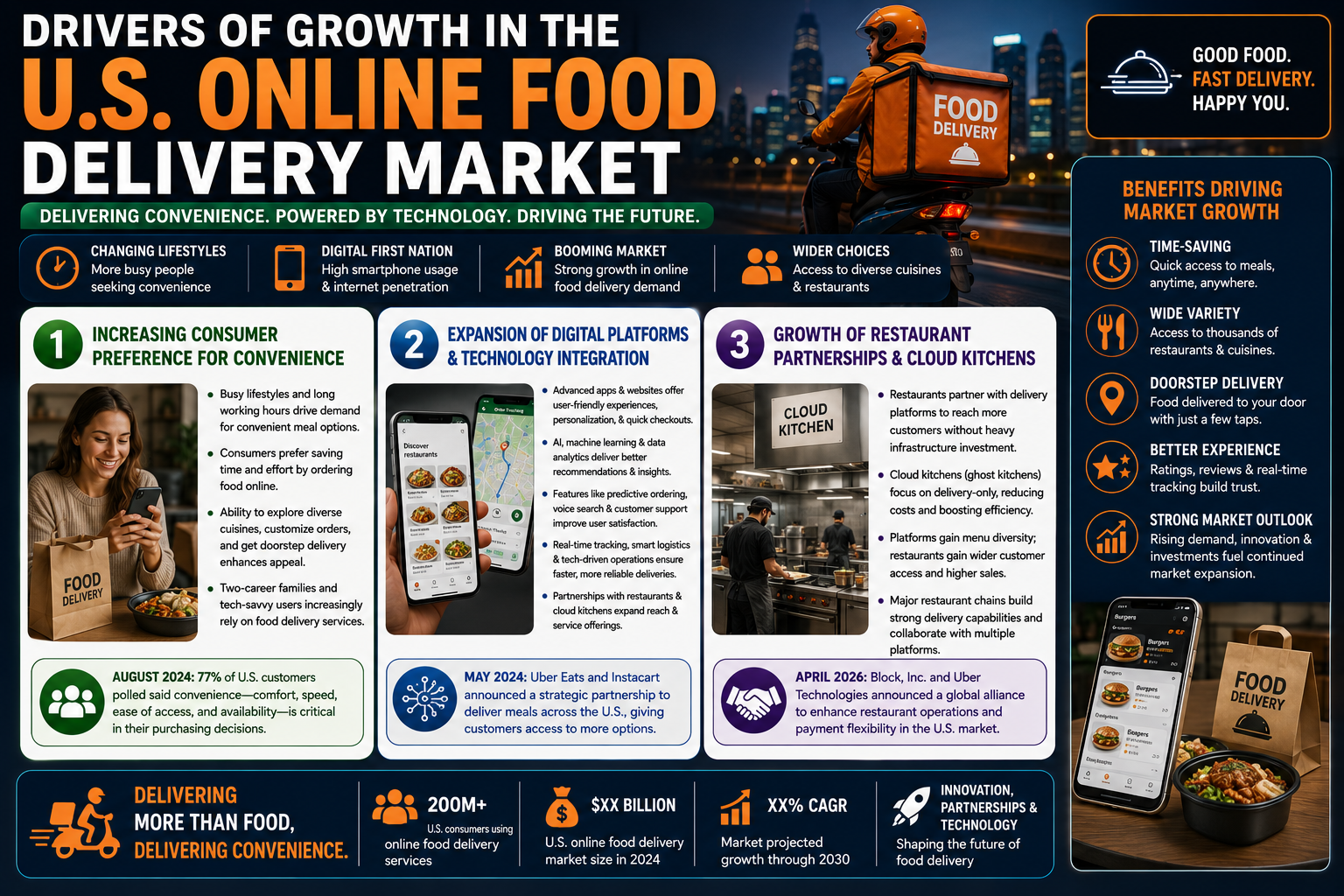
One of the strongest growth drivers behind the U.S. online food delivery market is the growing consumer preference for convenience and time-saving services.
Modern consumers increasingly prioritize:
Comfort, speed, accessibility, and flexibility when making purchasing decisions.
According to survey data highlighted in the report, approximately 77% of U.S. consumers in August 2024 identified convenience as a major factor influencing purchasing behavior.
The increasing number of:
Dual-income households, remote workers, urban residents, and tech-savvy younger consumers has significantly accelerated online food delivery demand.
Customers appreciate the ability to:
Explore multiple cuisines, place personalized orders, avoid cooking, and receive meals directly at their doorsteps with minimal effort.
The broad availability of international cuisine options through delivery platforms has also strengthened market appeal.
Mobile Applications and Digital Platforms Are Transforming the Industry
Technology remains at the center of the online food delivery revolution.
Food delivery companies continue investing heavily in:
User-friendly applications, artificial intelligence, machine learning, predictive analytics, and real-time logistics systems.
Modern food delivery applications now offer features such as:
Personalized recommendations, quick checkout systems, voice search capabilities, live order tracking, and AI-powered customer support.
Smartphone adoption and affordable internet access have further expanded the accessibility of online food delivery services across the country.
Real-time tracking and optimized delivery algorithms are helping improve efficiency while reducing delivery times.
In May 2024, Uber Eats partnered with Instacart to expand meal delivery services across the United States.
The integration of advanced digital technologies continues making food delivery services more reliable, efficient, and customer-focused.
Restaurant Partnerships and Cloud Kitchens Are Expanding Rapidly
Partnerships between restaurants and online delivery platforms are playing a critical role in market growth.
Many restaurants increasingly collaborate with third-party delivery companies to:
Expand customer reach, improve sales, and reduce operational limitations without investing heavily in independent delivery infrastructure.
The rapid rise of cloud kitchens — also known as ghost kitchens — is further transforming the market.
Cloud kitchens are delivery-only food preparation facilities that:
Operate without dine-in spaces and focus entirely on fulfilling online orders.
This business model allows operators to:
Reduce overhead costs, test new food concepts, and optimize delivery-focused operations.
Delivery platforms benefit by expanding cuisine variety, while restaurants gain access to larger customer bases.
In April 2026, Block, Inc. and Uber Technologies announced a strategic alliance to improve restaurant operations and payment flexibility within the U.S. market.
These collaborations highlight the growing integration between fintech, logistics, and food delivery ecosystems.
High Operational Costs Continue Challenging Profitability
Despite rapid market growth, profitability remains a major challenge for many online food delivery companies.
Food delivery platforms face substantial operational expenses related to:
Driver compensation, logistics management, technology development, promotions, and customer acquisition.
To remain competitive, companies frequently offer:
Discounts, free delivery promotions, loyalty rewards, and subscription services.
These strategies can significantly reduce profit margins.
Delivery commissions charged to restaurants can also create tensions between restaurants and delivery providers.
Urban logistics challenges including:
Traffic congestion, rising fuel costs, and labor expenses further increase operational complexity.
Balancing affordable pricing with long-term profitability remains one of the industry’s biggest strategic challenges.
Food Quality and Delivery Reliability Remain Key Concerns
Maintaining food quality during transportation remains another major industry challenge.
Unlike dine-in services where meals are consumed immediately, food delivery involves delays between preparation and consumption.
Factors such as:
Traffic congestion, weather conditions, packaging limitations, and delivery delays can negatively affect food freshness and presentation.
Consumers increasingly expect:
Fast delivery, accurate orders, proper packaging, and consistent quality across all restaurants and delivery drivers.
Poor delivery experiences can quickly damage customer loyalty and brand reputation.
As a result, food delivery platforms continue investing in:
Improved packaging technologies, route optimization systems, and delivery tracking tools.
Platform-to-Customer Delivery Models Continue Dominating
Platform-to-customer delivery services remain one of the most dominant business models within the market.
These digital platforms act as intermediaries connecting restaurants with customers while managing:
Ordering systems, payment processing, logistics, and delivery operations.
Consumers prefer these platforms because they offer:
Wide restaurant selections, customer reviews, loyalty programs, and seamless user experiences.
Restaurants benefit by reaching larger audiences without building expensive internal delivery systems.
The continued rise of cloud kitchens and virtual restaurants is further strengthening this segment’s growth.
Mobile Applications Are Becoming the Primary Ordering Channel
Food delivery mobile applications now dominate the online ordering ecosystem because of their convenience and ease of use.
Consumers increasingly prefer mobile apps because they provide:
Faster ordering, real-time notifications, GPS tracking, personalized recommendations, and secure payment options.
Young consumers and urban populations are especially reliant on app-based food delivery services.
Companies continue enhancing applications through:
AI-powered recommendations, subscription memberships, loyalty rewards, and voice-enabled ordering capabilities.
The combination of smartphone penetration and digital payment adoption continues driving strong long-term growth in this segment.
Digital Payments Are Supporting Market Expansion
The rapid rise of digital payments has become a major enabler for online food delivery growth.
Consumers increasingly use:
Credit cards, debit cards, digital wallets, net banking, and contactless payment systems.
Secure payment gateways help improve customer trust and encourage repeat usage.
Promotional incentives such as:
Cashback offers, loyalty points, and digital wallet discounts are also helping increase transaction volumes.
The expansion of fintech innovation and cashless payment systems is expected to further strengthen online food delivery adoption over the coming years.
New York, Los Angeles, San Diego, and Jacksonville Lead Regional Demand
New York
New York remains one of the most advanced and competitive online food delivery markets in the United States because of its fast-paced lifestyle and enormous culinary diversity.
Los Angeles
Los Angeles continues witnessing rapid food delivery growth due to strong demand for convenience, healthy meal options, and multicultural cuisine offerings.
San Diego
San Diego’s market is expanding steadily as younger consumers increasingly rely on food delivery applications for healthy and sustainable meal options.
Jacksonville
Jacksonville’s online food delivery market is growing because of population expansion, increasing technology adoption, and rising consumer demand for affordable convenience dining.
Major Companies Intensify Competition
Competition within the United States online food delivery market remains extremely intense.
Leading companies include:
Grubhub, DoorDash, Uber Eats, Postmates, Domino's Pizza, Kroger, Blue Apron, and HelloFresh.
Companies continue competing through:
Subscription programs, faster deliveries, AI-driven personalization, loyalty rewards, and expanded restaurant partnerships.
Final Thoughts
The United States online food delivery market is rapidly evolving into one of the most influential sectors within the country’s broader digital economy.
With the market projected to reach approximately US$67.85 billion by 2034, online food delivery is expected to remain deeply integrated into American consumer lifestyles.
However, the industry must continue addressing challenges related to operational profitability, delivery reliability, and food quality consistency.
As technology continues improving and consumers increasingly prioritize convenience and digital experiences, online food delivery platforms are likely to remain a dominant force shaping the future of dining and restaurant services in the United States
About the Creator
Enjoyed the story? Support the Creator.
Subscribe for free to receive all their stories in your feed.
Comments
There are no comments for this story
Be the first to respond and start the conversation.