
United States Nutraceuticals Market Expected to Reach Nearly US$ 293 Billion by 2034 as Preventive Healthcare and Functional Nutrition Gain Momentum
Rising Demand for Functional Foods, Clean-Label Supplements, and Science-Backed Wellness Products Is Driving Rapid Growth Across the U.S. Nutraceutical Industry

The United States nutraceuticals market is witnessing rapid expansion as consumers increasingly prioritize preventive healthcare, natural wellness solutions, and functional nutrition products designed to support long-term well-being. From probiotic beverages and immunity supplements to plant-based snacks and fortified foods, nutraceuticals are becoming an essential part of modern health-conscious lifestyles across the country.
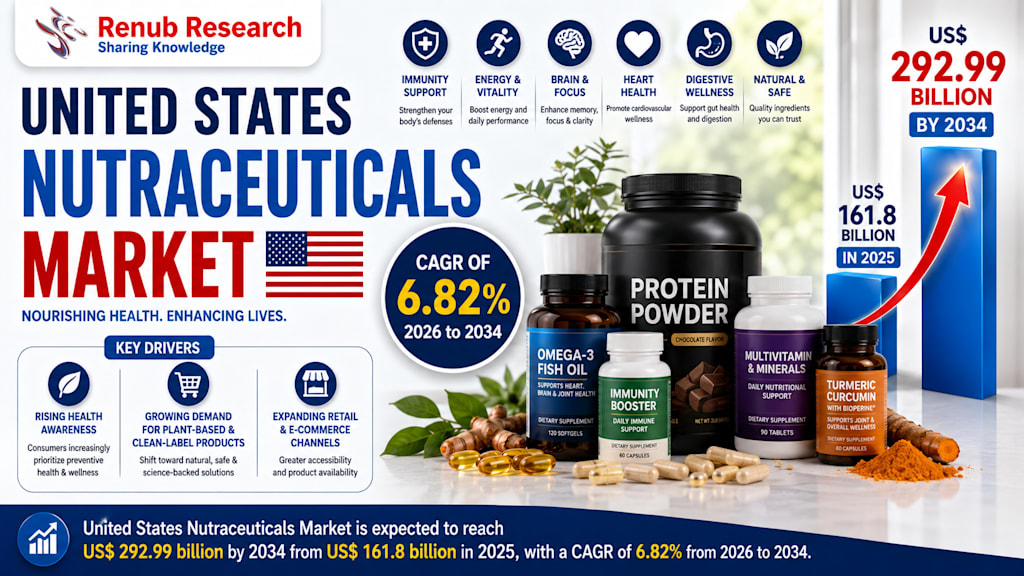
According to Renub Research, the United States nutraceuticals market is projected to grow from US$ 161.8 billion in 2025 to US$ 292.99 billion by 2034, expanding at a strong CAGR of 6.82% between 2026 and 2034. Rising health awareness, increasing prevalence of chronic diseases, growing demand for preventive care, and strong consumer preference for functional foods and supplements are all contributing to sustained market growth.
Nutraceuticals refer to products derived from food sources that provide additional health benefits beyond basic nutrition. These include dietary supplements, functional beverages, probiotics, vitamins, herbal extracts, fortified snacks, minerals, and plant-based wellness products designed to support immunity, digestion, energy, cognitive function, and overall health.
As Americans increasingly shift toward lifestyle-based health management, nutraceuticals are evolving into one of the most dynamic sectors within the broader health and wellness economy.
Preventive Healthcare Is Reshaping Consumer Behavior
One of the strongest drivers behind the U.S. nutraceuticals market is the growing consumer focus on preventive healthcare rather than reactive treatment.
Consumers are becoming more proactive about maintaining wellness, strengthening immunity, improving digestion, and reducing long-term health risks through nutrition-focused lifestyle choices.
Rising rates of chronic conditions such as obesity, diabetes, heart disease, and digestive disorders are encouraging Americans to integrate supplements and functional foods into their daily routines.
At the same time, consumers increasingly prefer natural and food-based wellness solutions over synthetic or pharmaceutical alternatives whenever possible.
This shift has significantly increased demand for products targeting:
- Immune support
- Gut health
- Cognitive wellness
- Joint mobility
- Heart health
- Stress management
- Energy enhancement
- Healthy aging
Nutraceuticals are now commonly viewed not just as supplements but as part of broader wellness strategies integrated into everyday living.
Younger consumers are embracing plant-based products, functional snacks, and wellness beverages, while older adults increasingly rely on supplements for long-term health support.
This broad cross-generational demand continues strengthening overall market stability.
Functional Foods Are Becoming Mainstream
Functional foods have emerged as one of the most important segments within the nutraceuticals market.
Consumers increasingly want foods that provide additional nutritional and wellness benefits beyond traditional calorie intake.
As a result, manufacturers are introducing products fortified with probiotics, vitamins, proteins, minerals, botanicals, and other functional ingredients designed to support specific health outcomes.
In August 2024, EZZ Life Science expanded its functional food portfolio by launching four new products targeting both children and adults. Three products focused on pediatric nutrition, while another addressed adult wellness needs.
This development reflects the growing market emphasis on age-specific and personalized nutrition solutions.
Families increasingly seek convenient nutritional products that fit into daily routines while supporting immunity, growth, and overall wellness.
Manufacturers focusing on scientifically backed formulations, clean-label ingredients, and multifunctional health benefits are gaining strong traction within the marketplace.
The expansion of targeted functional foods is helping nutraceuticals reach broader demographic groups while supporting long-term industry growth.

Functional Beverages Continue Gaining Popularity
The functional beverage category is becoming one of the fastest-growing areas within the U.S. nutraceuticals market.
Consumers increasingly prefer beverages that offer added wellness benefits such as digestive support, hydration, energy enhancement, or immune strengthening.
Products containing probiotics, adaptogens, vitamins, herbal ingredients, and low-sugar formulations are seeing especially strong demand.
In January 2024, Systm Foods acquired Humm Kombucha to strengthen its position within the refrigerated functional beverage market.
Humm Kombucha is known for its low- and zero-sugar kombucha products focused on digestive and gut health support.
The acquisition highlights how major industry players are investing aggressively in functional beverage innovation as consumer interest in gut health continues rising.
Functional drinks are increasingly positioned as healthier alternatives to sugary sodas and traditional energy beverages.
Consumers are particularly attracted to products that combine wellness benefits with convenience and enjoyable flavors.
As awareness around digestive health and microbiome science grows, beverages containing probiotics and prebiotics are expected to remain a major growth segment within the nutraceuticals industry.
Clean-Label and Natural Products Are Driving Purchasing Decisions
Modern nutraceutical consumers are increasingly focused on ingredient transparency, product authenticity, and clean-label formulations.
Consumers now carefully evaluate labels for:
- Natural ingredients
- Organic certifications
- Low sugar content
- Plant-based sourcing
- Non-GMO claims
- Artificial additive avoidance
- Sustainable production methods
This growing demand for transparency is pushing companies to reformulate products using cleaner and simpler ingredient lists.
Plant-based nutraceuticals are seeing especially strong growth as consumers seek vegan, vegetarian, and environmentally sustainable wellness solutions.
Younger demographics, particularly Millennials and Gen Z consumers, place significant value on products aligned with both personal health and environmental responsibility.
As a result, companies investing in clean manufacturing practices and transparent sourcing strategies are gaining stronger consumer trust and loyalty.
E-Commerce Is Accelerating Nutraceutical Accessibility
Online retail and digital wellness platforms are dramatically reshaping the nutraceuticals market.
Consumers increasingly purchase supplements, vitamins, and functional foods through e-commerce channels due to convenience, broader product variety, subscription services, and personalized recommendations.
Social media influencers, fitness creators, nutrition experts, and wellness-focused digital communities are also playing an increasingly important role in shaping purchasing behavior.
In December 2024, Nitches Inc. expanded its digital presence by launching its InTheZone Labs brand on Amazon. The company introduced products such as InTheZone Focused Extreme, InTheZone Focused Youth, and InTheZone Passion, all manufactured in FDA- and GMP-compliant U.S. facilities.
This move reflects the growing importance of direct-to-consumer and online supplement distribution channels.
E-commerce platforms also enable smaller nutraceutical brands to compete more effectively by reaching nationwide audiences without relying entirely on traditional retail networks.
Scientific Innovation Is Strengthening Product Development
Scientific research and ingredient innovation continue playing critical roles in market expansion.
Consumers increasingly demand nutraceutical products supported by clinical studies, validated formulations, and proven efficacy.
Manufacturers are investing heavily in technologies that improve ingredient delivery, stability, and bioavailability.
In April 2025, Lubrizol partnered with Palmer Holland to strengthen distribution of advanced nutraceutical ingredients throughout the Northeastern United States. The collaboration focused on Lubrizol’s microencapsulation technology, which enhances ingredient stability and nutrient delivery for dietary supplements and functional food applications.
This highlights the increasing role of science-driven innovation within the nutraceutical sector.
Companies capable of combining advanced nutritional science with consumer-friendly products are expected to remain highly competitive.
Regulatory Complexity Remains a Major Industry Challenge
Despite strong growth opportunities, regulatory uncertainty remains one of the biggest challenges within the nutraceuticals market.
Nutraceutical products exist in a regulatory space between conventional foods and pharmaceuticals, creating complex compliance requirements for manufacturers.
Companies must navigate strict labeling rules, ingredient safety standards, advertising regulations, and health-claim restrictions enforced by agencies such as the FDA and FTC.
Smaller companies often face significant financial burdens associated with:
- Product testing
- Documentation
- Certifications
- Clinical validation
- Compliance monitoring
Increasing scrutiny around scientific evidence and product authenticity is also forcing companies to invest more heavily in research and quality assurance.
These regulatory challenges can slow product development timelines and increase operational costs.
Consumer Skepticism Is Increasing
Another major issue facing the industry is growing consumer skepticism surrounding exaggerated marketing claims and inconsistent product quality.
With thousands of supplements and wellness products available in the market, many consumers struggle to distinguish scientifically validated products from less credible offerings.
Concerns around misleading claims, ineffective formulations, ingredient adulteration, and poor manufacturing practices have damaged trust in certain parts of the industry.
Consumers increasingly expect:
- Third-party testing
- Transparent labeling
- Clinical validation
- Verified ingredient sourcing
- Manufacturing certifications
Brands unable to demonstrate authenticity and efficacy risk losing consumer confidence and market share.
As a result, trust-building has become one of the most important competitive factors within the nutraceuticals industry.
California Leads the U.S. Nutraceuticals Market
California remains one of the largest and most influential nutraceutical markets in the United States due to its strong wellness culture, high consumer spending, and early adoption of natural health products.
The state’s consumers strongly embrace plant-based diets, clean-label supplements, probiotics, and functional beverages.
California also serves as a major innovation hub, with numerous health-focused startups and nutraceutical companies operating within its food and biotechnology ecosystem.
High product quality standards and strong wellness-oriented consumer behavior continue positioning California as a key market for nutraceutical growth.
Texas Shows Rapid Expansion
Texas is emerging as another major nutraceutical growth market driven by population expansion, rising disposable incomes, and increasing interest in active lifestyles.
Urban centres such as Austin, Dallas, and Houston support strong demand for supplements related to energy, fitness, digestive health, and chronic disease prevention.
Texas consumers increasingly seek clean-label, organic, and performance-focused wellness products.
Strong retail infrastructure and growing health awareness continue accelerating market penetration across the state.
New York and Florida Continue Supporting Strong Demand
New York remains a major nutraceutical consumption hub due to its dense urban population and fast-paced lifestyle culture.
Consumers in New York City particularly favor functional beverages, stress-relief supplements, immunity boosters, and convenient wellness products that align with busy schedules.
Florida also represents a highly important market because of its large aging population and wellness-focused lifestyle trends.
Older consumers in Florida frequently seek nutraceutical products supporting joint health, heart function, cognitive wellness, and immune support.
At the same time, younger consumers increasingly purchase hydration products, digestive supplements, and functional snacks.
Major Companies Continue Competing Through Innovation
Leading companies competing within the U.S. nutraceuticals market include:
- PepsiCo, Inc.
- General Mills, Inc.
- Nestlé S.A.
- Herbalife International of America, Inc.
- Abbott Laboratories
- NOW Foods
Competition increasingly focuses on clean-label innovation, science-backed formulations, personalized nutrition, and functional convenience products.
The Future of the Nutraceuticals Industry
The future of the U.S. nutraceuticals market appears exceptionally strong as consumers continue integrating wellness-focused nutrition into everyday life.
Preventive healthcare, personalized nutrition, clean-label products, and functional foods are expected to remain major long-term growth drivers.
Scientific innovation, digital wellness ecosystems, and expanding e-commerce accessibility will further accelerate market expansion over the next decade.
At the same time, companies that prioritize transparency, quality assurance, and clinically supported products will likely emerge as the most trusted and successful brands.
With market value expected to approach US$ 293 billion by 2034, nutraceuticals are rapidly becoming one of the most influential sectors within the modern health and wellness economy.
Final Thoughts
The United States nutraceuticals market is evolving rapidly as consumers increasingly prioritize preventive care, natural wellness, and science-driven nutrition solutions. Functional foods, supplements, and wellness beverages are no longer niche products—they are becoming mainstream components of everyday health management across all age groups.
Although regulatory complexity and consumer skepticism remain important challenges, continued innovation, rising health awareness, and strong demand for personalized wellness products continue positioning the industry for substantial long-term growth.
About the Creator
Enjoyed the story? Support the Creator.
Subscribe for free to receive all their stories in your feed.
Comments
There are no comments for this story
Be the first to respond and start the conversation.