
United States Next-Generation Sequencing Market Set to Surpass US$20 Billion by 2034 as Precision Medicine Revolution Accelerates
From cancer diagnostics to rare disease detection, next-generation sequencing is transforming American healthcare and driving one of the fastest-growing segments in genomic medicine.

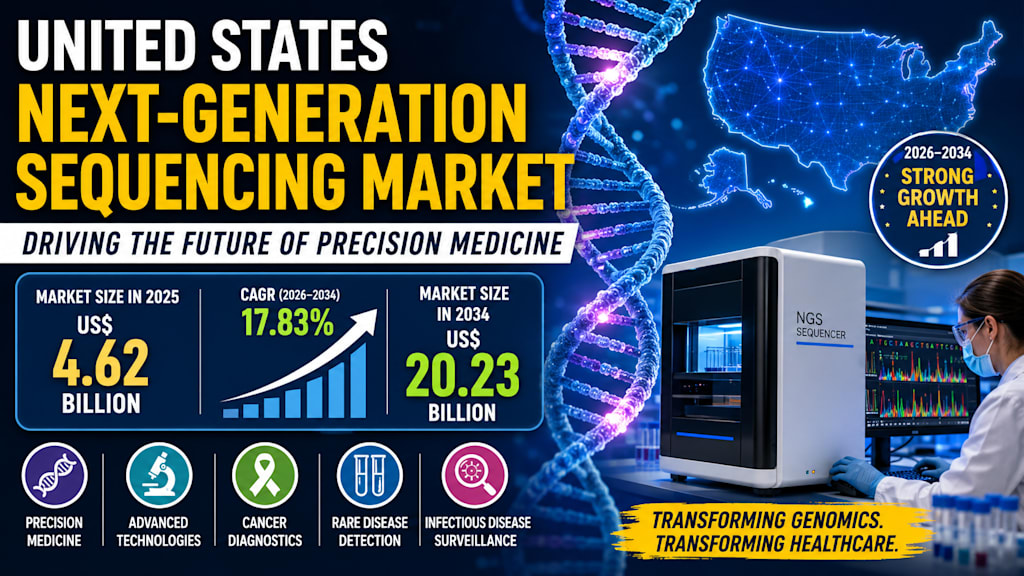
The future of healthcare is increasingly being written in genetic code. Across hospitals, research institutions, biotechnology firms, and pharmaceutical companies throughout the United States, Next-Generation Sequencing (NGS) is becoming one of the most transformative technologies of the modern medical era.
According to Renub Research, the United States Next-Generation Sequencing Market is projected to expand from US$ 4.62 billion in 2025 to US$ 20.23 billion by 2034, growing at a remarkable CAGR of 17.83% between 2026 and 2034. This extraordinary growth reflects the increasing importance of genomic analysis in disease diagnosis, treatment selection, drug discovery, and personalized medicine.
As healthcare providers move away from one-size-fits-all treatment approaches, NGS is emerging as the cornerstone of precision medicine, helping clinicians make more informed decisions based on an individual's genetic profile.
Understanding Next-Generation Sequencing
Next-Generation Sequencing is an advanced genomic technology capable of sequencing millions of DNA and RNA fragments simultaneously. Unlike traditional sequencing methods, NGS delivers faster, more accurate, and cost-effective analysis of genetic material.
The technology enables researchers and clinicians to examine entire genomes, identify genetic mutations, analyze gene expression patterns, and uncover disease-related biomarkers with unprecedented speed and precision.
Today, NGS is widely used in:
Cancer genomics
Rare disease diagnosis
Infectious disease surveillance
Reproductive health testing
Pharmacogenomics
Drug development
Population genetics research
The increasing accessibility of sequencing technologies has significantly broadened their use beyond academic laboratories and into mainstream healthcare settings.
Precision Medicine Is Reshaping Healthcare
One of the strongest forces driving the U.S. NGS market is the rapid expansion of precision medicine.
Traditional treatments often assume that patients with the same disease will respond similarly to therapy. However, genomic research has revealed that individuals can have vastly different biological responses based on their genetic makeup.
NGS enables healthcare providers to identify genetic mutations that influence disease progression and treatment outcomes. This information helps physicians tailor therapies to individual patients, improving effectiveness while minimizing adverse side effects.
In oncology, for example, genomic sequencing can identify specific mutations responsible for tumor growth. Physicians can then select targeted therapies designed to attack those mutations directly.
As precision medicine programs continue expanding across the United States, demand for comprehensive genomic testing is expected to increase substantially.
Cancer Diagnostics Remain a Major Growth Engine
Cancer remains one of the most significant healthcare challenges worldwide, and NGS is playing a critical role in transforming cancer care.
Modern sequencing technologies allow oncologists to:
Detect cancer-associated mutations
Classify tumors more accurately
Monitor disease progression
Evaluate treatment response
Identify candidates for targeted therapies
Rather than relying solely on traditional pathology, healthcare providers are increasingly incorporating genomic information into clinical decision-making.
The growing emphasis on personalized oncology treatments is expected to remain a major catalyst for NGS adoption over the next decade.
Rare Disease Diagnosis Creates New Opportunities
Millions of Americans suffer from rare genetic disorders, many of which remain undiagnosed for years due to limited diagnostic options.
Next-Generation Sequencing is changing that reality.
By analyzing large portions of a patient's genome simultaneously, NGS enables clinicians to identify rare mutations that might otherwise go unnoticed. Faster diagnosis can significantly improve patient outcomes and reduce unnecessary testing.
As awareness of rare diseases increases and genetic testing becomes more accessible, healthcare providers are expected to utilize NGS technologies more frequently in clinical practice.
Research Investments Continue to Fuel Innovation
The United States remains a global leader in genomics research and biotechnology innovation.
Government agencies, research universities, healthcare institutions, and private biotechnology firms continue investing heavily in genomic science. These investments are accelerating advancements in sequencing platforms, bioinformatics tools, and diagnostic applications.
Major research initiatives are generating enormous volumes of genomic data, creating new opportunities for scientific discovery and clinical implementation.
The strong research ecosystem gives the United States a significant competitive advantage in advancing next-generation sequencing technologies and applications.
Technological Advancements Are Lowering Barriers
One of the most important factors supporting market growth is the rapid evolution of sequencing technologies.
Modern NGS platforms offer:
Higher throughput
Faster processing times
Greater accuracy
Improved automation
Lower operating costs
Sequencing that once required weeks can now be completed within days or even hours.
Advancements in cloud computing, artificial intelligence, and bioinformatics software are also helping organizations analyze increasingly complex genomic datasets more efficiently.
As costs continue declining, NGS is becoming accessible to smaller hospitals, regional laboratories, and community healthcare providers.
Expanding Role in Drug Discovery
Pharmaceutical and biotechnology companies are increasingly relying on NGS throughout the drug development process.
Sequencing technologies support:
Target identification
Biomarker discovery
Pharmacogenomics research
Clinical trial optimization
Companion diagnostic development
By understanding the genetic mechanisms underlying disease, researchers can develop more effective therapies and improve clinical trial success rates.
The growing focus on biologics, gene therapies, and precision medicines is expected to drive significant demand for sequencing technologies within pharmaceutical research environments.
Hospitals and Clinics Embrace Genomic Medicine
Historically, NGS was primarily confined to specialized research laboratories.
Today, hospitals and clinical settings are rapidly becoming major end users of sequencing technologies.
Healthcare systems increasingly utilize NGS for:
Oncology testing
Prenatal screening
Rare disease diagnosis
Infectious disease monitoring
Personalized treatment planning
The availability of compact benchtop sequencers and automated workflows has made genomic testing more practical for routine clinical use.
As physician awareness grows and reimbursement pathways improve, hospitals are expected to become even more important contributors to market expansion.
Sequencing by Synthesis Leads the Market
Among available sequencing technologies, Sequencing by Synthesis (SBS) continues to dominate the U.S. market.
Its popularity stems from:
High accuracy
Scalability
Broad application range
Established clinical validation
SBS platforms support whole-genome sequencing, exome sequencing, RNA sequencing, and targeted gene analysis.
Because of its proven performance and extensive adoption, SBS remains the preferred technology across many clinical and research environments.
Ion Semiconductor Sequencing Gains Momentum
Although smaller in market share, Ion Semiconductor Sequencing is attracting growing attention.
Unlike optical-based sequencing approaches, this technology detects hydrogen ions released during DNA synthesis.
Advantages include:
Faster turnaround times
Reduced instrument complexity
Lower operating costs
Strong suitability for targeted sequencing applications
These characteristics make Ion Semiconductor Sequencing particularly appealing for clinical laboratories requiring rapid results.
Regional Markets Driving Growth
California
California remains the epicenter of genomic innovation in the United States.
The state hosts numerous biotechnology companies, leading research institutions, and advanced healthcare organizations. Significant venture capital funding and research investments continue driving adoption of NGS technologies across oncology, drug discovery, and precision medicine.
New York
New York's strong healthcare infrastructure and world-renowned medical centers make it a major hub for genomic medicine.
Hospitals and research institutions across the state actively utilize NGS for cancer diagnostics, prenatal testing, and large-scale genomic studies.
New Jersey
New Jersey benefits from its concentration of pharmaceutical and biotechnology companies.
The state's robust life sciences ecosystem supports widespread use of sequencing technologies in drug discovery, clinical trials, and companion diagnostics.
Texas
Texas is emerging as one of the fastest-growing regional markets for NGS.
Expanding healthcare infrastructure, population growth, and increased investment in biotechnology are creating significant opportunities for genomic testing and research.
Challenges That Could Slow Market Expansion
Despite impressive growth prospects, the NGS market faces several obstacles.
Data Management Complexity
NGS generates enormous volumes of genomic information that require sophisticated storage, analysis, and interpretation.
Many healthcare organizations struggle with:
Data infrastructure requirements
Bioinformatics expertise shortages
Integration with existing healthcare systems
Addressing these challenges will be critical for maximizing the technology's clinical value.
Reimbursement and Regulatory Uncertainty
Coverage policies for genetic testing remain inconsistent across healthcare payers.
Diagnostic laboratories often face uncertainty regarding reimbursement eligibility and payment levels.
Regulatory requirements can also delay commercialization of new sequencing-based tests, creating additional challenges for market participants.
10 Recent Developments from Leading Companies
1. Illumina
Continued expansion of high-throughput sequencing platforms aimed at reducing sequencing costs and improving workflow efficiency.
2. Thermo Fisher Scientific
Strengthened genomic solutions portfolio through investments in clinical sequencing and precision medicine applications.
3. Pacific Biosciences
Expanded long-read sequencing capabilities, enabling more comprehensive genomic analysis.
4. QIAGEN N.V.
Enhanced bioinformatics offerings with advanced genomic data analysis solutions for researchers and clinicians.
5. Roche
Continued integration of sequencing technologies into personalized healthcare and oncology diagnostics.
6. Bio-Rad Laboratories
Expanded molecular diagnostics capabilities supporting genomic testing applications.
7. Takara Bio
Advanced genomic research tools designed to improve sequencing workflows and laboratory productivity.
8. Hamilton Company
Introduced automation solutions supporting high-throughput genomic testing environments.
9. Geneious
Enhanced software platforms to improve genomic data visualization and interpretation.
10. BioMérieux
Expanded molecular diagnostic initiatives utilizing sequencing technologies for infectious disease detection and monitoring.
The Future of Genomic Medicine
The next decade is expected to bring unprecedented advancements in genomic healthcare.
As sequencing becomes faster, cheaper, and more accessible, NGS will move further into mainstream medicine. Healthcare providers will increasingly rely on genomic insights to diagnose diseases earlier, personalize treatments, and improve patient outcomes.
Artificial intelligence and advanced analytics will further enhance the value of genomic data, enabling deeper insights into disease mechanisms and therapeutic opportunities.
The convergence of genomics, biotechnology, and digital health is creating a powerful ecosystem that will reshape medicine for generations to come.
Final Thoughts
The United States Next-Generation Sequencing Market is entering a transformative period characterized by rapid technological advancement, growing clinical adoption, and increasing investment in precision medicine.
With the market expected to surge from US$ 4.62 billion in 2025 to US$ 20.23 billion by 2034, NGS is poised to become one of the most influential technologies in modern healthcare.
From revolutionizing cancer treatment to accelerating drug discovery and improving rare disease diagnosis, next-generation sequencing is helping unlock the full potential of genomic medicine. Organizations that continue investing in innovation, data analytics, and clinical integration will be best positioned to capitalize on this extraordinary growth opportunity.
About the Creator
Enjoyed the story? Support the Creator.
Subscribe for free to receive all their stories in your feed.
Comments
There are no comments for this story
Be the first to respond and start the conversation.