
United States Mobile Gaming Market Is Entering a New Era of Digital Entertainment
Rising smartphone usage, cloud gaming, esports, and immersive multiplayer experiences are driving explosive growth in America’s mobile gaming industry.

Mobile gaming has evolved far beyond simple puzzle apps and casual entertainment. In the United States, it has become one of the most influential sectors of the digital entertainment economy, attracting millions of users across every age group. From competitive esports and multiplayer battle arenas to cloud gaming and premium mobile experiences, the market is now reshaping how Americans consume interactive entertainment.
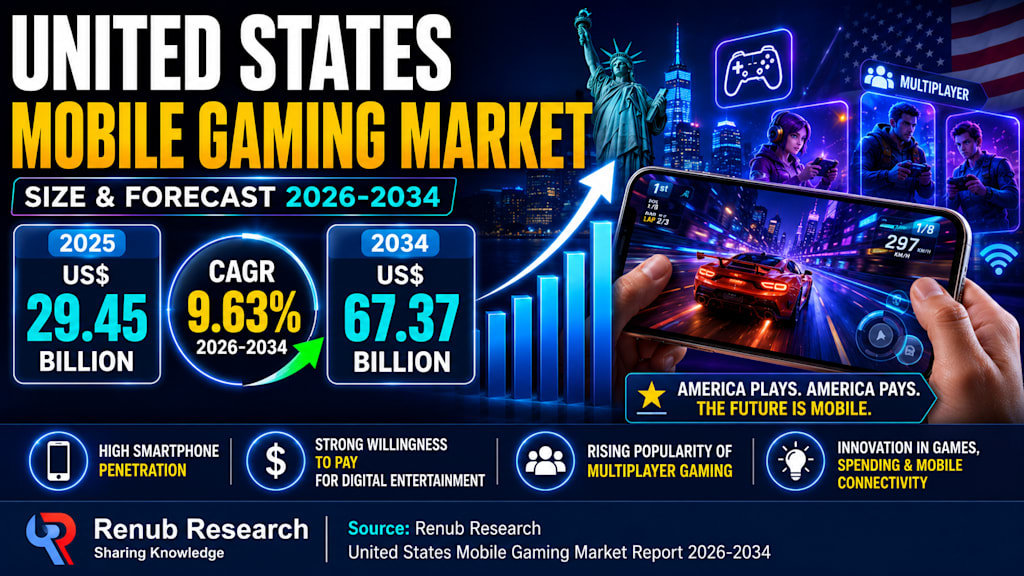
According to Renub Research, the United States Mobile Gaming Market is projected to grow from US$ 29.45 billion in 2025 to US$ 67.37 billion by 2034, expanding at a CAGR of 9.63% between 2026 and 2034. The market’s growth is fueled by widespread smartphone penetration, high consumer spending on digital entertainment, rapid advances in connectivity, and increasing demand for immersive gaming experiences.
The United States already represents one of the most mature gaming markets in the world, but mobile gaming is increasingly becoming its most dominant and fastest-evolving segment.
Mobile gaming has become mainstream entertainment
Mobile gaming refers to video games played on smartphones and tablets using downloaded apps or cloud-based gaming services. These games cover a wide variety of genres, including puzzle games, action titles, adventure experiences, multiplayer battles, strategy simulations, and role-playing games.
One of the biggest reasons for mobile gaming’s popularity is flexibility. Players can enjoy games for just a few minutes or spend hours in competitive and immersive environments. Modern smartphones now deliver graphics, controls, and multiplayer experiences that increasingly rival traditional console and PC gaming.
The industry has also built highly effective monetization systems. Free-to-play games supported by in-app purchases, subscriptions, cosmetics, and advertisements have created a profitable and sustainable ecosystem for developers and publishers.
In the United States, mobile gaming has become deeply integrated into daily digital habits. Convenience, social interaction, and competitive gameplay continue driving user engagement across multiple demographics.
Smartphone penetration is creating a massive gaming audience
One of the strongest growth drivers for the U.S. mobile gaming market is the near-universal adoption of smartphones. According to the report, approximately 98% of Americans possess a mobile phone, while 91% own smartphones. This enormous user base creates ideal conditions for mobile gaming expansion.
Modern smartphones are capable of supporting advanced graphics, fast processing, and real-time multiplayer interactions. This technological evolution has transformed mobile devices into powerful gaming platforms rather than simple communication tools.
Connectivity improvements are also playing a major role. Widespread 4G and 5G coverage allow users to access high-quality gaming experiences virtually anywhere. Faster internet speeds reduce latency and improve online multiplayer functionality, cloud gaming performance, and live streaming experiences.
The report highlights Nokia’s extended partnership with T-Mobile US, announced in April 2025, which focuses on improving and expanding 5G coverage across the country. Such infrastructure upgrades are expected to strengthen mobile gaming experiences even further.
American consumers are willing to spend heavily on gaming
The United States remains one of the world’s most profitable gaming markets because consumers are highly comfortable spending money on digital entertainment. Gamers regularly purchase subscriptions, cosmetic upgrades, battle passes, and in-app content.
Developers have become increasingly sophisticated in monetization strategies. Live events, personalized offers, seasonal updates, and reward systems help maximize long-term engagement and customer retention. These systems generate recurring revenue while keeping games accessible through free-to-play entry models.
The report also notes that 88% of American households pay for mobile phone services, with a median monthly bill of approximately $96 per month. This reflects how normalized digital spending and connected lifestyles have become in the U.S. market.
High consumer spending allows gaming companies to invest aggressively in game development, marketing campaigns, esports ecosystems, and innovative technologies. This continuous reinvestment further strengthens market growth.
Multiplayer gaming and esports are driving engagement
Social interaction has become one of the defining elements of modern mobile gaming. Multiplayer games, real-time collaboration, live chat systems, and competitive events are transforming gaming into a shared digital experience.
Mobile esports is also gaining significant traction in the United States. Competitive tournaments, streaming platforms, influencer marketing, and online gaming communities are attracting younger audiences who view gaming as both entertainment and social identity.
Cloud gaming is further accelerating the market by removing hardware limitations. Instead of requiring expensive gaming consoles or PCs, cloud gaming allows users to stream high-quality games directly to smartphones. This makes premium gaming experiences more accessible to broader audiences.
The report mentions that Activision Blizzard announced plans to strengthen its presence in the mobile gaming market by expanding successful franchises into mobile formats. Such moves demonstrate how even major traditional gaming companies now view mobile as a central pillar of the gaming industry’s future.
Market saturation is increasing competition
Despite strong growth, the U.S. mobile gaming industry faces intense competition. Thousands of games compete for visibility and user attention across app stores and digital platforms.
User acquisition costs have increased significantly as developers invest heavily in advertising, influencer partnerships, and promotional campaigns. Standing out in a saturated market has become increasingly difficult, especially for smaller studios with limited marketing budgets.
Maintaining user retention is equally challenging. Players frequently move between games depending on trends, updates, and social influence. As a result, developers must continuously release fresh content, live events, and gameplay improvements to remain competitive.
Regulations and privacy concerns are reshaping monetization
Regulatory pressure is becoming another major challenge for the U.S. mobile gaming market. Privacy regulations and platform policy changes are limiting targeted advertising and data tracking capabilities.
App store policies regarding subscriptions, refunds, and in-app purchases are also influencing monetization strategies. Concerns surrounding loot boxes, microtransactions, and children’s online safety are forcing developers to rethink certain game design and revenue practices.
Consumers are also becoming more selective about digital spending. Developers now face increasing pressure to balance monetization with fair and enjoyable user experiences.
Android gaming remains a major force
The Android mobile gaming segment contributes significantly to the U.S. market because Android devices are available across multiple price ranges and demographics.
Android supports a wide variety of gaming categories, including casual games, multiplayer titles, action adventures, and strategy games. Continuous software improvements and hardware upgrades have strengthened Android’s gaming capabilities considerably.
Although Apple’s iOS ecosystem remains highly influential in premium gaming, Android’s broad accessibility helps maintain its substantial market presence across the United States.
Action and adventure games are dominating engagement
Action and adventure mobile games continue attracting large audiences due to their immersive storytelling, character development, and visually rich gameplay experiences.
Advancements in smartphone graphics processors and gaming engines have enabled developers to create console-like experiences on mobile devices. American gamers are increasingly willing to spend money on premium action-oriented experiences that offer long-term engagement and social connectivity.
This genre remains especially important because it often drives stronger monetization through cosmetics, battle passes, multiplayer ecosystems, and downloadable content.
Gen Z is redefining gaming culture
The report identifies Gen Z as one of the most influential demographics in U.S. mobile gaming. This generation values social interaction, personalization, live events, and community-driven gameplay.
Gen Z gamers are highly influenced by short-form content, influencers, live streaming, and online communities. Multiplayer functionality, live updates, and cosmetic customization are often more appealing to them than traditional pay-to-win systems.
Mobile devices remain the primary gaming platform for this demographic because of convenience and constant connectivity. As Gen Z’s spending power grows, their preferences will increasingly shape game development, monetization strategies, and gaming culture overall.
Cloud gaming is becoming increasingly important
Cloud gaming represents one of the fastest-growing opportunities in the U.S. mobile gaming market. The country’s strong broadband infrastructure and expanding 5G adoption make it an ideal environment for cloud-based gaming services.
Cloud gaming allows users to stream games directly from remote servers without requiring powerful devices. This lowers hardware barriers and gives consumers instant access to extensive gaming libraries.
Although latency sensitivity and subscription costs remain challenges, improvements in cloud infrastructure are expected to make cloud gaming a larger part of the U.S. entertainment ecosystem in the coming years.
Premium gaming still attracts loyal audiences
Premium mobile gaming — paid games without intrusive advertisements — continues to maintain a dedicated audience in the United States.
Many American gamers are willing to pay for high-quality, uninterrupted experiences that prioritize gameplay quality over aggressive monetization. This segment may be smaller than free-to-play gaming, but it remains valuable because of strong customer loyalty and higher per-user spending.
As mobile gamers become more sophisticated, premium experiences are likely to remain relevant within the broader gaming ecosystem.
California remains the center of innovation
California continues to play a dominant role in the U.S. mobile gaming market due to its massive population, technology infrastructure, and concentration of major gaming companies.
The state supports multiplayer gaming, cloud gaming, esports, and emerging technologies such as augmented reality and artificial intelligence. California’s gaming ecosystem heavily influences broader industry trends throughout the United States.
High disposable income levels and strong digital adoption further support gaming growth within the state.
New York, Washington, and Massachusetts offer unique opportunities
New York’s mobile gaming market benefits from high population density, strong digital connectivity, and a highly diverse consumer base. Casual, strategy-based, and multiplayer games remain especially popular among urban consumers seeking short-form entertainment experiences.
Washington’s technology-driven economy and highly connected population create favorable conditions for cloud gaming and multiplayer experiences. Consumers in the state show strong interest in strategy, role-playing, and simulation games.
Massachusetts, meanwhile, stands out for its educated consumer base and experimental gaming culture. Puzzle games, educational experiences, and gamification-based concepts continue attracting attention within the state.
Major companies are intensifying competition
The U.S. mobile gaming market features competition among some of the world’s largest gaming companies. Key players highlighted in the report include Activision Blizzard, Electronic Arts, Microsoft, Sony Interactive Entertainment, Epic Games, Roblox, Riot Games, Nintendo, Ubisoft, and Valve.
These companies continue investing in multiplayer ecosystems, cloud gaming infrastructure, live-service content, and esports development to strengthen their positions in the rapidly expanding market.
Final thoughts
The United States mobile gaming market is evolving into one of the most influential segments of the global entertainment economy. According to Renub Research, the market’s projected growth from US$ 29.45 billion in 2025 to US$ 67.37 billion by 2034 reflects the growing dominance of mobile platforms in digital entertainment.
Mobile gaming has moved beyond casual entertainment to become a deeply social, competitive, and immersive experience. Advances in connectivity, cloud gaming, multiplayer ecosystems, and monetization models are continuously reshaping the industry.
About the Creator
Enjoyed the story? Support the Creator.
Subscribe for free to receive all their stories in your feed.
Comments
There are no comments for this story
Be the first to respond and start the conversation.