
United States Medical Simulation Market: Growth Driven by VR, AI, and Advanced Healthcare Training
The United States medical simulation market is expanding rapidly as hospitals and medical institutions adopt VR, AI, and simulation-based learning to improve healthcare training and patient safety.

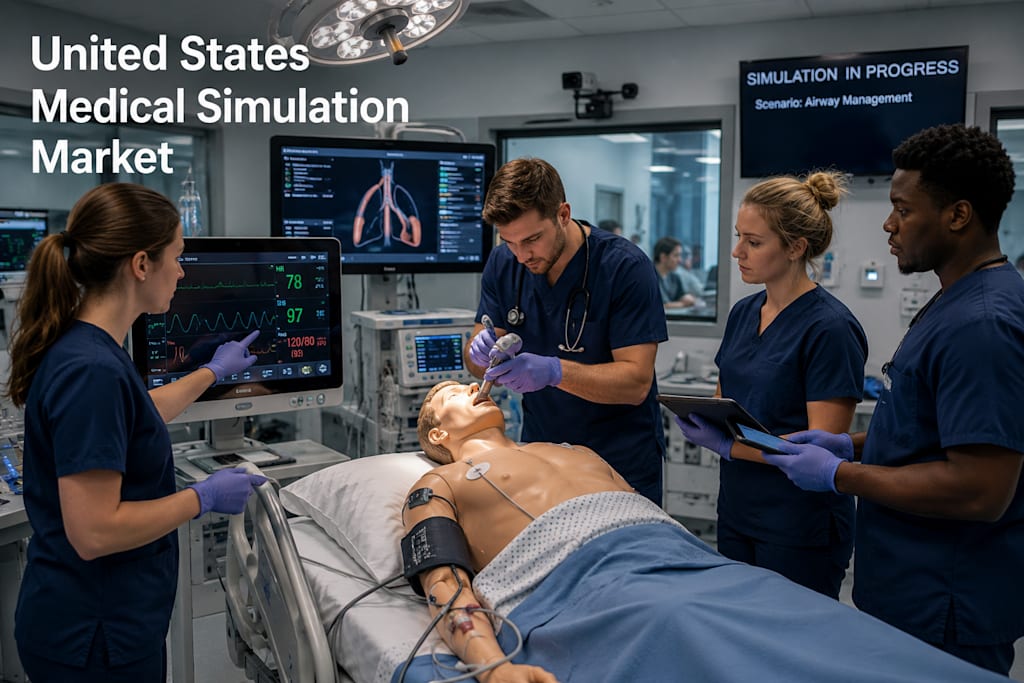
Healthcare education is in a state of radical change. Traditional training methods of medical practitioners are augmented by technologically advanced simulation technologies that assist healthcare providers to improve skills, enhance decision-making processes, and boost patient safety without the fear of harm. With hospitals and academic institutions shifting toward competency based learning, medical simulation has become an inseparable part of health education.
According to IMARC Group, the US medical simulation market size reached USD 675.0 million in 2025 and is projected to hit USD 1,468.9 million by 2034, growing at a CAGR of 9.02% during 2026-2034.
A prime reason behind the growth is growing focus on patient safety and reduction in medical errors. Simulation-based learning permits healthcare professionals to hone critical skills by practicing the procedure, emergency handling and surgical techniques on the virtual platform before treating patients. In this way they improve their clinical expertise, confidence and communication skills with no harm to real patients.
Another factor defining the medical simulation market growth is advancements in technologies like virtual reality (VR), augmented reality (AR) and artificial intelligence (AI). These cutting-edge technologies are enabling highly immersive and interactive learning experiences that realistically mirror clinical conditions and scenarios. The modern simulation platforms include adaptive learning capabilities, real-time performance feedback, and realistic patient responses to enhance medical education.
The widespread integration of simulation-based medical education across hospitals, nursing schools and academia is a major trend in the market. Since institutions suffer from scarcity of clinical training and demand for workforce is escalating, simulation has become vital for skill development and proficiency assessment among healthcare professionals. Accreditation standards and residency training programs are also mandating simulation.
Cloud based and remote medical simulation platforms are also transforming the industry, allowing access to training modules from remote locations for flexible learning. These platforms encourage collaboration training, remote interaction with virtual patients and inter-institution learning.
Increasing emphasis on interprofessional team training is another noticeable trend in the market. Simulation technology helps to train doctors, nurses, pharmacists and emergency teams together in real-life scenarios to enhance their communication and coordination skills while tackling critical events.
Among the various segments of the US medical simulation market which include model based simulation, surgical simulation, ultrasound simulation, web based simulation and simulation training services, the model based simulation holds the highest market share at 32% in 2025 owing to the large scale adoption of mannequins and anatomical models in hands-on clinical training.
The market has been segmented by fidelity in which the low-fidelity simulation accounted for the largest share of the market at 40% in 2025 due to its relatively low price point and high effectiveness in teaching basic skills and elementary concepts.
The hospital & clinics end-user segment is the leading segment in the US medical simulation market and captured a share of 43% in 2025, as health organizations are actively investing in simulation centers to improve staff competence, emergency preparedness and patient care outcomes.
Regionally, the southern region led the US medical simulation market by accounting for 30% share in 2025. The region comprises significant healthcare systems and medical academic centers, with increased investments in healthcare infrastructure across regions like Texas and Florida.
Significance of the US medical simulation market is rooted in the fact that it aligns with broader trends in modernization of healthcare where technology is taking a central role and pushing healthcare to become more data driven and outcome focused, while medical simulation plays a key role in technology driven medical training while safeguarding patient safety.
In the coming years, continuous technological advancement, increased demand in healthcare workforce, and soaring investments in cutting edge medical training systems are predicted to contribute to the growing market. Since the healthcare profession is continuously becoming more intricate, the role of medical simulation is inevitable in equipping healthcare professionals for the future.
About the Creator
michael matthew
I’m a market researcher passionate about understanding people, markets, and motivations. My work blends data analysis, consumer psychology, and strategic insight to help brands and businesses make informed, human-centered decisions.
Enjoyed the story? Support the Creator.
Subscribe for free to receive all their stories in your feed.
Comments
There are no comments for this story
Be the first to respond and start the conversation.