
United States Feed Additives Market: Growth Driven by Precision Nutrition and Livestock Health
The United States feed additives market is expanding steadily as livestock producers adopt precision nutrition, sustainable farming practices, and advanced animal health solutions.

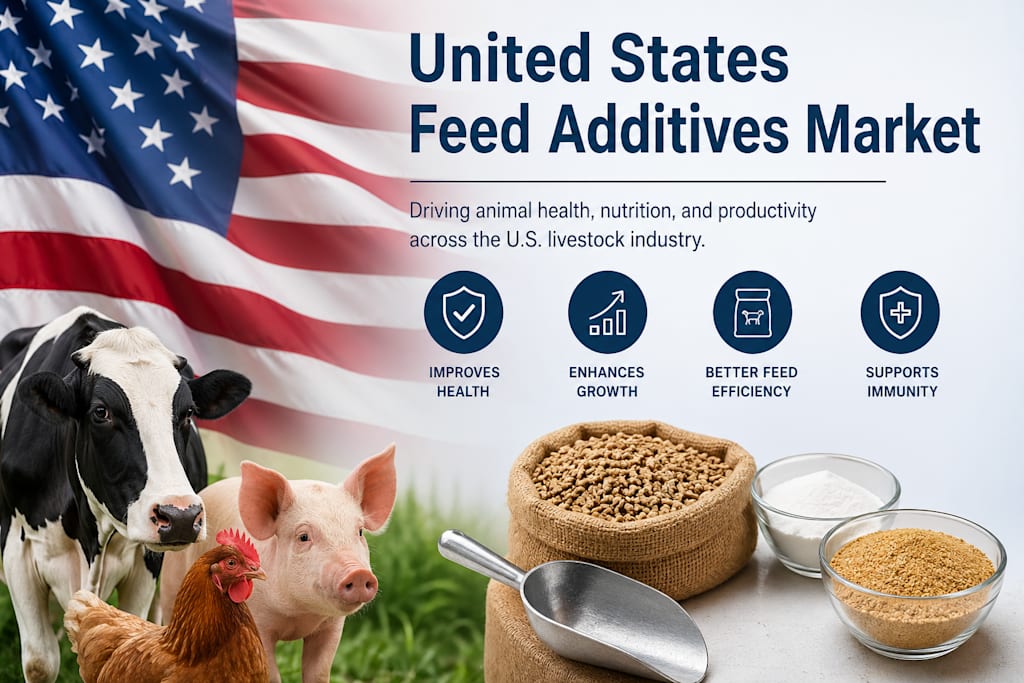
Producers in the United States are increasingly concerned with animal health, productivity and sustainable agricultural methods. With increasing demand for meat, eggs, dairy products, and poultry in the U.S., feed additives play an important role in modern animal nutrition, helping to boost feed efficiency, the immune system, growth performance, and livestock productivity in commercial livestock facilities.
IMARC Group reports that the United States feed additives market was $4.31 billion in 2025 and is expected to reach $5.41 billion by 2034, at a compound annual growth rate of 2.54% between 2026-2034.
One significant factor driving this market growth is the rising demand for animal protein products in the United States. As consumption of eggs, milk and meat continues to rise in the US, livestock producers are forced to enhance efficiency of livestock production, as well as the animals' productivity, and feed additives such as acids, amino acids, minerals, probiotics, vitamins, and enzymes help meet this food demand without sacrificing animal performance or quality.
Another driver of the market growth, is increased attention to animal health and disease prevention, which may be due to intensification of livestock production that elevates the risk of disease from infection, stress, and digestive disorders, leading to higher use of preventative nutrition through feed additives. Examples include the use of immune-support nutrients and organic acids as alternative to antibiotics and probiotics to promote animal health.
Increasing adoption of precision nutrition is also expected to boost the market; with more advanced technology in the U.S., livestock producers can implement modern data-driven farming to provide animals with optimal feed at each stage of development to maximize growth performance and reduce waste through utilization of digital monitoring, sensors and nutrition management systems, AI-driven nutrition.
Growing demand for antibiotic-free and organic livestock production are among factors driving the market forward, with a move toward utilization of organic and natural alternatives such as phytogenics and probiotics in place of traditional antibiotic growth promoters in an effort to align with both consumer needs and future regulation, and promote overall sustainability goals across the agricultural sector.
The growth of the U.S. Feed additives market is further augmented by expansion in the size and intensity of commercial livestock operations, requiring precise feed formulation in the swine, poultry, and cattle industries in order to maintain consistent production of animal protein products through efficient utilization of nutrients, enhanced digestion, and faster/healthier animal development.
The United States feed additives market, which is expected to grow at a CAGR of 2.54% between 2026 and 2034, is comprised of natural and synthetic feed additives. Synthetic feed additives are leading the market with a 73.92% market share as of 2025 due to their low cost, quality and reliable performance.
While, in the United States, market growth for natural feed additives is accelerated by the trend toward sustainable and antibiotic-free animal production. As of 2025, amino acids accounted for the largest share in terms of product type with 16.84% of the total market share due to their importance in protein synthesis and development of muscle tissue. As of 2025, poultry holds the largest share of the market by livestock with 36.93% as it accounts for high consumption rate of eggs and chicken.
Also, of importance, dry-form feed additives are expected to constitute the largest market share at 67.95% by 2025 because they offer improved storage capacity, usability, and compatibility with commercial feed production facilities. In the Midwest and South, which are agricultural regions, there is significant growth and demand for feed additives in poultry, swine, and cattle due to large livestock production facilities and feed production capabilities in these regions.
The significance of the U.S. Feed additives market extends beyond economic considerations and is a part of wider, agricultural and food sustainability trends in that producers are balancing profitability and animal welfare, as well as food safety and environmental stewardship which make feed additives a necessary aspect of future livestock farming. The market is predicted to grow as a result of ongoing development in sustainable animal feeds, livestock health management, and precision nutrition.
About the Creator
michael matthew
I’m a market researcher passionate about understanding people, markets, and motivations. My work blends data analysis, consumer psychology, and strategic insight to help brands and businesses make informed, human-centered decisions.
Enjoyed the story? Support the Creator.
Subscribe for free to receive all their stories in your feed.
Comments
There are no comments for this story
Be the first to respond and start the conversation.