
United States Autonomous Vehicle Market: Growth Driven by AI, Safety Demand, and Smart Mobility
The United States autonomous vehicle market is rapidly expanding, fueled by technological advancements, government support, and increasing demand for safer and more efficient transportation.

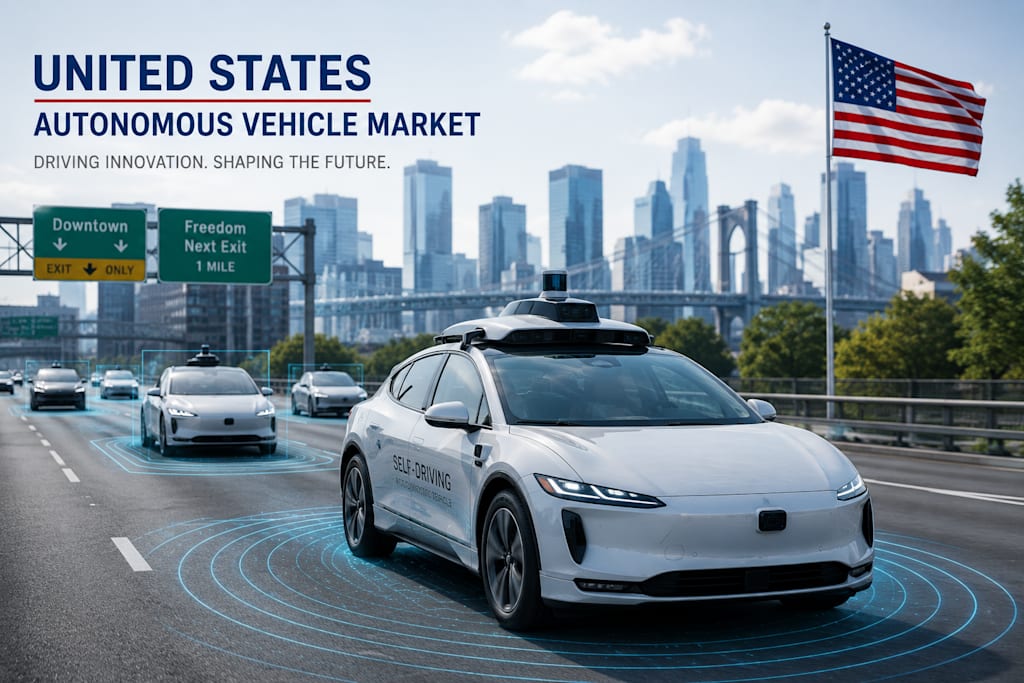
There is a huge shift about to happen in the U.S. In how both people and goods travel. Autonomous vehicles-once the stuff of science fiction-are about to become a reality with developments in artificial intelligence, sensor technology, and smart infrastructure leading the way toward what's likely to be one of the fastest growing markets in the automotive sector.
The US autonomous vehicle market was worth USD 44.1 billion in 2025, and by 2034 it's expected to reach USD 355.6 billion with a CAGR of 25.32% from 2026-2034.
Increased demand for safe transportation is one of the main reasons behind the rise of autonomous vehicles. Road traffic accidents cause thousands of deaths annually due to human error and self-driving cars have the potential to drastically reduce this number. By relying on complex systems of sensors, cameras, and processing capabilities, vehicles without human operators are able to perceive obstacles on the road, follow all the rules of the road, and respond to their surroundings more rapidly than their human counterparts.
Rapid technological advancement is the other key market driver. Ongoing advancements in LiDAR, radar, high-definition cameras, and machine learning algorithms are increasing the autonomous vehicle's ability to recognize and understand its environment as well as its capacity to make intelligent driving decisions. This technology enables the autonomous system to analyze massive amounts of data in real time, increasing accuracy and safety.
Government support is also a significant factor. The federal and state governments have implemented policies and regulations that facilitate testing and deployment. Efforts such as the US Department of Transportation's autonomous vehicle programs are helping create regulatory frameworks that allow for innovation in a safe environment.
Consumer acceptance of this technology is a major trend within the industry. Drivers have become more accepting of automation due to readily available systems such as adaptive cruise control and lane-keeping assist. As familiarity increases with these systems, so will acceptance of fully autonomous driving technologies ranging from levels 1-5.
Another factor driving the growth of this market is increased demand for efficient transportation. Autonomous vehicles can help decrease traffic congestion, increase fuel efficiency, and enhance the mobility within cities. In the logistics and ride-hailing services sector specifically, demand is high as businesses aim to increase efficiency and decrease operational costs by adopting the use of automated systems.
The market is segmented into semi-autonomous and fully autonomous vehicles as well as based on the level of automation (Level 1-5). Vehicle types can be divided into passenger cars and commercial vehicles and increasingly feature elements of autonomous operation.
Another major trend is the connection between autonomous vehicles and the electric vehicle industry. Autonomous electric vehicles (AEVs) have garnered a lot of attention as they have the potential to improve the environmental impact and sustainability. It is likely that AEVs will shape the future of the transportation sector.
While strong growth is evident in the sector, challenges remain. Unforeseen regulatory developments, cyber security issues, and safety concerns are all hurdles that must be overcome to ensure that the fully autonomous vehicles that will populate our streets and roads will operate safely and efficiently at all times. Ongoing research, testing, and collaboration between technology providers, automakers and governments continue to address these challenges.
It is important to consider what is setting the US autonomous vehicle market apart. Many societal and technological trends contribute to the sector's growth, including the proliferation of smart cities, connected infrastructure, and the increase of data-driven mobility solutions.
With future innovation and further investment, coupled with expansion into the real world, the market is positioned for continued success. Autonomous driving has the potential to revolutionize how we commute-making traveling safer, more efficient, and more environmentally friendly.
About the Creator
michael matthew
I’m a market researcher passionate about understanding people, markets, and motivations. My work blends data analysis, consumer psychology, and strategic insight to help brands and businesses make informed, human-centered decisions.
Enjoyed the story? Support the Creator.
Subscribe for free to receive all their stories in your feed.
Comments
There are no comments for this story
Be the first to respond and start the conversation.