
United States Assisted Reproductive Technology Market: How Science, Awareness, and Lifestyle Shifts Are Driving Growth in 2026
The U.S. ART market is expanding as delayed pregnancies, rising infertility rates, and advances in IVF, AI, and fertility preservation reshape reproductive healthcare.

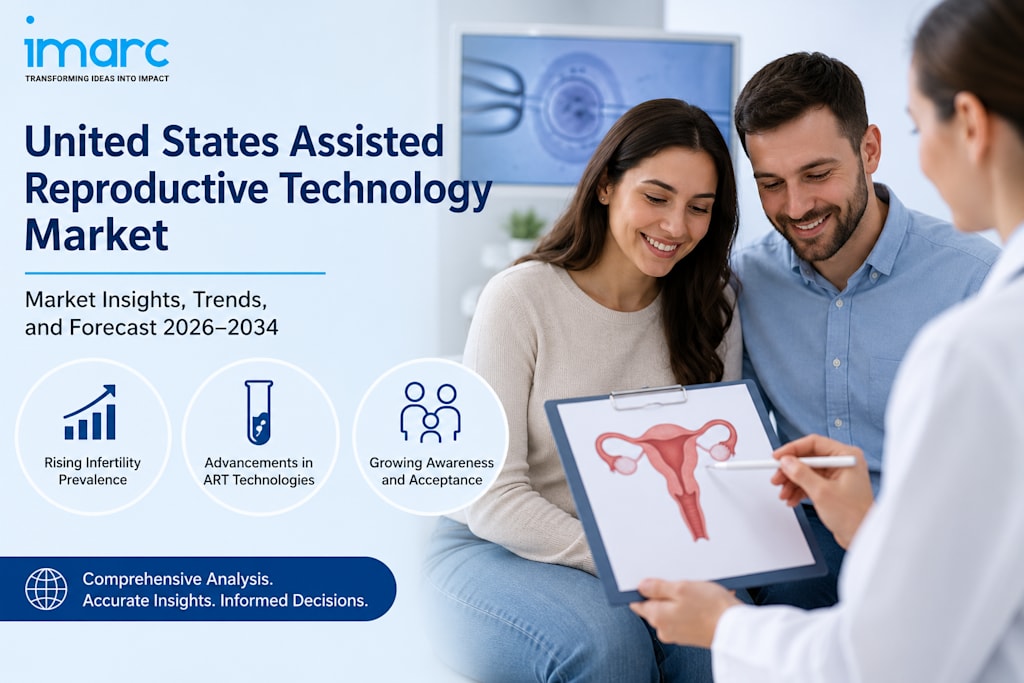
From Rare to mainstream in the U.S., the aided reproductive technology (ART) market continues its growth. As assisted reproductive treatments for family planning is becoming less rare to more common due to increasing rates of infertility and awareness of family planning resources.
The U.S. Aided reproductive technology (ART) market grew at a stable rate in 2026 on account of declining rates of late-stage pregnancies, expanding infertility incidence, increased success rates of aided reproductive technology, and awareness among couples for fertility preservation treatments like IVF and egg freezing.
By 2034, aided reproductive technology market size in the U.S is predicted to rise to USD 11.0 Billion in value from USD 6.4 Billion in 2025, recording a compound annual growth rate (CAGR) of 5.95% over 2026-2034 according to the new report by IMARC Group.
What is driving the ART market in the U.S in 2026?
- Delayed childbirth trends In the United States, the trend of later childbearing has increased. Most couples choose to delay having children until they are established educationally and professionally and have sufficient financial means to support a growing family, which results in many late-age pregnancies and higher fertility challenges and demand for assisted reproductive services in the US.
- Increase in infertility cases In the United States, infertility cases have risen over the past couple of years on account of various lifestyle factors such as obesity, smoking, and high levels of stress. As the number of infertility cases continues to rise, most individuals with conception challenges seek assisted reproductive technologies in a hospital or fertility clinic.
- In vitro fertilization (IVF) is a central ART The United States aided reproductive technology market is led by IVF, the most popular aided reproductive treatment and it involves procedures that can be combined with technologies such asICSI (intracytoplasmic sperm injection) and PGT (pre-implantation genetic screening) to improve fertility results and reduce the transmission of inherited diseases. Improvements in embryo culture, time-lapse imaging, and AI-based selection will enhance IVF treatment performance further, offering more streamlined and patient-focused approaches.
- Technological interventions are revolutionizing the market The year 2026 also marks an era of unprecedented integration of artificial intelligence and robotics in reproductive facilities. AI is widely used in analyzing the development of the embryo to accurately determine viability and also predicting implantation successfulness. These advancements improve efficiency, precision, and scalability of the procedure across the US.
- Popularity and availability of fertility preservation procedures Fertility preservation procedures have experienced enormous growth in the assisted reproductive tech landscape. More and more American women who find themselves at risk for future fertility problems choose to preserve their eggs when they are younger through what is referred to as ‘fertility preservation’ options. The rise in employee coverage benefits offered by top US companies in assisted reproductive technology treatment also plays a role in the surge of individuals opting for such procedures in the U.S.
- increased social acceptance and public awareness Fertility treatments have become more acceptable, thanks to rising public discussion, advocacy efforts from numerous individuals and social groups, and support groups available both on and offline. As people become more aware of the effectiveness and variety of fertility options, they are more apt to seek support earlier in the family building process rather than delaying treatment.
- prevalence of pre-implantation genetic screening Pre-implantation genetic screening is more prevalent as fertility patients use it to screen embryos for chromosomal anomalies prior to implantation, increasing successful fertilization and a more efficient overall outcome, especially for women and families with a predisposition to inherited conditions or multiple failed attempts. This trend toward more targeted treatment pathways makes for a much more accurate assisted reproductive cycle.
Structure and Segmentation of the U.S Assisted Reproductive Technology Market The U.S. ART market is segmented as follows – The report categorizes aided reproductive technology market products into equipment, supplies and reagents, procedure culture medium, and drugs, the procedures covered in the study comprise IVF, artificial insemination, surrogacy, and assisted reproductive technology treatments and the end-users include hospitals, fertility centers, diagnostic laboratories, etc. IVF and fertility clinics are the most popular and provide these therapies and services. The most influential type is, therefore IVF (in-vitro fertilization), with in-vitro fertilization accounting for most of the U.S. Market share of aided reproductive technology treatments due to the widespread preference for such assisted procedures.
What drives the need for this industry to prosper? In recent years the world of reproductive medicine has undergo immense revolution, transforming in vitro fertility technologies from mere clinical experiments into reliable medical methods that have changed reproductive technology by helping people make use of in vitro treatment for raising children. The increasing social acceptance of aided assisted reproductive techniques makes it an essential part of the contemporary medical field; these new therapies, coupled with breakthroughs in medical research and developments in health and technology also make up a critical area in healthcare in America.
Trends in U.S. Regional assisted reproductive technologies market the Northeast part of the US is the top location, but all parts of the U.S. Are gaining ground by adopting new methodologies, from the technology implemented on the west coast to innovative techniques offered on the East Coast and increasing options in other states to allow more families to use this service to build their families.
In conclusion, while it can be said that the aided assisted reproductive technology is on rise across the world, there are distinct and noteworthy reasons behind the growing prominence and significance of this sector of healthcare within the United States of America. The future is exceedingly promising for this segment of health technology, with further improvements in AI and automation being anticipated.
About the Creator
michael matthew
I’m a market researcher passionate about understanding people, markets, and motivations. My work blends data analysis, consumer psychology, and strategic insight to help brands and businesses make informed, human-centered decisions.
Enjoyed the story? Support the Creator.
Subscribe for free to receive all their stories in your feed.
Comments
There are no comments for this story
Be the first to respond and start the conversation.