
United Arab Emirates Quick Service Restaurant Market to Reach US$ 28.75 Billion by 2034 as Digital Ordering and Fast Urban Lifestyles Drive Industry Growth
Rising online food delivery adoption, expanding tourism activity, and changing consumer dining habits are transforming the UAE quick service restaurant market

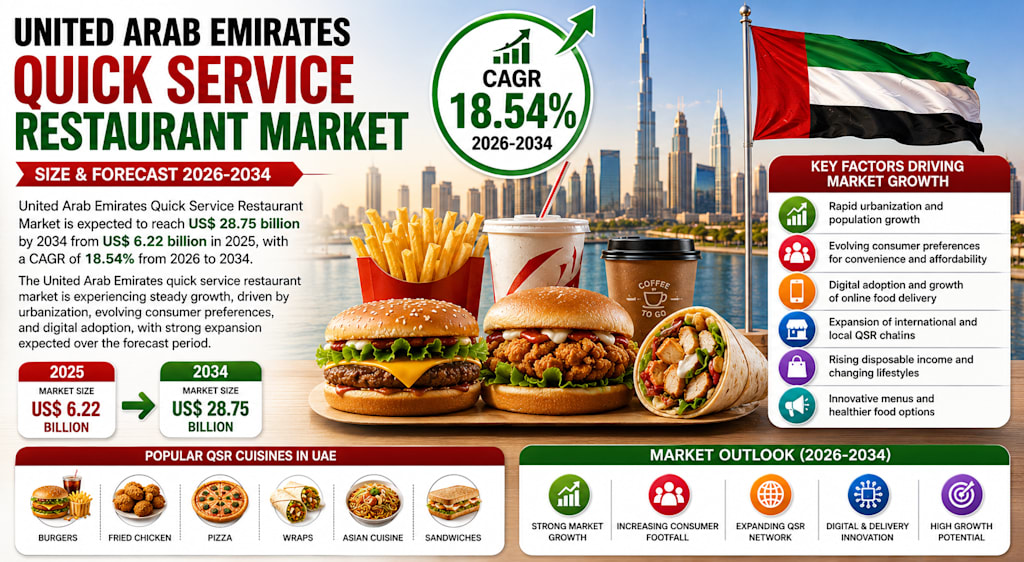
The United Arab Emirates quick service restaurant market is expected to witness remarkable growth over the coming decade as urbanization, digital transformation, and evolving dining preferences continue reshaping the country’s foodservice landscape. According to Renub Research, the United Arab Emirates quick service restaurant market is projected to grow from US$ 6.22 billion in 2025 to US$ 28.75 billion by 2034, registering a CAGR of 18.54% from 2026 to 2034. Increasing demand for affordable and convenient dining options, expanding tourism, rising online food delivery penetration, and continuous innovation in restaurant operations are among the key factors driving market growth across the UAE.
The UAE quick service restaurant (QSR) industry has evolved into one of the most dynamic segments within the country’s broader foodservice sector. International fast-food chains, regional brands, and modern fast-casual operators continue expanding aggressively across major cities such as Dubai, Abu Dhabi, and Sharjah.
The market is highly diverse, offering cuisines including:
- American fast food
- Middle Eastern cuisine
- Asian food
- Pizza
- Burgers
- Bakery products
- Fusion meals
- Ice cream and dessert concepts
This diversity reflects the multicultural nature of the UAE population and the country’s position as a global tourism and business hub.
Urbanization and Fast-Paced Lifestyles Are Fueling Market Expansion
One of the strongest growth drivers for the UAE quick service restaurant market is the country’s rapid urbanization and increasingly busy consumer lifestyles.
Modern consumers in the UAE increasingly seek convenient and time-saving meal solutions because of demanding work schedules, long commuting hours, and fast-paced urban living. Quick service restaurants provide affordable and efficient dining experiences that align perfectly with these evolving lifestyle patterns.
The growing number of working professionals and dual-income households has significantly increased reliance on dining out and food delivery services instead of home cooking.
Urban centers such as Dubai and Abu Dhabi continue attracting population growth, business expansion, and tourism activity, creating strong demand for accessible dining solutions.
The report highlights that dense commercial activity and high consumer mobility continue making urban regions the primary hubs for QSR expansion across the UAE.
As urbanization continues accelerating, quick service restaurants are expected to remain deeply integrated into everyday consumer behavior throughout the country.
Online Food Delivery Platforms Are Reshaping Consumer Behavior
Digital transformation has become one of the most influential forces within the UAE quick service restaurant industry.
Consumers increasingly use mobile applications and online food delivery platforms to browse menus, compare prices, place orders, and track deliveries in real time. This shift has dramatically expanded the reach of QSR operators beyond traditional dine-in locations.
Food delivery applications have transformed convenience expectations by offering:
- Fast delivery services
- Cashless payment systems
- Personalized promotions
- Loyalty rewards
- Real-time tracking
- Mobile ordering convenience
Partnerships between QSR brands and third-party delivery providers continue improving operational efficiency while expanding customer accessibility.
The report highlights that digital adoption and mobile ordering are significantly enhancing customer engagement and helping operators reach broader audiences across the UAE.
Cloud kitchens and virtual restaurant models are also gaining popularity because they allow brands to reduce operational costs while expanding delivery-focused business models.
As digital ordering becomes increasingly normalized, online delivery channels are expected to remain one of the strongest long-term growth drivers within the UAE QSR industry.
Tourism and Expat Population Growth Continue Supporting Demand
The UAE’s position as a global tourism and expatriate hub remains a major contributor to quick service restaurant market growth.
Millions of tourists visit the UAE annually for business, shopping, entertainment, and international events. These visitors frequently seek quick, affordable, and familiar dining experiences, making QSR outlets highly popular across airports, malls, hotels, and tourist destinations.
The country’s large expatriate population also creates strong demand for diverse international cuisines and fast-casual dining options.
QSR operators benefit from the UAE’s multicultural demographic by offering varied menu selections tailored to consumers from different cultural backgrounds.
The report highlights that major exhibitions, festivals, and international events continue increasing restaurant footfall and supporting higher sales volumes throughout the year.
This combination of tourism activity and international population diversity continues creating long-term opportunities for restaurant expansion and menu innovation.
Technology Integration Is Enhancing Customer Experience
Technology adoption is rapidly transforming operational models across the UAE quick service restaurant industry.
Restaurants increasingly implement advanced technologies such as:
- AI-powered ordering systems
- Self-service kiosks
- Contactless payments
- Mobile loyalty applications
- Automated kitchen systems
- Data-driven personalization
These innovations improve customer convenience while helping operators increase efficiency and reduce wait times.
Self-service kiosks and digital ordering systems are becoming increasingly common in shopping malls, airports, and high-traffic commercial areas.
Contactless payments and mobile ordering became especially important following changing consumer expectations regarding speed, hygiene, and convenience.
Data analytics also allows QSR brands to better understand consumer behavior and personalize promotional strategies, improving customer retention and operational performance.
Cloud Kitchens and Virtual Restaurant Models Are Expanding Rapidly
Cloud kitchens are becoming one of the fastest-growing business models within the UAE quick service restaurant market.
These delivery-focused kitchens operate without traditional dine-in spaces, allowing companies to significantly reduce rental and operational expenses.
Cloud kitchen models are especially attractive in major cities where commercial real estate costs remain high.
Virtual restaurant brands can quickly adapt menus, target niche consumer preferences, and expand through online platforms without requiring extensive physical infrastructure investments.
The rapid growth of online food delivery platforms continues supporting expansion of this flexible and technology-driven business model.
Health-Conscious Consumer Trends Are Influencing Menus
Increasing health awareness among UAE consumers is reshaping menu strategies across the QSR industry.
Consumers are becoming more conscious about nutrition, obesity, and healthier eating habits, creating demand for more balanced meal options. Traditional fast-food items are increasingly viewed as high in calories, fats, and sugars.
As a result, QSR operators are expanding healthier menu categories including:
- Salads
- Grilled meals
- Low-calorie items
- Plant-based alternatives
- Fresh ingredients
- Protein-focused meals
The report highlights that health-conscious eating trends are significantly influencing menu innovation across the UAE market.
However, balancing convenience, affordability, taste, and healthier ingredients remains one of the industry’s key operational challenges.
Sustainability and Eco-Friendly Practices Are Becoming Important
Sustainability is emerging as an increasingly important factor within the UAE quick service restaurant industry.
Consumers increasingly expect foodservice companies to adopt environmentally responsible practices such as:
- Eco-friendly packaging
- Responsible ingredient sourcing
- Waste reduction initiatives
- Sustainable operations
QSR brands are increasingly investing in recyclable materials and environmentally friendly packaging solutions to align with evolving consumer expectations and sustainability goals.
These initiatives are becoming particularly important among younger consumers who prioritize environmental awareness when choosing brands.
Intense Market Competition Remains a Major Challenge
Despite strong growth prospects, the UAE quick service restaurant market remains highly competitive.
Numerous international chains and regional brands aggressively compete for market share across shopping malls, business districts, airports, and urban centers.
This intense competition creates challenges including:
- Pricing pressure
- Reduced profit margins
- High marketing expenses
- Rising rental costs
- Constant menu innovation requirements
The report highlights that established brands continuously introduce promotional campaigns, value deals, and new menu items to retain customer loyalty.
Smaller operators and new entrants often struggle to compete against larger multinational companies with stronger financial resources and broader retail networks.
Sustaining long-term profitability therefore remains a major operational challenge within the UAE QSR industry.
Rising Operational Costs Continue Creating Pressure
High commercial rents, labor expenses, and supply-chain costs continue affecting profitability across the UAE restaurant sector.
Prime retail locations in malls, airports, and commercial centers often involve extremely high rental costs, significantly increasing operational expenditures.
In addition, maintaining food quality, delivery efficiency, and competitive pricing while adapting to evolving consumer expectations creates additional financial pressure for operators.
Restaurant companies increasingly rely on technology, cloud kitchens, and optimized logistics to improve efficiency and maintain profitability.
Dubai Remains the Leading QSR Market in the UAE
Dubai continues to dominate the UAE quick service restaurant industry because of its dense population, tourism activity, luxury retail infrastructure, and international business environment.
Shopping malls, airports, business centers, and entertainment destinations generate extremely high demand for fast and convenient dining solutions.
Consumers in Dubai strongly prefer:
- International cuisine variety
- Premium fast-casual concepts
- Delivery convenience
- Digital ordering services
The city’s status as a global tourism hub continues attracting international QSR chains and innovative restaurant concepts.
Abu Dhabi Market Benefits from Urban Development
Abu Dhabi’s quick service restaurant market is growing steadily due to rising urbanization, government investments, and expanding residential developments.
Increasing commercial activity and growing disposable incomes continue supporting demand for dining and takeaway food options.
Restaurants increasingly focus on delivery optimization and modern retail formats in order to serve the city’s expanding population efficiently.
Sharjah Continues Expanding Through Residential Growth
Sharjah’s QSR market is witnessing steady development as residential communities and commercial infrastructure continue expanding.
Consumers increasingly seek affordable and accessible dining options that fit modern lifestyles.
Retail expansion, improved transportation connectivity, and growing digital food-ordering adoption continue supporting long-term market growth in the emirate.
Recent Developments Highlight Strong Industry Innovation
Several major developments reflect the rapid evolution of the UAE quick service restaurant market.
In June 2025, Papa John’s launched a croissant pizza in the UAE featuring buttery pastry-like dough combined with traditional pizza toppings.
In February 2025, Haldiram’s opened a new restaurant in Bur Dubai focusing on authentic Indian flavors and premium quick-service dining experiences.
Also in February 2025, Al Safadi introduced Oventine, a Levantine-inspired fast-casual restaurant concept offering wraps, flatbreads, dips, and Lebanese specialty dishes.
These developments demonstrate how innovation, cuisine diversification, and fast-casual concepts continue shaping competitive dynamics within the UAE market.
Key Companies Operating in the UAE Quick Service Restaurant Market
Major companies operating in the UAE quick service restaurant market include AlAmar Foods, ALBAIK, Alghanim Industries, Americana Restaurants, Apparel Group, Emirates Fast Food Company, Kamal Osman Jamjoom Group, M.H. Alshaya, and Ring International Holding.
These companies compete through menu innovation, digital ordering technologies, delivery expansion, franchise development, and strong retail positioning across the UAE.
Final Thoughts
The United Arab Emirates quick service restaurant market is entering a period of rapid expansion driven by urban lifestyles, digital transformation, tourism growth, and evolving consumer dining habits.
Online food delivery platforms, cloud kitchens, advanced restaurant technologies, and multicultural food preferences are all reshaping the future of the industry. According to Renub Research, the market is projected to reach US$ 28.75 billion by 2034, reflecting the enormous growth potential of the UAE QSR sector.
However, operators must continue navigating intense competition, rising operational costs, and changing consumer expectations related to health and sustainability. Companies that successfully combine convenience, innovation, digital efficiency, and customer-focused dining experiences are likely to lead the next phase of growth within the UAE’s evolving quick service restaurant market.
About the Creator
Enjoyed the story? Support the Creator.
Subscribe for free to receive all their stories in your feed.
Comments
There are no comments for this story
Be the first to respond and start the conversation.